


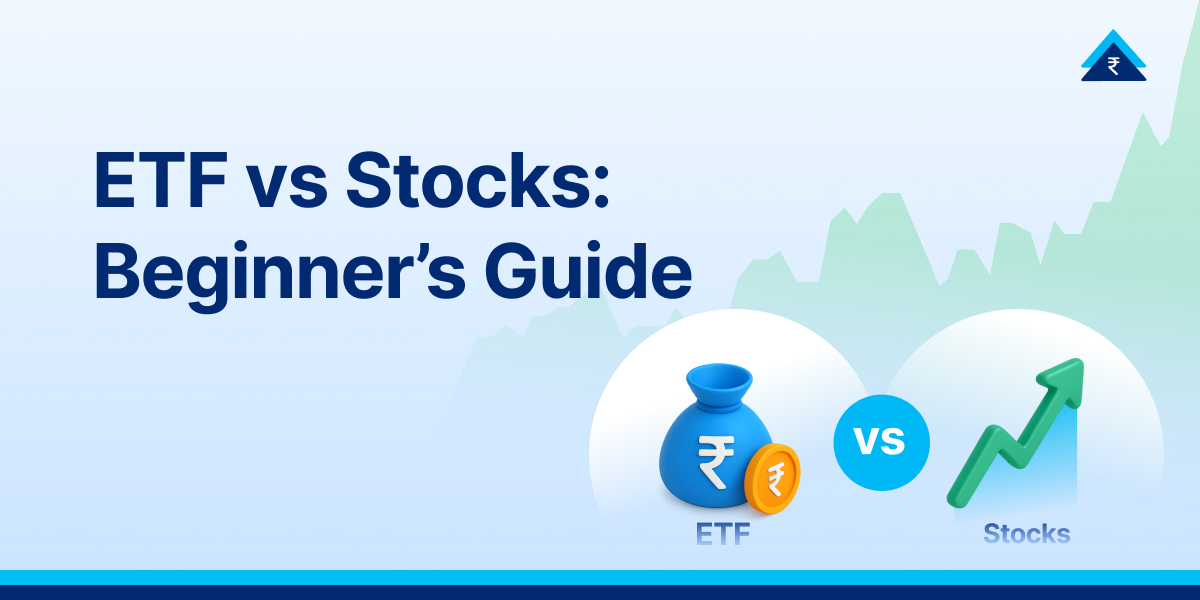
Most first-time investors hit the same wall: you’ve decided to start investing, but now you’re stuck choosing between ETF vs stocks, and neither explanation quite tells you what you actually need to know.
- What Are Stocks?
- How Stock Investing Works
- What Stock Investing Actually Requires
- What Are ETFs?
- How ETFs Work
- Types of ETFs Available in India
- ETF vs Stocks: Key Differences
- Which Is Easier for Beginners: ETF or Stocks?
- ETF vs Stocks: Returns and Risk
- Understanding Returns from Stocks
- Understanding Returns from ETFs
- How Risk Differs
- When Should You Choose ETFs?
- When Should You Choose Stocks?
- Final Verdict: ETF vs Stocks for Beginners
- FAQs
On the surface, they look similar. Both trade on the stock exchange. Both give you exposure to companies and markets. Both have the potential to grow your money over time. But the experience of investing in them is very different, especially early on, when mistakes cost you both money and confidence.
The ETF vs stocks question isn’t really about which one is ‘better’. It’s about which one fits where you are right now: how much time you have, how much risk you can stomach, and how much you enjoy analysing companies. This guide breaks it all down so you can decide with clarity, not guesswork.
What Are Stocks?
A stock represents ownership in a single company. When you buy shares of a company, say, Infosys or Reliance Industries, you become a part-owner of that business, however small the fraction.
How Stock Investing Works
As a stockholder, your returns come from two sources: the rise in the stock’s price over time, and dividends if the company distributes profits. But here’s the catch: both depend almost entirely on how well that specific company performs.
This is what makes stock investing both exciting and demanding. If you pick a strong company at the right time, your returns can significantly outpace the market. But if the company underperforms, due to poor management, sector headwinds, or simply bad timing, your investment suffers regardless of what the broader market is doing.
What Stock Investing Actually Requires
- Researching company financials — revenue growth, profit margins, debt levels
- Tracking sector trends and competitive positioning
- Monitoring news, quarterly results, and management decisions
- Making buy, hold, or sell decisions continuously
For investors who enjoy this process, stocks offer unmatched control and upside potential. For those who don’t, or don’t yet have the knowledge, the learning curve is steep and the risk of poor decisions is high.
What Are ETFs?
ETF stands for Exchange-Traded Fund. Think of it as a ready-made basket of stocks that you can buy and sell on the exchange, just like a single share.
Instead of picking one company, an ETF gives you exposure to many at once. A Nifty 50 ETF, for example, holds shares in all 50 companies that make up the Nifty 50 index, in the same proportion. When the index goes up, your ETF goes up. When it falls, your ETF falls.
How ETFs Work
ETFs are a form of passive investing. A fund manager doesn’t sit and decide which companies to buy — the ETF simply mirrors an index or theme. This keeps costs low and removes the element of fund manager judgment (for better or worse).
Because they hold many stocks simultaneously, ETFs offer instant diversification. If one company in the basket crashes, the impact on your overall investment is cushioned by the other holdings.
Types of ETFs Available in India
- Index ETFs: track broad indices like Nifty 50, Nifty Next 50, or Sensex
- Sector ETFs: focus on specific industries like banking (Bank Nifty), IT, or pharma
- Gold ETFs: track the price of gold without physical ownership
- International ETFs: provide exposure to global markets like the US or Nasdaq
- Debt ETFs: track bond indices for lower-risk, fixed-income exposure
ETF vs Stocks: Key Differences
Here’s how the two compare across the factors that matter most to a beginner:
| Feature | ETFs | Stocks |
|---|---|---|
| Diversification | High — holds many companies | Low — single company only |
| Risk Level | Spread across holdings | Concentrated in one business |
| Effort Required | Low — passive monitoring | High — active research needed |
| Control | Limited — follows index/theme | Full — you choose every stock |
| Cost Structure | Low expense ratio (0.05%–1%) | Brokerage per trade |
| Knowledge Needed | Beginner-friendly | Financial analysis skills |
| Return Potential | Market-linked, consistent | Higher ceiling & higher floor risk |
| Emotional | Lower — broad market exposure | Higher — single-stock volatility |
Which Is Easier for Beginners: ETF or Stocks?
‘Easier’ means different things to different people. But for most beginners, ease comes down to four things: how much you need to learn upfront, how much time it demands, how forgiving it is when you make mistakes, and how well it holds up against your own emotions. ETFs win on all four counts. Here’s why.
- The Learning Curve: To invest in stocks well, you need to understand how to read a balance sheet, evaluate a company’s competitive moat, interpret PE ratios and earnings growth, and track sector-level developments — all before you buy a single share. ETFs sidestep most of this. You don’t need to analyse individual companies. You’re essentially saying, ‘I believe the Indian economy (or a specific sector) will grow over time’ — and buying a basket that reflects that view. The decision is simpler, and the research required is much lighter.
- Risk Management: With individual stocks, your investment is tied to the fate of one company. A regulatory change, a management scandal, or even a bad quarterly result can wipe out a significant chunk of your holding, even when the broader market is doing well. ETFs spread your investment across many companies. If one falls sharply, the others absorb the impact. This doesn’t eliminate risk, markets can fall broadly, but it protects you from company-specific disasters, which are far more common.
- Time Commitment: Stocks require ongoing attention. Earnings seasons, sector news, management commentary, global cues, all of these can affect your holdings and demand a response. ETFs, once bought, require very little active management. You check in periodically, rebalance if needed, and let the market do its work. For working professionals or anyone without hours to spare each week, this is a significant practical advantage.
- Emotional Decision-Making: Behavioural finance research consistently shows that individual investors destroy returns through emotional decisions, panic-selling during drops, chasing momentum stocks, over-trading. These tendencies are amplified when you own individual stocks, because the volatility is more personal and the price swings are sharper. ETFs, by offering broad market exposure, tend to be less volatile than individual stocks. This makes it easier to stay calm and stay invested, which is, ultimately, what drives long-term returns.
ETF vs Stocks: Returns and Risk
When comparing ETFs and stocks, it’s important to understand that they differ in how returns are generated and the level of risk involved. Rather than one consistently outperforming the other, each approach offers a different way to participate in the market.
Understanding Returns from Stocks
Investing in individual stocks means your returns are directly linked to the performance of a specific company. If the company grows its business, improves profitability, or benefits from favourable market conditions, investors may see corresponding gains over time.
At the same time, stock performance can be influenced by multiple factors, including company-specific developments, industry trends, and broader economic conditions. As a result, returns from stocks can vary significantly across different companies and time periods.
Understanding Returns from ETFs
ETFs are designed to track a broader market index, such as the Nifty 50. Instead of relying on the performance of a single company, returns are linked to the collective performance of multiple companies within that index.
This structure means that ETFs reflect overall market movements. When the broader market rises or falls, ETFs tracking that index tend to move in a similar direction, subject to tracking differences and costs.
How Risk Differs
One of the key distinctions lies in how risk is distributed:
- Stocks: Exposure is concentrated in individual companies, so performance depends on specific business outcomes
- ETFs: Exposure is spread across multiple companies, which can reduce the impact of any single company’s performance
However, both remain subject to market risk, and their value can fluctuate based on overall market conditions.
Safe to say that: ETFs and stocks serve different roles within an investment portfolio. While stocks provide exposure to individual companies, ETFs offer broader market exposure through a single investment.
Hence, the choice between the two depends on factors such as investment approach, time commitment, and familiarity with the markets. Many investors also choose to use a combination of both, depending on their overall strategy.
When Should You Choose ETFs?
ETFs are likely the right starting point if:
- You are new to investing and want to learn without taking concentrated risk
- You prefer a passive, low-cost approach with minimal active management
- You don’t have time to research and track individual companies
- You want instant diversification across sectors and companies
- You are investing for long-term goals: retirement, wealth creation, or large purchases
- You want to implement a disciplined SIP strategy without stock selection pressure
When Should You Choose Stocks?
Direct stock investing may suit you better if:
- You genuinely enjoy researching businesses, financials, and market dynamics
- You are comfortable with higher volatility and the possibility of concentrated losses
- You have the time and discipline to monitor your portfolio actively
- You have already built a foundational portfolio (via ETFs or mutual funds) and want to add satellite positions
- You have specific conviction in particular sectors or companies based on independent analysis
One important note: choosing stocks doesn’t mean avoiding ETFs. Many experienced investors use ETFs as a core holding and stocks for higher-conviction bets — a ‘core and satellite’ approach that balances stability with upside.
Beginner Suitability: A Quick Snapshot
| Factor | ETFs | Stocks |
|---|---|---|
| Ease of Understanding | High | Medium to Low |
| Risk to Capital | Moderate (diversified) | High (concentrated) |
| Time Required Weekly | Low (1–2 hrs/month) | High (several hrs/week) |
| Emotional Difficulty | Lower | Higher |
| Min. Knowledge Needed | Basic | Intermediate to Advanced |
| Ease of Starting | Very Easy | Moderate |
| Long-Term Wealth Building | Yes | Yes (with experience) |
Final Verdict: ETF vs Stocks for Beginners
For most beginners, ETFs offer a more practical, less stressful, and more forgiving starting point. They lower the barrier to entry, reduce the impact of beginner mistakes, and allow you to participate in market growth without needing to master stock analysis first.
That doesn’t mean stocks are off the table; they absolutely have a place in a mature portfolio. But trying to build wealth primarily through stock picking before you understand how markets, businesses, and risk work is a high-stakes way to learn an expensive lesson.
It’s safe to say that, start with ETFs to build your foundation. Add stocks as your knowledge and confidence grow. Consistency and discipline, not complexity, are what build long-term wealth.
The best investment decision you can make right now isn’t choosing between ETFs and stocks. It’s simply choosing to start with the right tool for where you are today.
Disclaimer: Investment in the securities market is subject to market risks. Read all the related documents carefully before investing. This content is purely for information purpose only and in no way is to be considered as an advice or recommendation. The securities are quoted as an example and not as a recommendation. Investors are requested to do their own due diligence before investing.
SEBI Reg No.: Broking – INZ000240532, Research Analyst – INH000020086, Depository Participant – IN-DP-416-2019, Depository Participant Number: CDSL – 12088800, NSE (90165), BSE (6707), MCX (57525), NCDEX (1315), MSEI (85300).
Registered Office: 136, 1st Floor, Devika Tower, Nehru Place, Delhi – 110019.
For complete Terms & Conditions and Disclaimers, visit https://www.paytmmoney.com.