


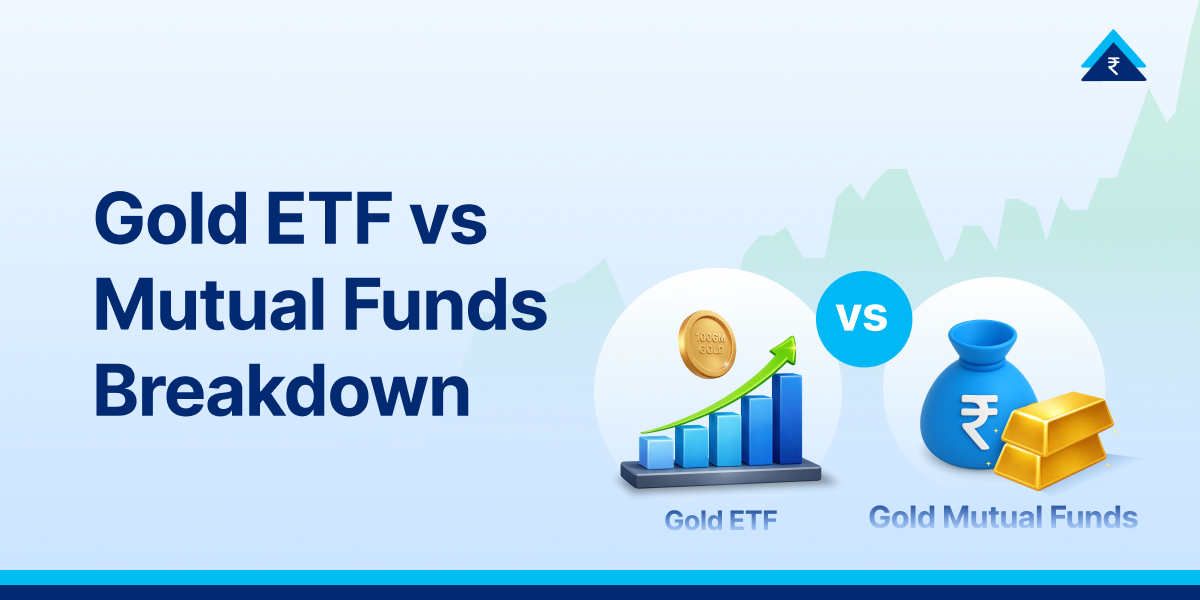
Let’s be honest. Gold has always been more than just an investment in India. It is emotion, tradition, and security rolled into one. From weddings to festivals, gold plays a central role in our financial and cultural lives. But today, investing in gold does not always mean buying jewellery or coins. With digital investing on the rise, options like Gold ETF vs Gold Mutual Fund have become popular.
- What Is a Gold ETF?
- Key Features:
- Benefits of Gold ETFs
- What Is a Gold Mutual Fund?
- Key Features:
- Benefits of Gold Mutual Funds
- Gold ETF vs Gold Mutual Fund: Key Differences
- Trading Flexibility
- Cost Efficiency
- Transparency and Tracking
- Risk Factors
- Minimum Investment Comparison
- Taxation Rules
- Which One Should You Choose?
- Explore Your Investment Options
- Conclusion
- FAQs
Both allow you to invest in gold without worrying about storage, purity, or safety. But which one is right for you? Let’s break it down in a simple and practical way so you can make an informed choice.
What Is a Gold ETF?
A Gold ETF, or Gold Exchange Traded Fund, is a market-linked instrument that tracks the real-time price of gold. These funds invest in physical gold bullion and are traded on stock exchanges just like shares.
Key Features:
- Each unit typically represents 1 gram of gold or less
- Prices change in real time during market hours
- Requires a Demat and trading account
- Can be bought and sold anytime during trading hours
In simple terms, a Gold ETF gives you direct exposure to gold prices without physically owning gold.
Benefits of Gold ETFs
- Real-time Trading: Since they are traded on the exchange, you can buy or sell them at any point during market hours. This is perfect for those who like to “time” their entries based on daily price fluctuations.
- High Purity and Safety: You do not have to worry about the “karats” or the safety of a locker. The underlying gold is held in secure vaults by a custodian.
- Lower Costs: Gold ETFs generally have lower expense ratios as they are passively managed and do not involve entry or exit loads.
(Source: Bajaj Finserv, Edelweiss Mutual Fund)
What Is a Gold Mutual Fund?
While an ETF is like a stock, a Gold Mutual Fund (often called a Gold Savings Fund) is a “fund of funds.” Instead of buying physical gold bullion directly, these mutual funds invest their corpus into Gold ETFs.
Essentially, it is a way for you to invest in gold without needing a Demat account. It offers the same exposure to gold prices but through the familiar structure of a traditional mutual fund managed by an Asset Management Company (AMC).
Key Features:
- No Demat account required
- Investment via lump sum or SIP
- NAV is calculated at the end of the day
Gold mutual funds can be ideal for investors who prefer simplicity and disciplined investing.
Benefits of Gold Mutual Funds
- SIP Convenience: This is the biggest draw for many. You can start a Systematic Investment Plan (SIP) with as little as ₹100-₹500 (varies by fund), allowing you to build your gold reserves gradually.
- No Demat Required: If you do not have a trading account or find the stock exchange interface intimidating, gold mutual funds are the perfect alternative. You can invest through any mutual fund platform or directly with the AMC.
- Regulated and Secure: Like all mutual funds in India, these are strictly regulated by the Securities and Exchange Board of India (SEBI), providing a layer of institutional safety.
(Source: Bajaj Finserv, Edelweiss Mutual Fund)
Gold ETF vs Gold Mutual Fund: Key Differences
| Feature | Gold Mutual Fund | Gold ETF |
|---|---|---|
| Meaning | Invests in gold ETFs and related assets | Tracks gold prices directly |
| Demat Account | Not required | Required |
| Investment Mode | SIP and lump sum | SIP and lump sum |
| Pricing | End-of-day NAV | Real-time market price |
| Min. Investment | Starts from ₹100-₹500 | Price of 1 ETF unit |
| Costs | Higher expense ratio | Lower cost structure |
| Liquidity | Redeemed via AMC | Traded on exchange |
| Transparency | Moderate | High |
| Taxation | LTCG applicable | LTCG applicable |
(Source: Bajaj Finserv, Edelweiss Mutual Fund)
Trading Flexibility
- Gold ETFs can be traded anytime during market hours, just like stocks.
- Gold mutual funds are bought or sold at the closing NAV of the day.
If you prefer active trading, ETFs are better. If you want convenience, mutual funds work well.
Cost Efficiency
Cost is an important factor when choosing between Gold ETF vs Gold Mutual Fund.
- Gold ETFs have lower expense ratios because they are passively managed
- Gold mutual funds have higher costs due to active management
Over time, lower costs can significantly improve returns.
Transparency and Tracking
- Gold ETFs: Gold ETFs typically track domestic gold prices, reflecting local market factors such as import duties and taxes.
- Gold Mutual Funds: Since they invest in ETFs, they also benefit from this transparency, though the end-of-day NAV calculation adds a slight layer of complexity in real-time tracking.
If you want a clear link to gold prices, ETFs are the better choice.
Risk Factors
Gold ETFs:
- Minimal counterparty risk
- Backed by physical gold
Since Gold ETFs are backed by actual physical gold stored securely, the dependency on third parties is limited. This reduces the risk of default or failure by another entity.
Gold Mutual Funds:
- Exposure to multiple instruments
- Slightly higher counterparty risk
Gold Mutual Funds invest in Gold ETFs and sometimes other financial instruments. This means your investment depends on multiple entities such as fund houses, ETF providers, and underlying assets. If any of these entities face issues, it can slightly impact the fund’s performance.
Minimum Investment Comparison
| Investment Type | Minimum Amount |
|---|---|
| Gold Mutual Fund | ₹100–₹500 onwards (varies by fund house) |
| Gold ETF | Price of 1 unit (fluctuates with real-time market price) |
This makes mutual funds more suitable for small and regular investments.
Taxation Rules
Both Gold ETFs and Gold Mutual Funds are treated as non-equity investments for tax purposes, but their holding periods differ.
Gold ETFs:
- Short-term capital gains (STCG): If held up to 12 months, taxed as per your income slab
- Long-term capital gains (LTCG): If held for more than 12 months, taxed at 12.5% without indexation
Gold Mutual Funds:
- Short-term capital gains (STCG): If held up to 24 months, taxed as per your income slab
- Long-term capital gains (LTCG): If held for more than 24 months, taxed at 12.5% without indexation
Important: Unlike earlier rules, long-term gains on both Gold ETFs and Gold Mutual Funds are now taxed without indexation benefits.
(Source: Cleartax)
Which One Should You Choose?
Your choice depends on your investment style:
Choose Gold ETF if:
- You have a Demat account
- You prefer real-time trading
- You want lower costs
Choose Gold Mutual Fund if:
- You want to invest via SIP
- You do not have a Demat account
- You prefer a simple investment process
Explore Your Investment Options
Both Gold ETFs and Gold Mutual Funds are accessible through digital investment platforms, making it easier to start and manage your investments in one place.
For instance, platforms like Paytm Money allow investors to explore, compare, and invest in both Gold ETFs and Gold Mutual Funds seamlessly, depending on their preferences and investment style.
Conclusion
Gold continues to be a reliable asset for diversification and wealth protection. Both Gold ETFs and Gold Mutual Funds offer a convenient way to invest in gold without physical hassles.
When comparing Gold ETF vs Gold Mutual Fund, there is no one-size-fits-all answer. ETFs are better for cost-conscious and active investors, while mutual funds suit those looking for ease and discipline.
The right choice depends on your financial goals, investment horizon, and comfort with market participation.
Disclaimer: Mutual fund investments are subject to market risks. Read all the related documents carefully before investing. This content is purely for information purpose only and in no way is to be considered as an advice or recommendation. The securities are quoted as an example and not as a recommendation. Investors are requested to do their own due diligence before investing.
SEBI Reg No.: Broking – INZ000240532, Research Analyst – INH000020086, Depository Participant – IN-DP-416-2019, Depository Participant Number: CDSL – 12088800, NSE (90165), BSE (6707), MCX (57525), NCDEX (1315), MSEI (85300).
Registered Office: 136, 1st Floor, Devika Tower, Nehru Place, Delhi – 110019.
For complete Terms & Conditions and Disclaimers, visit https://www.paytmmoney.com.