



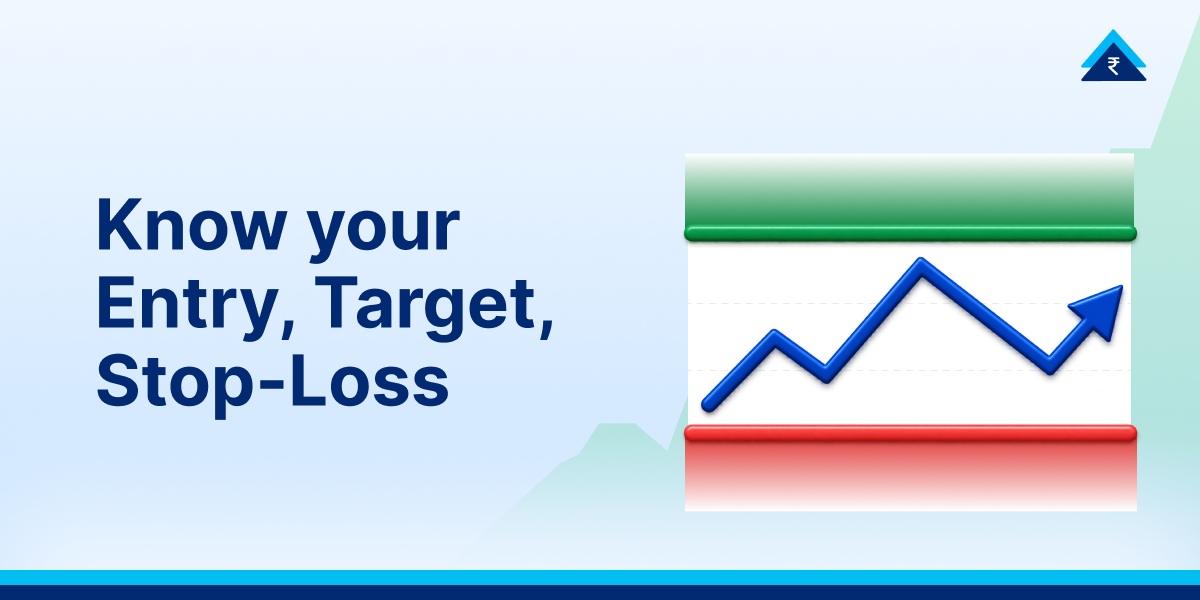
Ever opened a trade, watched it move, and wondered whether you were following a plan or simply hoping for the best? You are not alone. The good news is that three simple numbers can turn all that guesswork into a proper strategy: the entry price, the target price, and the stop-loss. Even better, you do not have to work them out alone. Trading Ideas feature hands you all three on a single page, each one backed by a research analyst rather than a random tip.
Once you understand these numbers and see how the Trading Ideas feature presents them, trading feels far less like a gamble and much more like a disciplined decision. Let us break them down in plain language.
What Is the Entry Price in Trading?
The entry price is the price at which you first open a position in the market. Think of it as the starting line of your trade. For example, if you buy shares of a company at ₹1,500, that exact number is your entry price. From that point on, your profit or loss depends entirely on how the market moves.
Put simply, it is the level where you step into the market, whether you are buying or selling. Smart traders plan this level carefully, because entering at the right moment can shape the whole outcome.
A few things worth remembering about entry price:
- It sets the reference point for every profit or loss calculation.
- A well-chosen entry can improve your reward-to-risk ratio.
- Entries are often planned using charts, patterns, or economic events.
- Patience while waiting for the right entry helps you avoid emotional decisions.
Why Entry Price Matters?
Your entry price shapes the entire trade, so it deserves real attention. Here is why it counts:
- Profit or loss anchor: Every calculation of gain or loss begins here.
- Risk management: A sensible entry helps you place stop-loss and target levels effectively.
- Strategy execution: Your entry shows whether you stuck to your plan or acted on emotion.
- Market timing: A good entry can mean stepping in at the best possible moment.
What Is the Target Price?
The target price is the best projected price level for a security. It is the point you consider the most likely reward for your investment. Once the price reaches your target, you simply sell, because you have collected the return you were aiming for.
Here is a quick example. Imagine two traders both holding a stock worth ₹600. They may expect very different profits from it. One trader sets a target price of ₹750, while the other aims for ₹1,200. Target price always depends on your risk tolerance and how long you are willing to hold the security.
What Is Stop-Loss?
The stop-loss is a pre-set price level designed to minimise your losses. Many investors use it when they cannot watch their holdings closely, perhaps while on holiday. It works well when a market falls in a steady, orderly way. In a disorderly crash, however, a stop-loss can still leave you with losses.
Consider a shareholder who owns shares of XYZ Co., currently trading at ₹500. To guard against a sharp fall, they place a stop-loss at ₹480. If the price drops to ₹480, the order triggers and the shares sell at the next available price. If that next price happens to be ₹479, the shares are sold at ₹479.
Here is how the three levels compare at a glance:
| Term | What It Means |
|---|---|
| Entry Price | The price where you open the trade |
| Target Price | The price where you plan to exit in profit |
| Stop-Loss | The price that caps your maximum loss |
What Are Trading Ideas?
Trading ideas are curated market opportunities prepared by SEBI registered research analysts. Each one is built around a clear framework rather than a random tip. A typical trading idea spells out the entry price, the target you are aiming for, the stop-loss that caps your risk, the call duration, the risk-reward ratio, and a short rationale behind the call. That structure is the whole point.
Why Traders Use Trading Ideas
The biggest benefit of trading ideas is that they replace guesswork with a structured plan. Instead of deciding on your own where to buy, where to exit, or how much risk to take, you get a research-backed framework with clearly defined entry, target, stop-loss, and expected duration.
Unlike a casual stock tip shared on social media, trading ideas are built to be tracked across their whole life. You can see when an idea was published, whether it is still active, how much target is left, whether it has moved into profit, and how it finally closed. That makes the process far more transparent and disciplined.
How Trading Ideas Work
Every trading idea follows a simple life cycle. A research analyst spots an opportunity using technical indicators, price momentum, sector trends, or company events, and then publishes the recommendation. The idea stays active until the target is achieved, the stop-loss is triggered, or the position is reviewed and closed after a set period.
Eligible equity trading ideas can also be executed using the Margin Trading Facility (MTF), letting traders take larger positions with the same capital. This can boost potential gains, but it can equally magnify losses, so disciplined risk management is essential.
Inside an Idea Details Page
Open any trading idea on the Paytm Money application, and you land on a clean Idea Details page. At the top you see the stock name, the research analyst, the analyst’s rating out of 5, and a Target Left indicator showing the remaining upside based on the target price. A timestamp tells you when the recommendation was last updated.
You can also open the analyst’s profile to view their active recommendations, recently closed ideas, and overall rating, and follow them for future research ideas. This helps you judge an analyst’s consistency over time rather than trusting a single call.
Below that sits a simple bar that maps the whole trade at a glance. It marks the stop-loss on the left, the entry price in the middle, the live last traded price (LTP), and the target on the right, so you can instantly see where the price sits between risk and reward.
| You Will See | Meaning |
|---|---|
| Entry Price | Suggested buying price |
| LTP | Current market price |
| Target | Expected exit price |
| Stop-Loss | Maximum loss level |
| Target Left | Remaining upside |
| Analyst Rating | Analyst performance score |
How the Trading Ideas Feature Simplifies Everything
Here is where it all comes together. The free trading ideas feature on the Paytm Money application removes the hardest part of trading, which is working out those three numbers yourself. Rather than staring at charts trying to gauge a fair entry price, a realistic target price, and a safe stop-loss, you get all three laid out clearly on one page, backed by a SEBI registered analyst’s research.
The visual bar shows exactly where the current price sits between your risk and your reward. For anyone still learning the ropes, that clarity makes the entry price, target price, and stop-loss far simpler to identify and act upon.
Conclusion
Master these three numbers and you hold the core of disciplined trading. The entry price sets your starting point, the target price defines your reward, and the stop-loss protects your capital. With the free trading ideas feature on the Paytm Money app doing the heavy lifting, you can focus on following a solid plan instead of chasing random tips.
Disclaimer: Investments in the securities market are subject to market risks, read all the related documents carefully before investing. Registration granted by SEBI, enlistment with BSE and certification from NISM in no way guarantee performance of the Research Analyst or provide any assurance of returns to investors. Paytm Money Limited is a distributor for Non-Broking Products/Services such as Mutual Funds and SIP any other third-party products/ services.
All disputes with respect to the distribution activity, would not have access to SCORES/ ODR, Exchange investor redressal forum or Arbitration mechanism. SEBI Reg No. Broking – INZ000240532; Depository Participant – IN – DP – 416 – 2019, Depository Participant Number: CDSL – 12088800. Trading and clearing member of: NSE (90165, M52073), BSE (6707), MCX (57525), NCDEX (1315, M51110), MSEI (85300). SEBI Reg. No. Research Analyst – INH000020086. Regd Office: 136, 1st Floor, Devika Tower, Nehru Place, Delhi – 110019. For complete Terms & Conditions and Disclaimers visit https://www.paytmmoney.com