


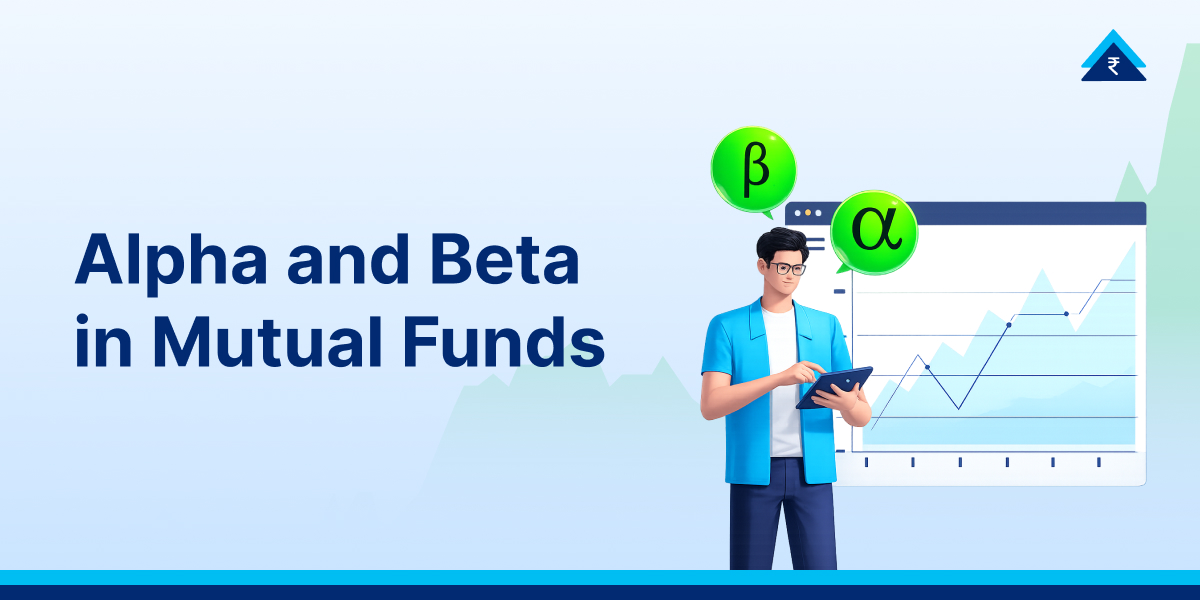
So you have found a mutual fund that looks promising, but how do you really know whether it is worth your money? This is where alpha and beta in mutual funds come into the picture. These two figures might sound like jargon at first, yet they quietly tell you a great deal about how a fund behaves and how well its manager is doing the job. Think of them as two trusted advisers, where one judges skill and the other judges nerve. Once you get comfortable reading them, picking a fund stops being a guessing game and starts feeling like an informed choice.
In this guide, we will break down these risk and return metrics in plain language, explain why they matter, show how they are worked out, and look at a few related ratios that round out the full story.
What is Alpha in Mutual Funds?
Alpha measures how well a fund performs against its benchmark index. In simple terms, it reflects the value a fund manager adds to, or takes away from, your returns through their decisions.
The baseline for alpha is 0. A reading of exactly 0 means the manager has matched the benchmark precisely. A figure above 0 shows the fund has beaten its benchmark, while a negative figure points to underperformance. For example, a fund with an alpha of 3 has outpaced its benchmark by 3%.
A benchmark, by the way, is simply an index that sets the standard against which a fund or security is measured.
What is Beta in Mutual Funds?
Beta measures a fund’s volatility, or its systematic risk, in relation to the wider market. It tells you how sharply a fund’s returns are likely to swing when the market moves.
The baseline for beta is 1. A beta of 1 means the fund moves in step with the market. A beta above 1 signals greater volatility than the market, and a beta below 1 signals less. To put numbers on it, a fund with a beta of 1.2 is expected to be 20% more volatile than the market, whereas a fund with a beta of 0.7 is 30% less volatile than its benchmark.
Here is a quick reference to keep the two straight:
| Metric | Baseline | Below baseline | Above baseline |
|---|---|---|---|
| Alpha | 0 | Underperforms the benchmark | Beats the benchmark |
| Beta | 1 | Lower volatility, lower risk | Higher volatility, higher risk |
Why Do Alpha and Beta Ratios Matter?
Before putting money into any fund, whether a capped fund, an ELSS or something else, it pays to study its track record. Ratios give you that history across different market phases and hint at future prospects such as growth potential, sustainability and risk. These forecasts may not always match reality, but they still paint a useful picture.
The value of alpha
Alpha helps you judge whether a fund’s returns came from genuine manager skill or simply from a rising market. A high alpha suggests the manager has consistently squeezed out extra returns above the benchmark.
For instance, if a manager earns 10% on a fund while the benchmark returns 8%, the alpha works out to 2. Many investors generally prefer funds with consistently positive alpha values.
One word of caution: judge alpha on an average of past performance rather than a single recent figure.
The value of beta
Beta shows how jumpy a fund is when markets wobble. A beta of 1 indicates the fund is expected to move broadly in line with the market. Cautious investors tend to favour a lower beta because it promises a calmer ride through turbulent markets.
Those chasing bigger returns, and willing to stomach the swings, often prefer a beta of 1 or higher. Beta also feeds into the Capital Asset Pricing Model, or CAPM, which estimates the expected rate of return on a fund and helps you decide whether it belongs in your portfolio.
Putting them together
Read side by side, alpha and beta in mutual funds support smarter decisions. A return seeker comfortable with risk might pick a fund with a high alpha and a high beta. A more cautious investor might lean towards a moderate alpha paired with a low beta.
How Alpha and Beta Are Calculated
Both metrics rely on set formulas. One straightforward formula is:
Alpha can be drawn from CAPM. Since CAPM points to the expected return, any gap between that and the actual return is the alpha. Imagine an ELSS fund with a CAPM figure of 5% that later delivers 8%. That 3% difference shows the manager produced 3% more than was anticipated. Expressed as a fuller formula:
Alpha = R − [Rf + β(Rm − Rf)]
where R is the fund return, Rf is the risk-free rate, and Rm is the market return.
Working out beta
Beta leans on two ideas: covariance and variance. Covariance shows how two stocks move in relation to each other. Positive covariance means they move together, while negative covariance means they move in opposite directions. Variance captures how far a fund’s price strays from its average, reflecting its volatility over time. The formula is:
Beta = Covariance (Fund, Benchmark) / Variance of Market Returns
Other Ratios Worth Knowing
Alpha and beta do not work alone. A handful of other measures help complete the picture when comparing similar funds.
| Ratio | What it tells you |
|---|---|
| Standard Deviation | How far a fund’s returns stray from their average, a gauge of volatility. |
| Sharpe Ratio | The return earned for the risk taken, found by deducting the risk-free rate from the mean; a risk-adjusted return. |
| P/E Ratio | The price paid for each unit of a fund against the earnings per unit. |
| R-Square | The share of fund returns that track the benchmark, scored between 0 and 1. |
A note on R-Square: it sits closest in spirit to alpha and beta. A value of 0 means none of the fund’s movement follows the benchmark, while a value of 1 means the fund mirrors the benchmark almost exactly.
Conclusion
Taken together, alpha and beta in mutual funds, supported by ratios like standard deviation, the Sharpe ratio and R-square, build a rounded view of how a fund has behaved and how it might fare ahead. Alpha speaks to manager skill, beta to market sensitivity, and the rest fill in the detail. Lean on these risk and return metrics, and you can match a fund to your own goals with far greater confidence.
Disclaimer: Investments in the securities market are subject to market risks. Read all the related documents carefully before investing. This content is purely for informational purposes only and should not be considered as investment advice or a recommendation. Securities quoted are for illustration purposes only and not recommendatory. Investors are requested to do their own due diligence before investing.
Paytm Money Ltd. SEBI Reg. No. Broking – INZ000240532; Depository Participant – IN – DP – 416 – 2019, Depository Participant Number: CDSL – 12088800. Trading and clearing member of NSE (90165, M52073), BSE (6707), MCX (57525), NCDEX (1315, M51110), and MSEI (85300). SEBI Reg. No. Research Analyst – INH000020086. Regd. Office: 136, 1st Floor, Devika Tower, Nehru Place, Delhi – 110019. For complete Terms & Conditions and Disclaimers visit: https://www.paytmmoney.com/stocks/policies/terms