


What if investing in the stock market didn’t start with the pressure of picking the right stocks?
- What is an Index ETF?
- In simple words,
- How Do Index ETFs Work?
- Example
- Index ETF vs Index Fund
- What This Means for You
- Why Are Index ETFs Considered Low-Cost Investments?
- Key Benefits of Index ETFs
- Things to Consider Before Investing in Index ETFs
- Popular Types of Index ETFs in India
- Who Should Invest in Index ETFs?
- When Should You Avoid Index ETFs?
- Conclusion: A Smarter, Simpler Way to Invest
- FAQs
For most new investors, that’s the first hurdle. You open an app, see hundreds of companies listed, and immediately wonder: Which stocks should I buy? Which ones will grow? What if I pick the wrong ones?
The truth is, stock selection can feel overwhelming, even for experienced investors. Markets move unpredictably, trends shift quickly, and not every “hot tip” plays out the way you expect.
But what if there was a way to skip this constant decision-making altogether?
What if you didn’t have to identify winners, track individual companies, or worry about timing the market, and could still participate in its overall growth?
That’s exactly where Index ETFs come in.
Instead of trying to beat the market by picking a few outperformers, Index ETFs take a simpler and more disciplined approach: they aim to replicate the market itself. By tracking widely followed indices like the Nifty 50 or Sensex, these funds allow you to invest in a broad basket of leading companies, all at once.
The idea is straightforward but powerful: if the market grows over time, your investment grows with it.
In this guide, we’ll break down everything you need to know about Index ETFs, including:
- What an Index ETF actually is
- How it works in practice
- Why it’s considered a low-cost investment option
- And whether it fits into your investment strategy
What is an Index ETF?
An Index ETF (Exchange-Traded Fund) is a type of investment fund that:
- Tracks a specific stock market index
- Holds the same companies in the same proportion as the index
- Trades on the stock exchange like a regular stock
In simple words,
An Index ETF is a low-cost investment that mirrors the performance of a market index and can be bought or sold on the stock exchange.
For example, a Nifty 50 ETF invests in all 50 companies in the Nifty 50, so your returns closely match the index.
How Do Index ETFs Work?
Index ETFs follow a passive investing strategy, meaning they don’t try to outperform the market.
Here’s how they work:
- The ETF selects an index (e.g., Nifty 50)
- It buys all the stocks in that index
- It maintains the same weightage as the index
- It adjusts holdings when the index changes
Example
If the Nifty 50 rises by 10%:
- Your ETF investment will also grow ~10% (minus small costs)
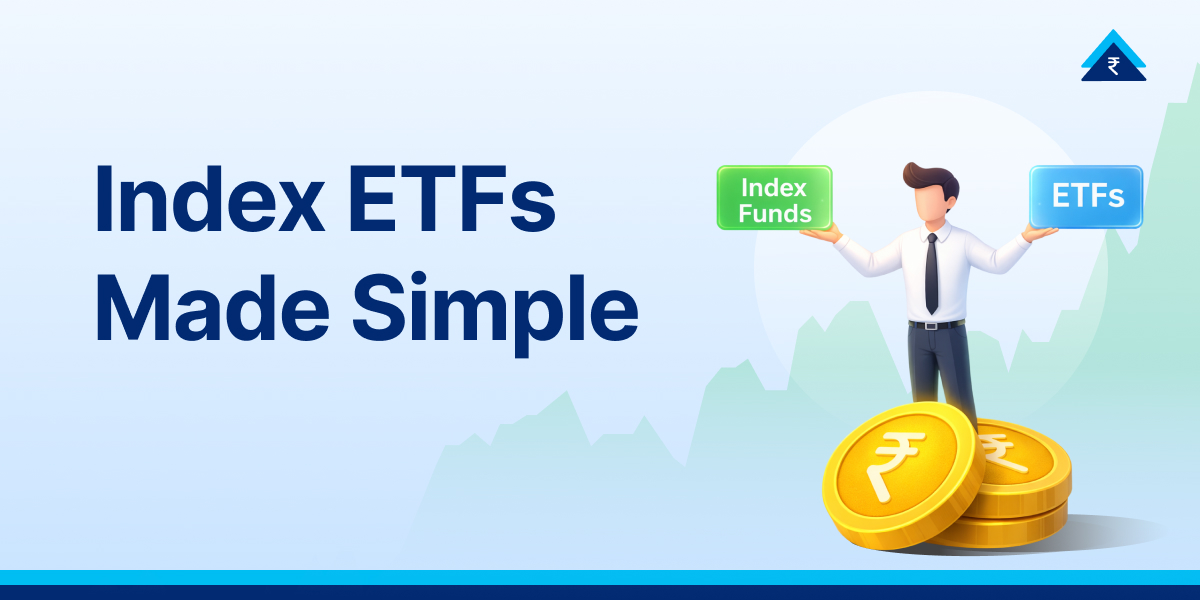
Index ETF vs Index Fund
This is one of the most common comparisons for beginners—and an important one. While both options follow a passive investing approach and track market indices like the Nifty 50, the way you invest in them is quite different.
| Feature | Index ETF | Index Fund |
|---|---|---|
| How you invest | Bought and sold on the stock exchange like shares | Invested directly through fund houses (AMCs) |
| Pricing | Real-time market price during trading hours | Calculated once daily (NAV) |
| Minimum investment | Cost of one unit (e.g., ~₹250 for Nifty BeES) | Can start small via SIP (often ₹100 – ₹500) |
| Liquidity | High, can trade anytime during market hours | Transactions processed at end of day NAV |
| Demat account | Required | Not required |
What This Means for You
Both Index ETFs and Index Funds aim to deliver market-linked returns, but they cater to slightly different investing styles.
- Index ETFs offer more control and flexibility. You can buy or sell them anytime during market hours, just like stocks, often at a lower cost.
- Index Funds, on the other hand, are more hands-off. They’re ideal if you prefer disciplined investing through SIPs without needing a demat account.
Key Takeaway
- Choose Index ETFs if you want flexibility and lower costs
- Choose Index Funds if you prefer SIP-based investing
Why Are Index ETFs Considered Low-Cost Investments?
One of the biggest advantages of Index ETFs is their cost efficiency. Since they follow a passive strategy and simply replicate an index like the Nifty 50, they avoid the need for active stock selection. This significantly reduces management costs, which is reflected in their lower expense ratios. Over time, even a small difference in costs can have a meaningful impact on overall returns, as more of your money stays invested and compounds.
This cost advantage comes from a few key factors:
- No active management: No fund managers actively picking stocks, which keeps fees low
- Lower expense ratios: Typically much cheaper than actively managed funds
- Minimal portfolio churn: Fewer changes in holdings mean lower transaction and operational costs
Together, these make Index ETFs a practical option for investors looking to keep costs low while staying aligned with market performance.
Key Benefits of Index ETFs
Index ETFs are designed to simplify investing while offering broad market exposure. By tracking established indices like the Nifty 50 or Sensex, they allow investors to participate in the overall market without the complexity of selecting individual stocks. This makes them especially appealing for those looking for a straightforward, cost-efficient way to build wealth over time.
Some of the key benefits include:
- Instant diversification: A single investment gives you exposure to multiple companies—50 in a Nifty ETF or 30 in a Sensex ETF
- Market-linked returns: Instead of trying to outperform, you track the market, reducing the risk of poor stock selection
- Transparency: Holdings mirror the index, so you always know where your money is invested
- Liquidity and flexibility: Traded like stocks, allowing you to buy or sell anytime during market hours at real-time prices
- Built for long-term investing: Well-suited for beginners, passive investors, and those focused on steady wealth creation
Things to Consider Before Investing in Index ETFs
While Index ETFs are simple, there are a few important concepts:
- Tracking Error: This measures how closely the ETF follows the index. Lower tracking error = better performance alignment
- Liquidity: Some ETFs may have low trading volumes, affecting ease of buying/selling.
- Demat Account Requirement: You need a trading + Demat Account to invest in ETFs.
- NAV vs Market Price: ETF prices may slightly differ from actual NAV due to market demand.
Popular Types of Index ETFs in India
Index ETFs are available across different market segments:
| Type | Example Exposure |
|---|---|
| Large-cap ETFs | Nifty 50, Sensex |
| Sector ETFs | IT, Banking (Nifty Bank), Pharma |
| International ETFs | Global indices (NASDAQ 100, S&P 500) |
| Gold ETFs | Domestic Gold prices |
Who Should Invest in Index ETFs?
Index ETFs are ideal for:
- Beginners: No need to pick individual stocks
- Cost-conscious investors: Low expense ratios help maximise returns
- Long-term investors: Great for compounding over time
- Passive investors: No need to actively manage your portfolio
When Should You Avoid Index ETFs?
While Index ETFs are simple and cost-efficient, they may not suit every investment approach. Since they are designed to mirror the market rather than outperform it, they may fall short for investors with more specific expectations or preferences.
You may want to consider alternatives if:
- You aim to significantly outperform the market: Index ETFs are built to match market returns, not beat them
- You prefer SIP-based investing without a demat account: ETFs require a trading and demat account, unlike traditional mutual funds
- You’re looking for active fund management: If you want a fund manager to actively select and rebalance stocks, actively managed funds may be more suitable
Conclusion: A Smarter, Simpler Way to Invest
Index ETFs simplify investing in one powerful way, they remove the need to constantly decide what to buy.
Instead, they allow you to:
- Stay invested in the broader market
- Keep costs low
- Build wealth steadily over time
In a world where beating the market is difficult even for experts, Index ETFs offer a practical alternative:
Don’t chase the market. Grow with it.
Disclaimer: Investment in the securities market is subject to market risks. Read all the related documents carefully before investing. This content is purely for information purpose only and in no way is to be considered as an advice or recommendation. The securities are quoted as an example and not as a recommendation. Investors are requested to do their own due diligence before investing.
SEBI Reg No.: Broking – INZ000240532, Research Analyst – INH000020086, Depository Participant – IN-DP-416-2019, Depository Participant Number: CDSL – 12088800, NSE (90165), BSE (6707), MCX (57525), NCDEX (1315), MSEI (85300).
Registered Office: 136, 1st Floor, Devika Tower, Nehru Place, Delhi – 110019.
For complete Terms & Conditions and Disclaimers, visit https://www.paytmmoney.com.