


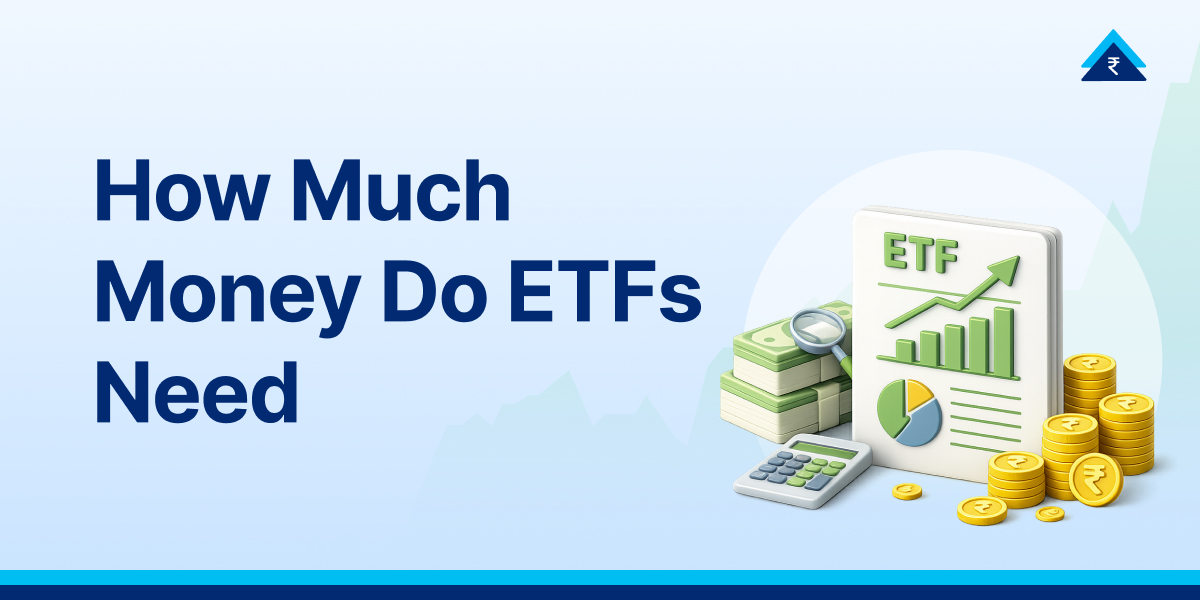
For many first-time investors, one question comes up again and again: What is the minimum investment in ETFs? Do I need a lot of money to start investing in ETFs? The hesitation is understandable. Investing has long been associated with large capital, financial confidence, and a perceived barrier to entry. But ETFs have quietly changed that narrative.
- Why ETFs Lower the Entry Barrier Without Compromising Strategy
- Minimum Investment in ETFs: The Price of One Unit
- The Practical Minimum: When Investing Becomes Meaningful
- ₹500–₹1,000: Learning the Basics
- ₹2,000–₹5,000: Building Early Structure
- ₹5,000–₹10,000+: Portfolio Building Begins
- Can You Invest in ETFs Through SIPs?
- Step-by-Step: How to Start Investing in ETFs
- The Hidden Layer: Costs, Liquidity, and Execution
- Why ETFs Are Growing Rapidly
- Investing Beyond India: Global ETFs
- Why consider global ETFs?
- Types of ETFs You Can Explore
- Exploring ETFs on Paytm Money
- Starting Small vs Starting Right
- Common Mistakes to Avoid
- Conclusion
- FAQs
The answer, surprisingly, is simple: you can start with far less than you think.
But that’s only the starting point. The more meaningful question isn’t just how much you can invest, but how much you should invest for it to actually make a difference. That distinction is where most beginner journeys either stall or scale.
Why ETFs Lower the Entry Barrier Without Compromising Strategy
Exchange-Traded Funds (ETFs) are designed for accessibility. They track an index, sector, commodity, or asset class and trade on the stock exchange like regular stocks.
This structure removes two traditional barriers:
- You don’t need a large lump sum to get started
- You don’t need to actively pick and manage multiple securities
Instead of buying 50 individual stocks, you can buy one ETF unit and gain exposure to an entire index. This is what makes ETFs one of the most beginner-friendly investment options available today.
At the same time, accessibility doesn’t eliminate the need for strategy and allocation. ETFs make entry easier, but outcomes still depend on how you invest.
(Source: Investopedia)
Minimum Investment in ETFs: The Price of One Unit
There is no fixed minimum investment required to start investing in ETFs in India. Your starting amount depends on just one thing: The market price of a single ETF unit
For example:
- If an ETF is priced at ₹50, you can start with ₹50
- If another ETF is priced at ₹500, your starting investment becomes ₹500
That’s it.
Here’s how it typically looks across categories:
| ETF Category | Representative Fund | Approx. Unit Price |
|---|---|---|
| Nifty 50 | SBI Nifty 50 ETF | ₹255.41 |
| Gold | Nippon Gold BeES | ₹122.67 |
| Banking | Axis Bank ETF | ₹566.25 |
| International | Motilal Oswal NASDAQ 100 ETF | ₹256.20 |
Note: Data compiled as of April 9, 2026, at 1:04 PM; figures are indicative and subject to change over time.
(Source: NSE)
Key insight: Your entry point is simply the price of one unit + brokerage and charges.
Some global platforms even allow fractional investing, but even without that, ETFs remain among the lowest entry-point investment options. Fractional investing allows you to invest a small amount in a US stock or ETF without needing to buy a full share.
(Source: The Economic Times)
The Practical Minimum: When Investing Becomes Meaningful
While you can start with ₹50 or ₹500, investing at that level is more about participation than portfolio building. Imagine investing ₹300 in a single ETF. You’ve entered the market. You’ll see price movements. You’ll understand how ETFs behave.
But:
- There’s limited diversification
- No real allocation strategy
- Minimal room to learn across asset types
This is why the idea of a practical minimum matters more.
₹500–₹1,000: Learning the Basics
At this level, ETF investing acts as a learning tool.
You begin to understand:
- How ETF prices move during market hours
- The difference between market and limit orders
- How tracking error shows up
However, transaction costs can feel relatively high, and your exposure remains limited to one instrument.
₹2,000–₹5,000: Building Early Structure
This is where ETF investing starts becoming effective.
You can:
- Invest across 2–3 ETFs
- Combine exposures (e.g., equity + gold)
- Observe how different assets behave
You move from simply investing to allocating capital thoughtfully.
₹5,000–₹10,000+: Portfolio Building Begins
At this level, ETFs truly function as portfolio building blocks.
You gain the ability to:
- Diversify across indices, sectors, and asset classes
- Average investments over time
- Reduce the relative impact of costs
Here, the focus shifts from “minimum investment” to consistency and long-term discipline.
Can You Invest in ETFs Through SIPs?
Yes, and this is where ETFs become even more powerful. While ETFs are traded like stocks, many platforms allow you to invest a fixed amount regularly, effectively simulating an SIP.
Using platforms like Paytm Money, you can:
- Invest consistently in ETFs
- Automate your investment habit
- Avoid timing the market
- Build wealth gradually without large initial corpus
This approach combines the discipline of SIPs with the flexibility of ETFs, making it especially suitable for salaried investors and beginners.
Step-by-Step: How to Start Investing in ETFs
Getting started is straightforward:
- Open a Demat account
- Complete your KYC verification
- Link your bank account
- Choose an ETF based on your goals
- Invest via lump sum or periodic investments
Once set up, everything from investing to tracking can be managed digitally.
The Hidden Layer: Costs, Liquidity, and Execution
While ETFs are cost-efficient, small investors should pay attention to a few important nuances:
- Transaction Costs: Brokerage and exchange charges, even if minimal, can impact returns when investing small amounts.
- Bid-Ask Spread: The difference between buying and selling price can act as a hidden cost, especially in low-volume ETFs.
- Liquidity: Not all ETFs are actively traded. A low-priced ETF isn’t necessarily better if it’s difficult to buy or sell efficiently.
So while the minimum investment is low, execution quality matters.
(Source: Bajaj Finserv)
Why ETFs Are Growing Rapidly
The popularity of ETFs is not accidental, it reflects a broader shift in investing behavior.
- Global ETF AUM has crossed $19.5 trillion (2025)
- India ETF AUM has crossed ₹10 lakh crore+ (Dec 2025)
- Passive investing now accounts for 17-19% of total mutual fund AUM in India
- Nifty 50 ETFs are among the most traded passive instruments
This growth signals a move toward low-cost, transparent, index-based investing.
(Source: CNBC, PWC, Moneycontrol)
Investing Beyond India: Global ETFs
One of the biggest advantages of ETFs is access to global markets.
Through international ETFs, you can invest in companies like:
- Apple
- Microsoft
- Amazon
This expands your portfolio beyond domestic markets.
Why consider global ETFs?
- Geographical diversification: Reduces dependence on one economy
- Access to global leaders: Invest in industries not fully represented in India
- Currency advantage: Benefit from global growth trends over time
Global ETFs allow you to participate in worldwide innovation, from technology to healthcare.
Types of ETFs You Can Explore
Depending on your financial goals, ETFs offer a wide range of choices:
- Equity ETFs: Track indices like Nifty 50
- Debt ETFs: Invest in bonds
- Gold/Commodity ETFs
- Sectoral ETFs: Banking, IT, etc.
- International ETFs
This variety allows you to build a diversified portfolio with just a few instruments.
Exploring ETFs on Paytm Money
For beginners, platform experience plays a critical role.
Paytm Money offers:
- A wide selection of ETFs
- Seamless Demat integration
- Real-time tracking and execution
- A simple interface for monitoring investments
For investors starting small, this ease of use reduces friction and builds confidence.
To know more about ETFs explore here
Starting Small vs Starting Right
There’s a difference between:
- Starting small out of caution
- Starting small without strategy
A ₹300 investment introduces you to ETFs.
A ₹5,000 allocation begins to use ETFs effectively.
The goal isn’t just to start; it’s to scale with intent.
Common Mistakes to Avoid
- Treating ETFs like short-term trades
- Investing in only one ETF
- Ignoring liquidity and spreads
- Overlooking costs due to small investment size
These are not flaws in ETFs, but gaps in approach.
Conclusion
ETFs have democratized investing in a very real sense. They’ve removed the need for large starting capital and made diversified exposure accessible to almost anyone.
You can begin with ₹50.
You can learn with ₹500.
But you build effectively with ₹2,000 and beyond.
The minimum amount gets you started. Consistency and allocation determine where you go.
Disclaimer: Investment in the securities market is subject to market risks. Read all the related documents carefully before investing. This content is purely for information purpose only and in no way is to be considered as an advice or recommendation. The securities are quoted as an example and not as a recommendation. Investors are requested to do their own due diligence before investing.
SEBI Reg No.: Broking – INZ000240532, Research Analyst – INH000020086, Depository Participant – IN-DP-416-2019, Depository Participant Number: CDSL – 12088800, NSE (90165), BSE (6707), MCX (57525), NCDEX (1315), MSEI (85300).
Registered Office: 136, 1st Floor, Devika Tower, Nehru Place, Delhi – 110019.
For complete Terms & Conditions and Disclaimers, visit https://www.paytmmoney.com.