


If you are an active trader using a Margin Trading Facility (MTF) to leverage your positions, you likely receive a daily email with an attached file titled MTF Daily Report.
- What is MTF Daily Report?
- 1. Client Code & Name
- 2. MTF Ledger Amount
- 3. Funding Stock Value
- 4. Margin Required (A)
- 5. MTOM Loss (B)
- 6. Total Margin Required (A + B)
- 7. MTF Cash Collateral (C)
- 8. Excess / Shortfall
- Part 5: The “Scrip” Details (Stock-Level Analysis)
- Part 6: The “Fine Print” You Shouldn’t Ignore
- Summary: How to Read Your Report in 30 Seconds
- FAQs
Many traders glance at it, look for the word “Shortfall,” and close it if the number is zero. While that works for survival, understanding the mechanics of this report is crucial for long-term profitability and risk management.
In this guide, we will break down a real-world MTF report to explain exactly what each column means, how your “Loss” is calculated, and why the “Haircut” matters more than you think.
What is MTF Daily Report?
The Daily MTF report is essentially a daily balance sheet for your leveraged trades. When you buy stocks on margin, you are paying only a fraction of the cost (the margin) while the broker funds the rest. Because the broker is lending you money, they need to ensure you have enough cash or stock collateral in your account to cover potential losses.
This report tells you three things:
- How much you borrowed (Ledger Amount)
- How your stocks are performing (MTOM)
- If your positions are safe or need attention (Excess/Shortfall)
Let’s dissect the report section by section, using the example below of a trader named Bhupender Jogi:
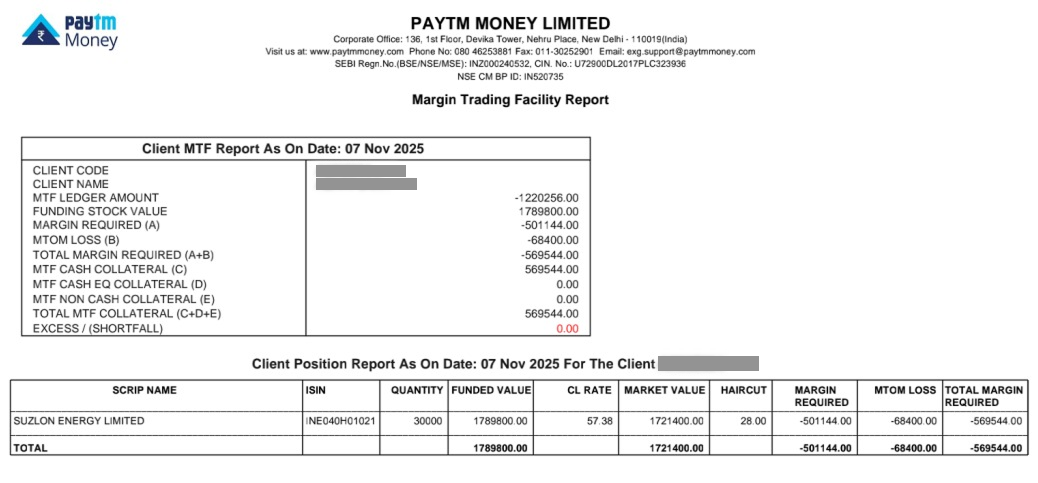
1. Client Code & Name
Right on top, you’ll see basic details like your name and your client code.
In this case, the Client Name is Bhupender Jogi and the Client Code will be a unique 8 character long alphanumeric code. For example: AB123456
2. MTF Ledger Amount
In our example, the MTF Ledger amount is -1,220,256.00.
What it means: This is the loan. It represents the debit balance in your MTF account.
Why is it negative? In accounting terms, a debit (money you owe the broker) is often shown as a negative. This is the amount the broker has funded for you to hold your positions.
3. Funding Stock Value
Here, the value is 1,789,800.00.
What it means: This is the original “cost” or funded value of the stocks you bought.
The Math: If you check the detailed table, Bhupender Jogi bought 30,000 shares of Suzlon. This number represents the total capital deployed (your money + broker’s money) to buy those shares.
4. Margin Required (A)
The report lists this as -501,144.00.
What it means: This is the “skin in the game” the broker demands. You cannot borrow 100% of the trade value. You must put up a percentage (the margin).
How is it calculated? It is based on the stock’s volatility (VAR + ELM margins set by the exchange). Risky stocks require higher margins. In this specific case, the margin required is roughly 28% of the funded value.
VAR (Value at Risk): The base margin calculated by the exchange. It estimates the maximum likely loss in a single day under normal market conditions.
ELM (Extreme Loss Margin): An additional safety buffer that covers losses in extreme or highly volatile market situations such as market crashes.
5. MTOM Loss (B)
The report shows an MTOM (Mark-to-Market) loss of -68,400.00.
What it means: This is your unrealized loss for the day or since the position was opened.
The Calculation:
- Funded Value (Cost): 1,789,800.00
- Market Value (Current): 1,721,400.00
- Difference: 1,789,800 – 1,721,400 = 68,400 Loss.
Why it matters: In MTF, your losses are deducted from your available margin immediately. If your stock drops, your “margin available” drops with it.
6. Total Margin Required (A + B)
This is the most critical formula in the report: -569,544.00.
- The Logic: The broker requires the standard margin PLUS coverage for any losses you have incurred.
- The Math: 501,144 (Base Margin) + 68,400 (MTOM Loss)= 569,544
- Takeaway: As your loss grows, your “Total Margin Required” increases. You need more cash to hold a losing position than a winning one.
7. MTF Cash Collateral (C)
In the report, this shows 569,544.00.
- What it means: This is the actual cash or cash-equivalent you have allocated to MTF.
- Interesting Note: Notice that the collateral amount exactly matches the “Total Margin Required” (569,544). This suggests the system or the trader has balanced the account perfectly to cover the requirement.
8. Excess / Shortfall
The magic number: 0.00.
- Positive Number: You have extra cash. You can buy more stocks or withdraw funds.
- Zero: You are exactly on the line. You are safe, but barely.
- Negative Number (Shortfall): Needs Attention.
- If this number is negative, you have a margin call.
- The Consequence: The report explicitly notes: “You are requested to clear the shortfall if any, failing which we would be constrained to liquidate the positions”.
- This means the broker will sell your Suzlon shares without asking you, just to recover their loan.
Part 5: The “Scrip” Details (Stock-Level Analysis)
Page 1 of the report also provides a detailed table breakdown by stock (Scrip). This is useful if you hold multiple stocks, as it shows you which specific stock is eating up your margin.
Let’s look at the entry for SUZLON ENERGY LIMITED:
| Column | Value | Explanation |
|---|---|---|
| Quantity | 30,000 | Total shares held. |
| Funded Value | 1,789,800.00 | Total purchase cost of the position. |
| CL Rate | 57.38 | The Closing Rate (market price) of the stock on that date. |
| Market Value | 1,721,400.00 | Current value: 30,000 (shares) × 57.38 (price). |
| Haircut | 28.00% | Crucial Metric: This is the risk discount. A 28% haircut means the broker considers the stock volatile; only 72% of the value is counted as effective collateral. |
Part 6: The “Fine Print” You Shouldn’t Ignore
The second page of these reports often contains standard “Key Notes,” but they hold the legal reality of your trade.
- Charges are Included: The “Funding Stock Value” isn’t just the share price; it includes brokerage and other charges. This means you start slightly in the red the moment you buy.
- Valuation Timing: Collaterals are valued at the closing price of the same date. If the market crashes at 3:25 PM, your report at 5:00 PM will reflect that crash immediately.
- Computer Generated: This document requires no signature, but it is a legally binding record of your debt. If you see a discrepancy, you must report it immediately.
Summary: How to Read Your Report in 30 Seconds
You don’t need to do the math every day. Just follow this 3-step routine when you open the PDF:
- Check the “Excess/(Shortfall)” Row: Is it zero or positive? Great, you are safe. Is it negative? Transfer money immediately.
- Check “MTOM Loss”: Is this number growing? If your MTOM loss is approaching your total cash collateral, you are close to a margin call.
- Check the “CL Rate” (Closing Rate): Compare the CL Rate (57.38 in this case) to your average buy price. It helps you mentally track the trend.
The Golden Rule of MTF:
Never ignore the daily report. In the world of leverage, a “Shortfall” today can turn into a “Liquidation” tomorrow. Stay informed, stay safe!
Disclaimer: Investments in securities market are subject to market risks, read all the related documents carefully before investing.. This content is purely for information purpose only and in no way is to be considered as an advice or recommendation. The securities are quoted as an example and not as a recommendation. Investors are requested to do their own due diligence before investing.
SEBI Reg No.: Broking – INZ000240532, Research Analyst – INH000020086, Depository Participant – IN-DP-416-2019, Depository Participant Number: CDSL – 12088800, NSE (90165), BSE (6707), MCX (57525), NCDEX (1315), MSEI (85300).
Registered Office: 136, 1st Floor, Devika Tower, Nehru Place, Delhi – 110019.
For complete Terms & Conditions and Disclaimers, visit https://www.paytmmoney.com.