

Borrowing to invest can magnify both gains and losses. If you’re considering leverage, two common paths surface in India: Margin Trading Facility (MTF) through your broker, and personal loans from banks/NBFCs. They look similar (“take money now, pay interest later”), but they differ sharply on legality, pricing, and risk. Let’s unpack the real costs, the rules that govern each option, and when one can make more sense than the other.
- TL;DR
- What exactly is Margin Trading Facility (MTF)?
- What does MTF cost at Paytm Money?
- What is a Personal Loan (PL)?
- Apple-to-apple: Cost comparison
- Scenario Table – ₹2,00,000 Funding
- Beyond cost: 6 factors that matter
- 1. Legality & documentation
- 2. Cash-flow flexibility
- 3. Risk management
- 4. Eligible securities
- 5. Operational simplicity
- 6. Credit score impact
- When does each path make sense?
- Frequently Asked Questions (FAQs):
TL;DR
- Compliance first: Many banks’ personal-loan T&Cs prohibit using loan proceeds for stock market/speculative purposes—so even if the maths looks attractive, it may violate your loan agreement.
- MTF is the regulated route to fund equity purchases via your broker on eligible securities, margin, haircuts, and pledge. Source
- Cost crossover: For short/medium holding periods (≈ up to 6–7 months), MTF often costs less than a personal loan; beyond ~7–9 months, a competitive personal loan may look cheaper on raw interest + fees—but remember the compliance caveat above.
What exactly is Margin Trading Facility (MTF)?
Margin Trading Facility lets you partially fund your stock purchase; you put up initial margin (cash/collateral), your broker funds the rest. Funded shares are pledged, and you pay daily interest on the financed portion until you square off or convert to delivery by paying down.
India’s exchanges prescribe which stocks are eligible, how margin is calculated, and how funded stock is held. Brokers can liquidate positions if you don’t meet margin calls.
What does MTF cost at Paytm Money?
Paytm Money follows a slab-based interest model for MTF; interest accrues daily on the used amount. Current slabs:
| MTF Interest Slab | Interest Rate |
|---|---|
| Up to ₹1 Lakh | 7.99% |
| ₹1 Lakh to ₹1 Crore | 10.99% |
| ₹1 Crore to ₹3 Crore | 9.99% |
| Above ₹3 Crore | 8.99% |
Interest is charged only for the period you use the funding as per the applicable slab. Please refer to the Official Pricing page for current rates.
What is a Personal Loan (PL)?
An unsecured loan with fixed EMIs, processing/origination fees, and foreclosure/part-payment charges. Recent advertised ranges from large banks: ~9.99%–22% p.a. (Axis Bank) and ~10.60%–16.50% p.a. (ICICI Bank), with processing up to ~2% + GST, and foreclosure/part-payment fees often applicable.
Crucial compliance caveat
Multiple banks explicitly bar using personal-loan funds for capital market/speculative activity in their T&Cs. For example:
- HDFC Bank PL agreement: “I agree that: …The loan proceeds are not used for investment in capital market including margin trading and derivatives.” HDFC Bank
Bottom line: Even if a PL looks cheaper on paper, using it to buy shares may violate your loan agreement. When in doubt, read your bank’s T&Cs and seek independent advice.
Apple-to-apple: Cost comparison
At Paytm Money, MTF funding begins at 7.99% p.a. (for funding up to ₹1 lakh). For funding between ₹1 lakh and ₹1 crore, the applicable interest rate is 10.99% p.a., while funding above ₹1 crore is charged at 9.99% p.a.
In this section, we compare the cost of using a Margin Trading Facility (MTF) with a standard Personal Loan (PL).
To illustrate, we assume a funding requirement of ₹2,00,000.
- MTF case: Paytm Money’s applicable interest rate of 10.99% p.a. (₹1 lakh–₹1 crore slab). Interest is charged only for the period the funding is used. There are no EMIs, and repayment happens when you square off your position or top up the required amount.
- PL case: Personal loan at 12% p.a., with a 2% processing fee + 18% GST, and a 3% foreclosure charge + applicable GST if the loan is closed before the lender’s prescribed minimum tenure. Actual charges may vary across lenders.
These examples are purely illustrative and intended to show how borrowing costs behave over different holding periods. Actual costs depend on the applicable interest rate, funding amount, tenure, and lender or broker charges.
Scenario Table – ₹2,00,000 Funding
| Holding Period | MTF Interest @ 10.99% p.a. | Personal Loan (12% p.a.) incl. fees* |
|---|---|---|
| 30 days | ₹1,807 | Not practical: PLs typically have 12–60 month tenures. Even if prepaid, total cost generally includes processing fee, accrued interest and foreclosure charges, making the overall cost significantly higher. |
| 90 days | ₹5,418 | ~₹15,634 if prepaid after 3 months (processing fee + foreclosure charges + GST + ~3 months’ interest). |
| 180 days | ₹10,830 | ~₹17,968 if prepaid after 6 months (based on the same assumptions). |
| 365 days | ₹21,980 | ~₹17,957 (assuming the loan is held for the full 12-month tenure, including EMI interest and processing fee). |
Note: The personal loan calculations are based on fee structures similar to those used by Axis Bank/ICICI Bank and assume a 12-month EMI repayment schedule. Your actual lender may have a different interest rate, fee structure, or repayment grid, so the final figures may vary. And brokerage on MTF is charged as 0.1% with 4x leverage of trade value or current brokerage, whichever is higher.
Beyond cost: 6 factors that matter
1. Legality & documentation
- MTF is explicitly allowed, with clear rules on eligible securities, margins, and pledge.
- PLs commonly forbid capital-market use in T&Cs.
2. Cash-flow flexibility
- MTF: pay interest only for days used; top-up/close anytime.
- PL: fixed EMI; pre-closure/part-payment may attract fees.
3. Risk management
- MTF: subject to MTM calls; failure to add margin can trigger forced liquidation.
- PL: no liquidation risk, but EMIs keep running irrespective of market conditions.
4. Eligible securities
- MTF works only for eligible securities
5. Operational simplicity
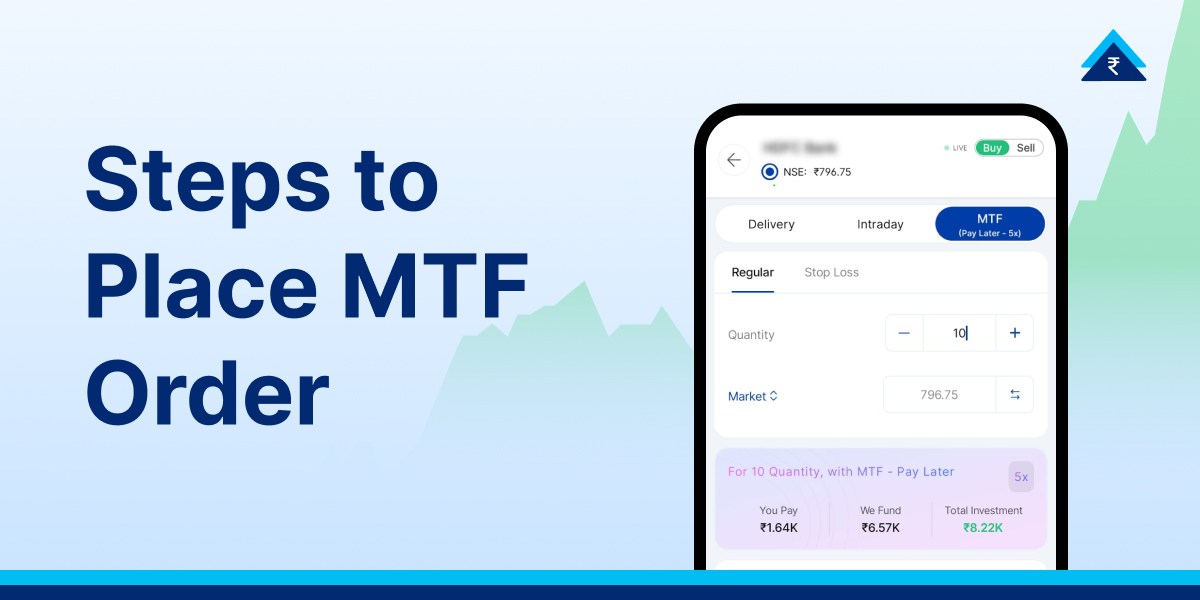
- MTF is handled within the broker app; funded stock is pledged and de-pledged per your repayments.
6. Credit score impact
- PL: an unsecured loan hits your credit file; missed EMIs hurt your score.
- MTF: handled within your trading account; credit bureau impact is indirect (if at all), but market risk is higher due to leverage.
When does each path make sense?
- You want tactical exposure (weeks–months), are buying eligible large/mid caps, and can monitor margin:
MTF is the designed, regulated route. It’s generally cheaper for shorter holds and keeps funding tied to the securities you’re buying. - You’re thinking multi-quarter to multi-year leverage purely on cost grounds:
A PL may look cheaper in year-long maths—but using it for stocks likely breaches T&Cs. If you want longer-term, lower-rate funding against investments, look at Loan Against Securities (LAS) products (different from PLs; secured and purpose-aligned). Check your lender’s LAS/LAS-MF pages and disclosures.
Frequently Asked Questions (FAQs):
Is it legal to use a personal loan to invest in stocks in India?
Personal loans are general-purpose, but many banks explicitly forbid using them for speculative/capital-market activity in their T&Cs. Violating this can put you in breach of contract.
What happens in MTF if the market falls?
Your maintenance margin can fall short; brokers can raise a margin call. If you don’t fund the shortfall within the stipulated window, the broker may liquidate positions per your rights & obligations.
Is MTF interest charged on weekends/holidays?
Yes—interest is typically computed daily on the funded amount, for calendar days of usage. (See Paytm Money’s MTF explainer and pricing.)
What are Paytm Money’s MTF rates right now?
Check the Pricing section in the Paytm Money app/site for the latest slabs. Rates may change.
Key takeaways
- If you plan to hold positions for weeks to a few months, MTF usually delivers lower effective cost and clean compliance.
- For very long holds, a low-APR loan may appear cheaper on paper, but personal loans generally can’t be used for stock purchases—review your lender’s T&Cs.
- Leverage amplifies risk. Use conservatively, size positions sensibly, and maintain buffers for MTM volatility.
Disclaimer: This article is for information only, not investment or tax advice. Costs, rates, and features can change. Please review current Paytm Money pricing, exchange regulations, and your lender/bank documents before making decisions.