


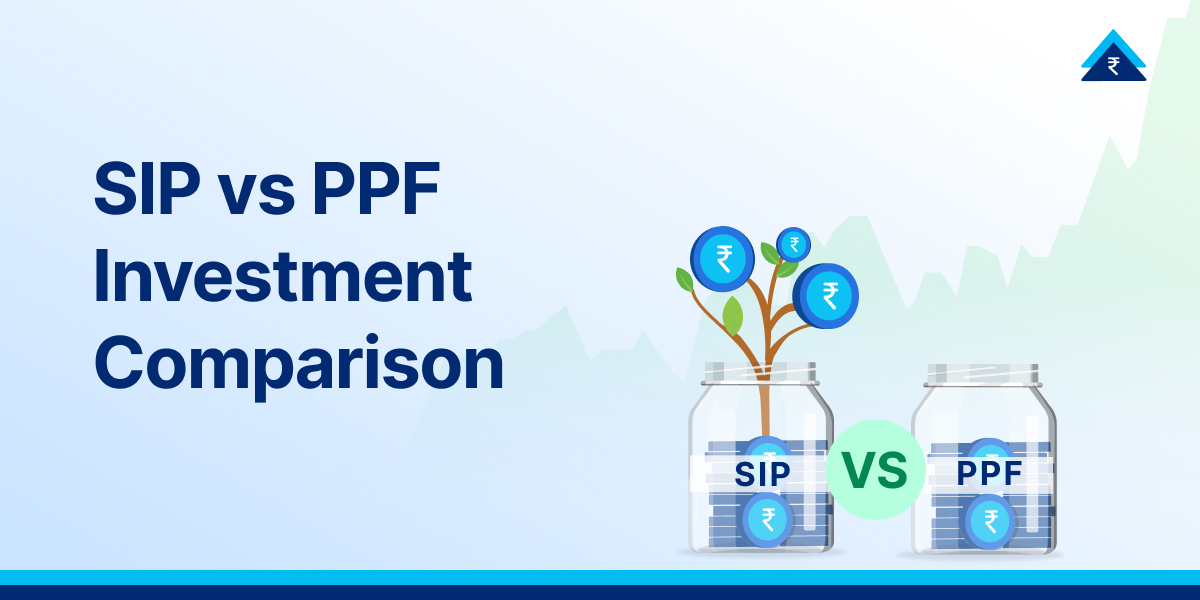
For many individuals in India, the first serious investment decision begins with a familiar question. Should your money go into a safe government backed scheme, or should it be invested in the stock market for potentially higher growth?
- Understanding the Basics: PPF vs Mutual Fund SIP
- Public Provident Fund (PPF)
- Systematic Investment Plan (SIP)
- SIP vs PPF: Key Differences
- ₹10,000 Monthly Investment for 15 Years: Return Comparison
- The 15 Year Wealth Gap Explained
- 1. Wealth Difference of ₹17.91 Lakh
- 2. Compounding in PPF vs SIP After 15 Years
- Risk vs Stability: The Real Difference
- Advantages of PPF
- Advantages of SIP
- Is PPF Better Than SIP for Tax Saving?
- SIP vs PPF for Salaried Employees 2026
- Which is Better: SIP or PPF for Long Term?
- Conclusion
- FAQs
This debate often centres around SIP vs PPF, two of the most widely used long term investment options in India. The Public Provident Fund offers stability and tax free returns, while a Systematic Investment Plan in mutual funds allows investors to benefit from equity market growth.
At first glance, investing ₹10,000 every month may seem modest. However, over a long period such as 15 years, consistent investing combined with compounding can transform a small monthly amount into a sizable corpus.
This raises an important question for investors: Which is better, SIP or PPF for long term wealth creation?
To answer that, let us examine the numbers, the features, and the long term outcomes using a SIP Calculator and a PPF Calculator.
Understanding the Basics: PPF vs Mutual Fund SIP
Before comparing returns, it helps to understand how both instruments work.
Public Provident Fund (PPF)
The Public Provident Fund is a government backed long term savings scheme designed to encourage disciplined saving.
Key highlights include:
- Current interest rate of 7.1 percent
- 15 year lock in period
- Tax benefits under Section 80C
- Completely tax free maturity due to the EEE (Exempt – Exempt – Exempt) structure
Systematic Investment Plan (SIP)
A SIP is a method of investing regularly in mutual funds, usually every month. Instead of investing a lump sum, investors contribute small amounts consistently.
Key highlights include:
- Investments linked to equity market performance
- Potential long term returns of around 12 to 15 percent historically
- Flexibility to start with as little as ₹100 per month
- No fixed tenure, although long term investing is recommended
Unlike PPF, SIP returns fluctuate because they depend on the stock market. However, over long periods equities have historically delivered higher growth.
This is why many investors compare PPF vs Mutual Fund SIP while building a best investment plan for 10 years or longer.
(Source: ICICI Direct)
SIP vs PPF: Key Differences
| Parameters | SIP (Mutual Funds) | PPF (Public Provident Fund) |
|---|---|---|
| Suitability | Ideal for wealth creation across short, medium, and long term goals | Suitable for long term retirement oriented savings |
| Returns | Market linked and depend on fund performance | Government declared interest rate |
| Interest Rate | Historically around 12% to 15% (Equity) | 7.1% (FY 2024-25) |
| Min. Investment | ₹100 per month | ₹500 per year |
| Max. Investment | No upper limit | ₹1.5 lakh per year |
| Lock-in Period | None (except 3 yrs for ELSS) | 15 years |
| Liquidity | Highly liquid | Limited liquidity (Partial withdrawal after 7th yr) |
| Risk Level | Moderate to high | Very low (Sovereign Guarantee) |
| Tax Treatment | LTCG (12.5% on gains >₹1.25L) | Fully tax-free (EEE status) |
This comparison helps investors understand that SIP vs PPF is not just about returns. It also involves risk tolerance, investment horizon, and financial goals.
(Source: ICICI Direct)
₹10,000 Monthly Investment for 15 Years: Return Comparison
To clearly understand the difference, let us compare the growth of a ₹10,000 monthly investment over a 15 year period.
The calculations below use:
- PPF interest rate: 7.1 percent
- SIP expected return: 12 percent
These figures can be easily calculated using a PPF Calculator and SIP Calculator.
| Feature | PPF (Fixed Income) | SIP (Equity Market) |
|---|---|---|
| Monthly Investment | ₹10,000 | ₹10,000 |
| Total Investment (15 yrs) | ₹18,00,000 | ₹18,00,000 |
| Assumed Return | 7.1% | 12% |
| Total Wealth Gained | ₹14,54,567 | ₹32,45,760 |
| Final Corpus | ₹32,54,567 | ₹50,45,760 |
(Note: The above figures are for illustrative purposes only. PPF interest rates are subject to government revisions, and SIP returns are market linked and may vary based on market conditions and fund performance.)
(Source: Paytm Money PPF calculator & SIP calculator)
The 15 Year Wealth Gap Explained
When comparing PPF interest rate vs SIP returns 2026, the most striking insight is the large difference in the final corpus.
1. Wealth Difference of ₹17.91 Lakh
The SIP investment grows to ₹50,45,760, while the PPF investment reaches ₹32,54,567. This creates a wealth gap of ₹17,91,193 over 15 years. The reason for this difference lies in the higher long term growth potential of equities.
2. Compounding in PPF vs SIP After 15 Years
Compounding plays a major role in long term investing.
PPF Growth
- Interest earned: ₹14,54,567
- Share of final corpus: about 45 percent
Since the PPF interest rate is fixed, the growth remains steady but relatively moderate.
SIP Growth
- Wealth generated: ₹32,45,760
- Share of final corpus: about 64 percent
This demonstrates how equity investments benefit from stronger compounding over long periods. Even a difference of around 4.9 percent in annual returns can create a massive gap in wealth over time.
(Source: Paytm Money PPF calculator & SIP calculator)
Risk vs Stability: The Real Difference
While the numbers make SIP appear attractive, the decision should not be based only on returns.
Advantages of PPF
- Government backed security
- Guaranteed interest rate
- Completely tax free maturity
- Ideal for conservative investors
Advantages of SIP
- Potential for higher long term returns
- Flexible investment amounts
- No fixed maturity period
- Ability to benefit from market growth
(Source: India Today)
Is PPF Better Than SIP for Tax Saving?
Tax treatment is another key factor when comparing SIP vs PPF for salaried employees 2026.
PPF Tax Benefits
- Eligible for deduction under Section 80C up to ₹1.5 lakh
- Interest earned is tax free
- Maturity amount is also tax free
SIP Taxation
For equity mutual funds:
- Short Term Capital Gains tax: 20 percent
- Long Term Capital Gains tax: 12.5 percent on gains above ₹1.25 lakh
(Source: Clear Tax)
SIP vs PPF for Salaried Employees 2026
For salaried individuals, the choice between the two often depends on financial priorities.
PPF may be suitable if:
- You want guaranteed returns
- Tax saving is your main objective
- You prefer stable long term savings
SIP may be suitable if:
- You want higher growth potential
- You can tolerate short term market fluctuations
- You are investing for goals such as wealth creation or financial independence
Many financial planners actually recommend using both. A combination of PPF and SIP helps create a balanced portfolio that includes both stability and growth.
Which is Better: SIP or PPF for Long Term?
If the goal is pure wealth creation over 15 years, the mathematical comparison clearly favours SIP. A ₹10,000 monthly SIP returns for 15 years can generate a corpus of about ₹50.45 lakh, compared to ₹32.54 lakh in PPF. However, PPF remains valuable because of its stability, tax efficiency, and government backing.
The most effective approach for many investors is diversification.
- Use PPF for safe long term savings
- Use SIP for inflation beating growth
Together, they can form a strong long term financial strategy.
(Source: Paytm Money PPF calculator & SIP calculator)
Conclusion
The debate around SIP vs PPF is not about choosing a single winner. Instead, it is about understanding how both investments serve different purposes. PPF offers security, predictable returns, and tax advantages. SIPs offer the potential for higher wealth creation through equity market growth.
When planning a best investment plan for 10 years or longer, combining both options often works best. Investors get the safety of PPF and the growth potential of SIP.
Before making a decision, it is always useful to experiment with a SIP Calculator and PPF Calculator to understand how small monthly investments can grow over time.
Disclaimer: Investments in securities market are subject to market risks, read all the related documents carefully before investing.. This content is purely for information purpose only and in no way is to be considered as an advice or recommendation. The securities are quoted as an example and not as a recommendation. Investors are requested to do their own due diligence before investing.
SEBI Reg No.: Broking – INZ000240532, Research Analyst – INH000020086, Depository Participant – IN-DP-416-2019, Depository Participant Number: CDSL – 12088800, NSE (90165), BSE (6707), MCX (57525), NCDEX (1315), MSEI (85300).
Registered Office: 136, 1st Floor, Devika Tower, Nehru Place, Delhi – 110019.
For complete Terms & Conditions and Disclaimers, visit https://www.paytmmoney.com.