


Learn what MTF trading means, understand five common mistakes, and explore margin shortfalls, revised Paytm Money interest rates, brokerage charges and ways to manage trading costs.
Margin Trading Facility (MTF) is a trading facility that allows you to buy eligible shares by paying a portion of the trade value, while your broker funds the remaining amount. You pay interest on the borrowed amount for as long as the funding remains outstanding.
If you have been investing in the stock market for some time, you may have considered increasing your market exposure without committing the entire amount upfront. This is where MTF trading comes into the picture.
Also known as leveraged trading, MTF can increase your buying power. However, it also increases your financial responsibility. A stock price movement that seems small can have a significant impact when borrowed funds are involved.
Understanding the MTF trading meaning is therefore not just about knowing how the facility works. It is equally important to understand its costs and risks. Here are five common mistakes to avoid when using MTF.
1. Using Too Much Leverage Just Because It Is Available
Having access to additional buying power does not mean you should use the entire limit.
For example, suppose you have ₹10 lakh in your trading account and can take a position worth ₹25 lakh using MTF. While this increases your market exposure, it also means a larger portion of your position is funded through borrowing.
If the stock price declines, your losses can erode your own contribution quickly. You may also need to arrange additional funds to meet margin requirements.
How to avoid it:
Use leverage only after assessing your financial capacity and the potential downside. Avoid using your entire available limit simply because your broker offers it.
2. Ignoring Stock Haircuts and Liquidity Risks
Not all stocks have the same margin requirements under MTF. Brokers apply a haircut to account for the risk associated with individual securities. A haircut is the percentage deducted from a stock’s market value while calculating the eligible collateral value.
For example, if a stock worth ₹10 lakh has a 30% haircut, its eligible collateral value is ₹7 lakh. This means the entire market value cannot be considered towards meeting margin requirements.
Liquidity is another important consideration. Stocks with lower trading volumes may be difficult to sell quickly, particularly during volatile market conditions.
How to avoid it:
Check the applicable haircut, margin requirements and trading volumes before placing an MTF order. Understand the risks associated with the stock rather than relying only on its potential returns.
3. Not Monitoring Your Margin Requirements
MTF positions require regular monitoring because stock prices and margin requirements can change with market conditions. A decline in the value of your holdings can reduce your available margin and create a margin shortfall. If you fail to meet the additional requirement within the stipulated time, your broker may square off your position.
For example, suppose you purchase shares worth ₹10 lakh by contributing ₹2.5 lakh, while your broker funds ₹7.5 lakh. If the share value falls by 10%, your holdings are now worth ₹9 lakh. Assuming a 25% margin requirement, you need ₹2.25 lakh as margin. However, your remaining equity is only ₹1.5 lakh, resulting in a margin shortfall of ₹75,000.
How to avoid it:
Monitor your margin utilisation and available balance regularly. Keep sufficient funds available to meet potential margin requirements and understand your broker’s timelines for addressing shortfalls.
4. Acting on Tips Instead of Independent Research
Market rumours, social media discussions and unverified stock recommendations can influence trading decisions. However, using borrowed funds based on an unverified tip can increase your financial exposure without adequate understanding of the risks.
Even a stock that appears promising may experience unexpected price movements due to company developments, market sentiment or broader economic conditions.
How to avoid it:
Evaluate a company’s financial performance, business fundamentals and relevant market developments before taking an MTF position. Base your decisions on independent research rather than relying solely on recommendations or market speculation.
5. Overlooking MTF Interest and Other Charges
MTF trading involves borrowing costs that can accumulate throughout the holding period. Interest is generally calculated daily on the outstanding funded amount.
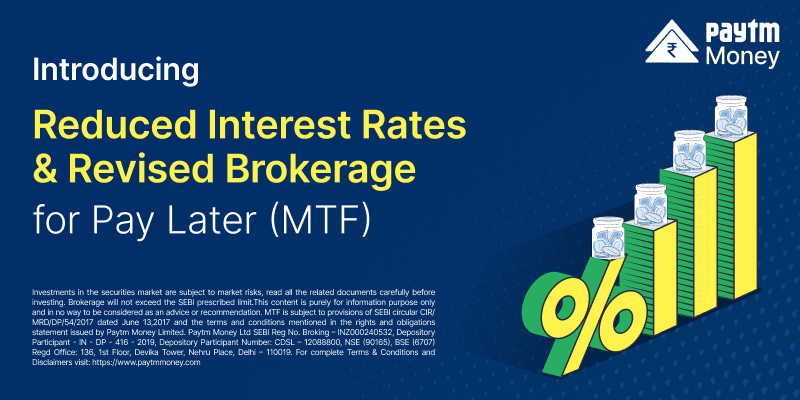
At Paytm Money, the revised MTF interest rates, effective November 2, 2026, depend on the funded amount. The applicable annual rates are:
| MTF Book Size | Interest Rate (p.a.) |
|---|---|
| Below ₹1 lakh | 7.99% |
| ₹1 lakh to ₹50 lakh | 11.99% |
| ₹50 lakh to ₹1 crore | 11.99% |
| ₹1 crore to ₹3 crore | 11.99% |
| Above ₹3 crore | 10.99% |
Note: Brokerage remains unchanged at 0.1% of turnover or ₹20 per order, whichever is higher.
Applicability: The new MTF interest rates are effective from November 2, 2026, for all new and existing users, including positions already open on November 2. Interest accrued up to November 1 will be charged at the existing rates, while interest accrued from November 2 onwards will be charged at the new rates.
For example, suppose you borrow ₹10 lakh for 30 days. Since the funded amount falls within the ₹1 lakh to ₹50 lakh slab, the applicable interest rate is 11.99% p.a.
- Daily Interest = (Funded Amount × Annual Interest Rate) ÷ 365
- Daily Interest = (₹10,00,000 × 11.99%) ÷ 365 = ₹328.49
- Interest for 30 days = ₹328.49 × 30 = ₹9,854.79
Apart from interest, brokerage and other applicable transaction charges also contribute to the total cost.
How to avoid it:
Calculate the expected interest for your holding period and account for brokerage and other applicable charges. Use an MTF calculator to estimate your borrowing costs before placing an order.
Conclusion: Understand the Risks Before Using MTF
MTF can increase your buying power, but it also exposes you to higher financial risks. Using excessive leverage, ignoring haircuts, overlooking margin shortfalls, relying on unverified tips and underestimating interest costs can affect your trading experience.
Before using MTF, assess your financial capacity, understand the applicable margin requirements and calculate the costs involved. A clear understanding of the MTF trading process can help you make more informed decisions about using borrowed funds.
You can explore Paytm Money’s MTF facility, check eligible stocks and use the MTF calculator to estimate potential borrowing costs before placing an order.
Disclaimer: Investment in securities market is subject to market risks. Read all the related documents carefully before investing. This content is purely for information purpose only and in no way is to be considered as an advice or recommendation. The securities are quoted as an example and not as a recommendation. Investors are requested to do their own due diligence before investing.
SEBI Reg No.: Broking – INZ000240532, Research Analyst – INH000020086, Depository Participant – IN-DP-416-2019, Depository Participant Number: CDSL – 12088800, NSE (90165), BSE (6707), MCX (57525), NCDEX (1315), MSEI (85300).
Registered Office: 136, 1st Floor, Devika Tower, Nehru Place, Delhi – 110019.
For complete Disclaimers, visit https://www.paytmmoney.com.