


The word mutual fund sounds simple and uniform. But in reality, mutual funds come in different forms, and each behaves very differently depending on where the money is invested.
- What is an Equity Mutual Fund?
- How Does it Generate Returns?
- Who Should Consider Equity Mutual Funds?
- What is a Debt Mutual Fund?
- How Does It Generate Returns?
- Who Should Consider Debt Mutual Funds?
- Equity vs Debt Mutual Funds in 2026: Key Differences
- Risk and Volatility
- Equity Mutual Funds
- Debt Mutual Funds
- Returns: What Should Beginners Expect?
- Investment Horizon Matters
- Taxation Differences in 2026
- Instruments and Diversification
- Debt Mutual Funds vs Fixed Deposits
- How to Choose Between Equity and Debt Mutual Funds in 2026
- Conclusion
- FAQs
In 2026, more beginners are entering the investment space than ever before. With easy access to digital platforms and financial awareness on the rise, people are keen to grow their savings. Yet one basic confusion still remains: what is the real difference between Equity Mutual Funds and Debt Mutual Funds?
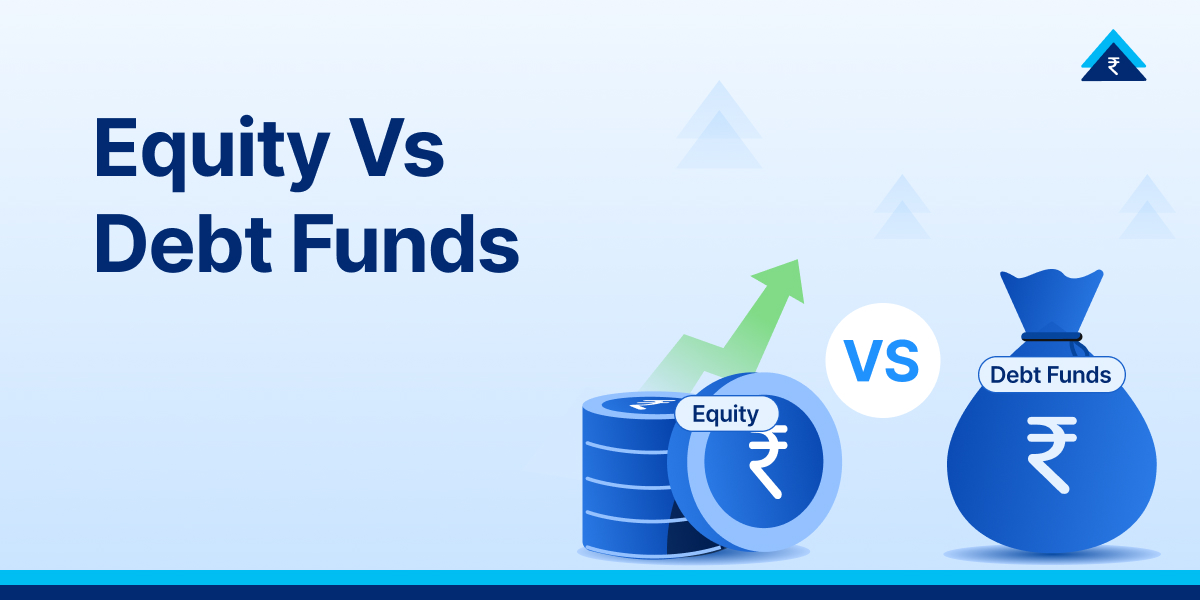
Understanding Equity vs Debt Mutual Funds in 2026 is not just about definitions. It is about knowing how your money grows, what risks you take, how long you should stay invested, and what kind of returns you can realistically expect. A wrong choice between equity and debt can significantly impact your returns, risk exposure, and stress levels during market volatility.
This guide breaks everything down in the simplest way possible.
What is an Equity Mutual Fund?
An Equity Mutual Fund invests primarily in shares of companies. When you buy shares, you become a partial owner of that company.
As per SEBI regulations, equity mutual funds must invest a minimum of 65 percent of their assets in equity and equity-related instruments. This ensures that the fund remains market-linked.
(Source: SEBI)
How Does it Generate Returns?
Returns come mainly from:
- Capital appreciation, meaning the increase in share prices
- Dividends declared by companies
Since stock prices fluctuate daily, equity mutual funds are subject to market volatility. However, over a long period, they have the potential to generate higher returns.
Who Should Consider Equity Mutual Funds?
- Investors with a long-term horizon of 5 years or more
- Investors willing to tolerate market ups and downs
- Individuals aiming for wealth creation and capital growth
(Source: Standard Chartered)
What is a Debt Mutual Fund?
A Debt Mutual Fund invests in fixed income securities. These include:
- Government Securities also called G-Secs
- Corporate Bonds
- Treasury Bills or T-Bills
- Commercial Papers or CPs
- Certificates of Deposit or CDs
- Non Convertible Debentures or NCDs
The primary objective of debt mutual funds is to provide stable and predictable income.
(Source: ICICI Bank)
How Does It Generate Returns?
Returns mainly come from:
- Interest income earned on bonds
- Capital gains from changes in bond prices
Debt funds are generally less volatile than equity funds. However, they are not completely risk-free. Interest rate changes and credit rating downgrades can impact returns.
Who Should Consider Debt Mutual Funds?
- Investors with short to medium-term goals
- Individuals seeking capital preservation
- Those who prefer relatively stable returns
(Source: Standard Chartered)
Equity vs Debt Mutual Funds in 2026: Key Differences
Understanding the distinction between these two types is essential for beginners.
| Parameters | Equity Mutual Funds | Debt Mutual Funds |
|---|---|---|
| Primary Investment | Minimum 65 percent in equities | Fixed income securities such as bonds and T-Bills |
| Risk Level | Higher | Lower compared to equity funds |
| Return Potential | Higher over long term | Moderate and stable |
| Ideal Investment Horizon | 5 years or more | Short to medium term |
| Volatility | High | Relatively low |
| Objective | Capital appreciation | Income generation and capital preservation |
(Source: Standard Chartered)
Risk and Volatility
When comparing Equity vs Debt Mutual Funds in 2026, risk is a major factor.
Equity Mutual Funds
- Highly influenced by stock market movements
- Can experience sharp short-term fluctuations
- Suitable for investors who can handle volatility
Debt Mutual Funds
- Less volatile
- Sensitive to interest rate changes
- Impacted by credit quality of underlying securities
While equity funds offer higher growth potential, debt funds provide relative stability.
(Source: Standard Chartered)
Returns: What Should Beginners Expect?
Historically, equity mutual funds have delivered stronger returns over long periods (often 9%–12% annually in India). However, short-term performance can vary significantly. Debt mutual funds generally provide moderate returns (around 6%–8%) but with lower fluctuations.
If your goal is long-term wealth creation such as retirement planning, equity funds may be more suitable. If your goal is capital protection over a shorter period, debt funds may be preferable.
Investment Horizon Matters
Your time horizon plays a crucial role in choosing between Equity vs Debt Mutual Funds in 2026.
- Equity mutual funds are generally considered more suitable for long-term goals (beyond 5 years).
- For goals within 1 to 3 years, debt mutual funds may be more appropriate.
- For medium-term goals of 3 to 5 years, a combination of both can work.
Matching your fund choice with your timeline reduces stress during market volatility.
(Source: Standard Chartered)
Taxation Differences in 2026
Taxation is another important distinction.
Equity Mutual Funds
- 20 percent tax if held for less than 1 year
- 12.5 percent tax on gains above ₹ 1.25 lakh if held for more than 1 year
Debt Mutual Funds
- Taxed as per the investor’s income tax slab rate
Understanding taxation helps you calculate your net returns accurately.
Instruments and Diversification
Both equity and debt mutual funds offer diversification.
Equity Funds
- Invest across sectors and market capitalisations
- Spread risk across multiple companies
Debt Funds
- Invest across various fixed income instruments
- Reduce default risk through diversification
Diversification helps reduce the impact of poor performance from a single security.
Debt Mutual Funds vs Fixed Deposits
Many beginners compare debt mutual funds with bank fixed deposits.
| Feature | Debt Mutual Funds | Fixed Deposits (FD) |
|---|---|---|
| Returns | Market linked (Subject to interest rate & credit movements) | Fixed and predetermined at the time of booking |
| Liquidity | High; units can be redeemed anytime (Exit load may apply for short durations) | Moderate; premature withdrawal often attracts a penalty (0.5% to 1%) |
| Risk | Low to Moderate; no capital guarantee | Very Low; capital protected up to ₹5 Lakh by DICGC insurance |
| Taxation | Gains added to income and taxed as per **Income Tax Slab** | Interest added to income and taxed as per **Income Tax Slab** |
Debt funds offer better liquidity in some categories such as liquid funds. However, they do not guarantee returns like fixed deposits.
(Source: DBS Bank)
How to Choose Between Equity and Debt Mutual Funds in 2026
Ask yourself three questions:
- What is my investment goal?
- What is my time horizon?
- How much risk can I tolerate?
If you want growth and can stay invested for the long term, equity mutual funds may suit you. If you want stability and predictable income, debt mutual funds may be better.
You can also combine both through asset allocation to balance risk and return.
Conclusion
The debate around Equity vs Debt Mutual Funds in 2026 is not about which is better. It is about which is better for you. Equity mutual funds aim for higher growth but come with volatility. Debt mutual funds focus on stability and income but offer moderate returns.
There is no one-size-fits-all solution. Align your choice with your goals, risk appetite, and investment horizon. When used wisely, both types of mutual funds can help you build a strong financial foundation.
Disclaimer: Investments in securities market are subject to market risks, read all the related documents carefully before investing.. This content is purely for information purpose only and in no way is to be considered as an advice or recommendation. The securities are quoted as an example and not as a recommendation. Investors are requested to do their own due diligence before investing.
SEBI Reg No.: Broking – INZ000240532, Research Analyst – INH000020086, Depository Participant – IN-DP-416-2019, Depository Participant Number: CDSL – 12088800, NSE (90165), BSE (6707), MCX (57525), NCDEX (1315), MSEI (85300).
Registered Office: 136, 1st Floor, Devika Tower, Nehru Place, Delhi – 110019.
For complete Terms & Conditions and Disclaimers, visit https://www.paytmmoney.com.