


Navigating the dynamic landscape of the stock market requires a strategic balance between risk management, capital allocation, and perfect timing. For modern traders looking to maximize their potential returns without liquidating their existing portfolios, the MTF-Pay Later (MTF trades) has emerged as a game-changer.
- Components That Affect Break-Even in MTF Trades
- The Break-Even Formula
- Step-by-Step Calculation Walkthrough
- Practical Example: Calculating MTF Break-Even in Action
- Initial Trade Parameters
- Comprehensive Cost Breakdown (approx.)
- The Final Break-Even Calculation
- Key Factors That Change Your Break-Even
- Common Mistakes to Avoid
- How Paytm Money Helps You Manage Break-Even for MTF Trades
- Interest Rate Slabs
- Conclusion
- FAQs
However, leveraging borrowed capital introduces a vital mathematical metric that every trader must master before executing an order: the break-even price. Knowing your break-even price is critical because it reveals exactly how much a stock needs to appreciate just to cover the costs associated with the trade. Without this knowledge, you might exit a position believing you secured a profit, only to realize that accrued interest and transaction fees have completely eroded your margins. By calculating this threshold in advance, you can set realistic target prices and strict stop-losses, ensuring your trading strategy remains systematically profitable.
Components That Affect Break-Even in MTF Trades
To accurately pinpoint when your MTF trade becomes profitable, you must dissect and understand the underlying costs. Unlike standard cash-and-carry trades, where your primary expense is a one-time brokerage fee, MTF trades involve ongoing financing costs.
- Purchase Price of the Stock: The foundational baseline of your calculation is the original price at which you acquired the shares in the open market.
- Interest Charges on Borrowed Funds: Interest is charged daily and applied pro-rata, strictly on the broker-funded amount, not the total trade value.
- Brokerage & Transaction Charges: These are the standard fees incurred during the buying and selling process. While brokerage varies across brokers, standard charges like Security Transaction Tax(STT), Stamp Duty, and GST are applicable regardless of your brokerage plan. You must also account for Pledge / Unpledge Fees, which are ₹20/- per transaction (includes ₹5 CDSL charge), and DP Charges of ₹20/- (applies when you sell shares/debit transaction).
- Holding Period: While you can hold your positions for several months, the longer you hold the stock, the higher your total costs climb. Since interest accrues daily, long-held positions can push your break-even price further up.
The Break-Even Formula
Determining your true break-even requires aggregating your initial purchase price with all subsequent costs, distributed on a per-share basis. The basic framework of this formula is:
| Break-Even Price = Initial Buy Price + (Total Interest Cost / Number of Shares) + (Total Brokerage & Taxes / Number of Shares) |
Step-by-Step Calculation Walkthrough
If you want to manually calculate your break-even point for an upcoming MTF trade to build a robust trading plan, follow these straightforward steps:
- Step 1: Calculate the Interest Cost. Determine exactly how much capital the broker is funding. Take that borrowed amount, multiply it by the applicable MTF Interest Rate (e.g., 7.99%), multiply by your expected holding days, and divide by 365. Remember, interest is calculated strictly on the broker-funded amount.
- Step 2: Aggregate Transaction Charges. Sum up the entry and exit costs. Include the brokerage rate of 0.1% of trade value or the standard brokerage (whichever is higher). Remember this is applied on both the buy and sell sides. Add the ₹20 DP charge for selling and the ₹20 pledge/unpledge fees. Add estimated regulatory taxes (STT, GST, Exchange Transaction charges).
- Step 3: Determine the Break-Even. Divide the total costs from Step 1 and Step 2 by the number of shares you hold. Add this per-share cost directly to your original Buy Price. This final figure is your definitive break-even price.
Practical Example: Calculating MTF Break-Even in Action
Suppose you spot a strong breakout opportunity in a stock and decide to buy 800 shares at ₹100 each. Instead of committing the full ₹80,000 from your cash balance, you use MTF to pay a 25% upfront margin, allowing Paytm Money to fund the remaining 75%. You plan to hold this position for a 15-day swing trade.
Initial Trade Parameters
| Parameter | Value |
|---|---|
| Stock Price | ₹100 |
| Quantity | 800 Shares |
| Total Trade Value | ₹80,000 |
| Your Upfront Margin (25%) | ₹20,000 |
| Borrowed Amount (75%) | ₹60,000 |
| Expected Holding Period | 15 Days |
| Applicable Interest Rate | 7.99% p.a. (for MTF book size up to ₹1 Lakh) |
Now, let’s calculate the specific costs involved in executing this trade, holding it for 15 days, and then selling it to close the position.
Comprehensive Cost Breakdown (approx.)
| Cost Component | Calculation Method | Amount |
|---|---|---|
| MTF Interest | (₹60000 × 7.99% × 15 days) / 365 | ₹197 |
| Brokerage (Buy Leg) | 0.1% of ₹80,000 trade value | ₹80 |
| Brokerage (Sell Leg) | 0.1% of estimated ₹80,000 trade value | ₹80 |
| Pledge Fees | ₹20 flat fee per transaction | ₹20 |
| DP Charges | ₹20 flat fee applied when selling | ₹20 |
| Taxes & Regulatory Fees | Estimated STT, GST, and Exchange charges | ~₹109 |
| Total Trade Cost | Sum of all the above expenses | ~₹506 |
(Note: Taxes and regulatory fees like STT and GST are estimated slightly for illustrative purposes.)
The Final Break-Even Calculation
Now that we have the total cost of executing and carrying the trade, we can calculate the exact break-even price.
- Total Costs: ₹506
- Cost Per Share: ₹506.00 ÷ 800 shares = ₹0.63 per share
- Break-Even Price: ₹100 (Initial Buy Price) + ₹0.63 (Cost Per Share) = ₹100.63
The Takeaway: In this scenario, the stock price needs to rise from ₹100 to ₹100.63 just to cover your borrowing and transactional costs. Any exit above ₹100.63 represents your pure net profit.
Key Factors That Change Your Break-Even
Your break-even point is not static; it is highly sensitive to the mechanics of your trade strategy.
- Holding Duration: The phrase “Time is Money” is literally true in MTF trading; while rates are low, interest accrues daily. Exits should be based on strict technical/fundamental targets. A longer holding period directly correlates to higher accumulated interest, which steadily pushes your break-even price higher day by day.
- Leverage Ratio: You can get up to 4x buying power on your available funds. The higher the leverage you utilize, the larger your loan size. A larger loan means higher daily interest in absolute terms, requiring a larger price movement to break even.
- Tactical Portfolio Diversification: You can use MTF to build a medium-term “Satellite” portfolio (e.g., catching a breakout in the Metals sector) using leverage, while keeping your long-term “Core” portfolio (e.g., Banking compounders) intact without liquidating them to free up cash.
| Leverage Ratio: The proportion of borrowed funds used to purchase an asset compared to your own invested capital. Satellite Portfolio: A smaller portion of an investment portfolio used to take higher-risk, tactical, or short-term trades, separate from the main “core” long-term investments. |
Common Mistakes to Avoid
Even seasoned traders can stumble when managing MTF positions if they neglect the fine print.
- Ignoring Daily Interest Accumulation: A common oversight is treating MTF like a standard delivery trade. Because interest is charged daily, your profitability target shifts slightly every 24 hours. Failing to account for this can result in unexpected net losses.
- Forgetting Exit-Side Charges: Many traders calculate costs solely upon entry. However, you must remember that brokerage is applicable on both Buy and Sell legs. Additionally, DP Charges of ₹20 apply when you sell shares/debit transaction.
- Not Managing Margin Shortfalls: If the stock price drops and the value of the pledged collateral falls below the required threshold, you will face a margin call and must add fresh funds or risk auto-square-off. Always factor in that an exchange-mandated “haircut” (safety buffer) is applied on collateral value.
| Margin Call: A broker’s demand that an investor deposit additional money or securities to bring the account up to the minimum required maintenance margin. Haircut: The percentage reduction applied to the market value of a security when it is used as collateral, serving as a safety buffer against market fluctuations. Auto-square-off: When the broker automatically closes your open trading position because you failed to meet margin requirements. |
How Paytm Money Helps You Manage Break-Even for MTF Trades
Navigating manual calculations can be tedious, especially in fast-moving markets. To simplify this, Paytm Money provides a dedicated MTF Calculator. This intuitive tool is designed to provide clear, upfront breakdowns of daily interest charges, brokerage, GST, and pledge charges.
Before executing a trade, you can use the MTF Calculator to perform a Leverage & Buying Power Analysis, which shows the exact margin required and how much additional purchasing power (up to 4x) is available for specific stocks. Furthermore, it features a Profit vs. Cost Comparison, which compares net returns with and without MTF, helping users visualize if the gain offsets the holding costs. You can calculate analyze up to 5 stocks simultaneously.
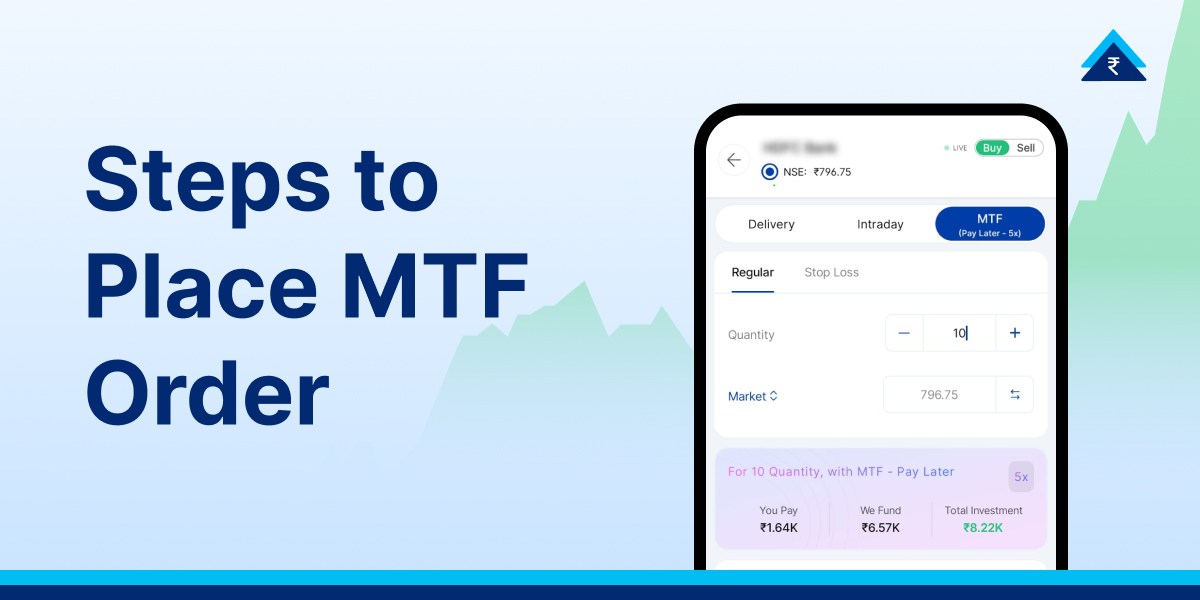
To access MTF, navigate to the Portfolio or Stocks tab in the Paytm Money App, choose a stock, press buy and look for MTF-Pay Later on Order Pad. You can even enable placing buy orders directly from the calculator widget after reviewing the funding details.
Paytm Money offers a competitive interest structure designed to protect your profit margins. Interest is calculated daily and applied pro-rata, ensuring you only pay for the specific duration you hold a position.
Interest Rate Slabs
The applicable rate is determined by your Book Size (total borrowed amount):
| MTF Interest Slab | Interest Rate |
|---|---|
| Up to ₹1 Lakh | 7.99% |
| ₹1 Lakh to ₹1 Crore | 10.99% |
| ₹1 Crore to ₹3 Crore | 9.99% |
| Above ₹3 Crore | 8.99% |
Brokerage for MTF trades is calculated at 0.1% of the trade value or your current brokerage rate, whichever is higher.
Conclusion
Margin Trading Facilities offer an exceptional pathway for tactical portfolio diversification and maximizing market opportunities. However, leverage is a double-edged sword. Knowing your break-even price equates to smarter, more disciplined MTF decisions. By meticulously calculating your interest, brokerage, and holding costs before entering a trade, you transform a potentially risky guess into a calculated, strategic investment. Always do the math—or let the MTF Calculator do it for you—before you trade, not after.
Disclaimer: Investment in securities market is subject to market risks. Read all the related documents carefully before investing. This content is purely for information purpose only and in no way is to be considered as an advice or recommendation. The securities are quoted as an example and not as a recommendation. Investors are requested to do their own due diligence before investing.
SEBI Reg No.: Broking – INZ000240532, Research Analyst – INH000020086, Depository Participant – IN-DP-416-2019, Depository Participant Number: CDSL – 12088800, NSE (90165), BSE (6707), MCX (57525), NCDEX (1315), MSEI (85300).
Registered Office: 136, 1st Floor, Devika Tower, Nehru Place, Delhi – 110019.
For complete Disclaimers, visit https://www.paytmmoney.com.