


Have you ever spotted a perfect “breakout” candle on a stock chart, only to realize your capital is already locked up in long-term investments? It is a common frustration for many investors in India. You see the opportunity, you have the research and conviction, but you lack the immediate liquidity to take action. This is the classic dilemma of the stock market: how do you maximize your opportunities without overextending your finances? This is where understanding MTF vs Regular Trading becomes important.
- Understanding Regular Trading: The Traditional Path
- What is Margin Trading Facility (MTF)?
- The “Buy Now, Pay Later” for Stocks
- How the Mechanics Differ: MTF vs Regular Trading
- The Cost of Convenience: Understanding MTF Interest Rates
- Interest Rate Slabs
- Strategic Use Cases: When to Use Which?
- 1. The Core Portfolio (Regular Trading)
- 2. Positional and Swing Trading (MTF)
- 3. Cashless Trading via Pledging (Margin Pledge + MTF)
- Managing the Risks: The Concept of Haircuts and Margin Calls
- The Margin Call
- The Haircut
- Using the MTF Calculator for Informed Decisions
- Key Takeaways
- Conclusion
- FAQs
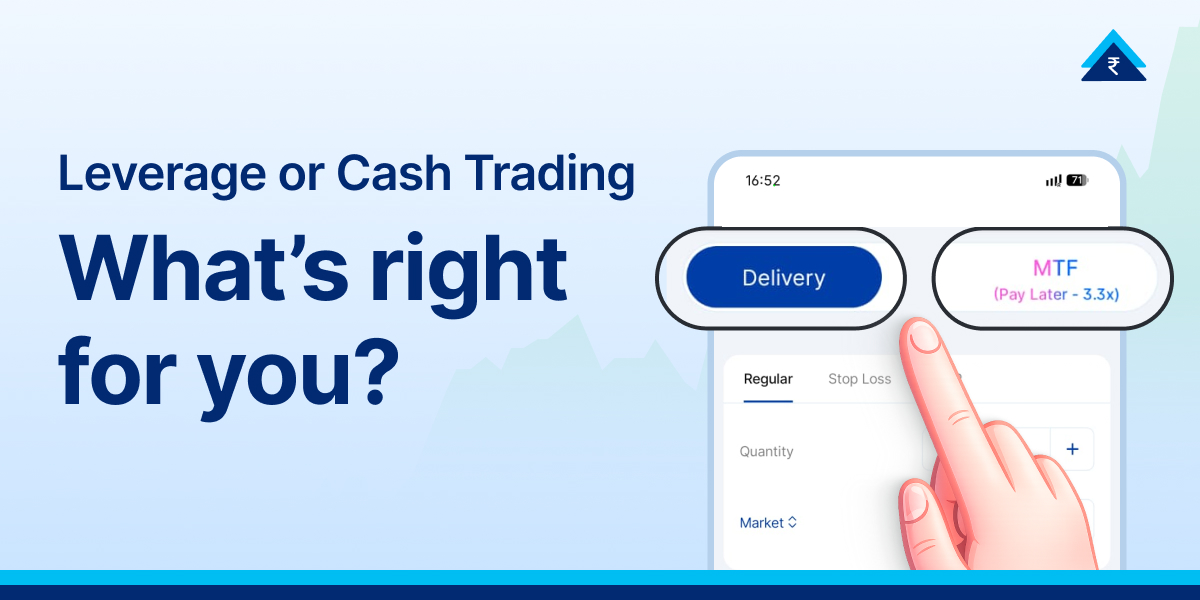
In the Indian markets, two primary paths exist for acquiring shares: Regular Trading (often called delivery trading or cash market trading) and Margin Trading Facility (MTF). While regular trading is the bedrock of long-term wealth creation, MTF has emerged as a powerful tool for those looking to “Buy Now, Pay Later” for stocks. Choosing between them isn’t about finding which one is “better,” but rather understanding which one fits your current market view and financial goals.
In this guide, we will dive deep into the mechanics of both approaches, comparing costs, risks, and strategic advantages. By the end, you will have a clear framework for deciding when to use your own cash and when to leverage the power of a Margin Trading Facility (MTF) to boost your purchasing power.
Understanding Regular Trading: The Traditional Path
Regular trading, specifically in the “delivery” segment, is the way most Indians begin their journey in the stock market. The logic is simple: if you want to buy ₹50,000 worth of shares in a blue-chip company, you must have ₹50,000(plus charges) in your trading account. Once the trade is executed, the money is deducted, and the shares are moved to your Demat account.
Regular trading offers a sense of absolute ownership. Since you have paid for the shares in full, you can hold them for ten days, ten months, or ten years without worrying about interest costs or “margin calls.” It is the ideal method for “Core” portfolio building—those stocks you intend to hold until retirement or for long-term compounding.
However, the limitation of regular trading is capital efficiency. Your growth is strictly capped by the amount of liquid cash you have. If the market presents five great opportunities but you only have enough cash for one, you are forced to miss out on the others or sell your existing winners prematurely to free up funds.
What is Margin Trading Facility (MTF)?
If regular trading is like buying a house with full cash, Margin Trading Facility (MTF) is more like buying a house with a home loan. It is a SEBI-approved facility provided by brokers like Paytm Money that allows you to buy stocks by paying only a fraction of the total value upfront.
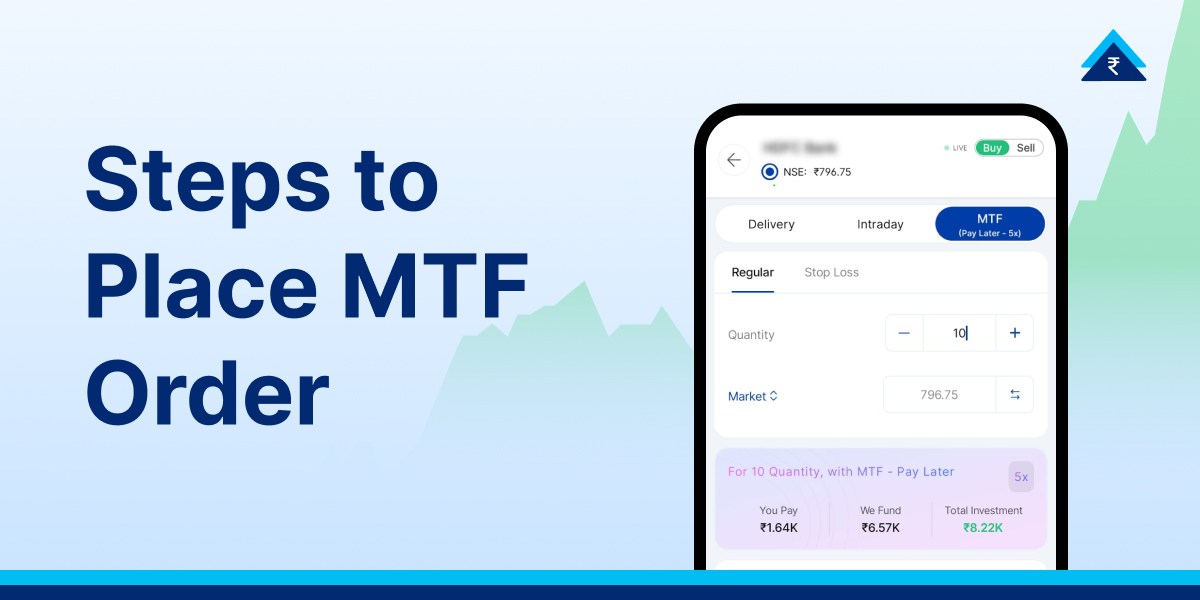
With MTF, you can boost your purchasing power by up to 4x. This means if you have ₹25,000 in your account, you could potentially buy up to ₹1,00,000 worth of shares. You provide the “Initial Margin” (the 25%), and the broker funds the remaining 75% as a low-cost loan.
The “Buy Now, Pay Later” for Stocks
Paytm Money often refers to MTF as “Pay Later,” and for a good reason. It allows you to capture market opportunities immediately. Unlike intraday trading, where you must close your position by the end of the day, MTF allows you to hold your positions for a significantly longer period—up to 365 days—provided you maintain the required margin.
How the Mechanics Differ: MTF vs Regular Trading
To decide which makes more sense for you, it is essential to look at how these two methods function side-by-side.
| Feature | Regular Trading (Cash) | Margin Trading Facility (MTF) |
|---|---|---|
| Purchasing Power | 1x (Limited to your cash) | Up to 4x (Leveraged) |
| Upfront Payment | 100% of trade value | As low as 25% of trade value |
| Holding Period | Unlimited | Up to 365 days |
| Costs | Brokerage + Statutory taxes | Brokerage + Statutory taxes+ Daily interest on funded amount |
| Risk | Price depreciation of stock | Price depreciation + Potential Margin Calls |
| Ownership | Full ownership from day one | Full ownership, but shares are pledged |
The Cost of Convenience: Understanding MTF Interest Rates
While regular trading has no “holding cost” (other than the opportunity cost of your cash), MTF involves an interest component. Since the broker is lending you money to buy shares, they charge interest on the amount they fund.
At Paytm Money, the interest structure is designed to be competitive, ensuring that the cost of borrowing doesn’t eat away at all your potential profits. The interest is calculated daily and applied pro rata, meaning you only pay for the exact number of days you hold the position.
Interest Rate Slabs
The rate you pay often depends on your “Book Size” (the total amount funded by Paytm Money i.e., the borrowed portion only).
| MTF Interest Slab | Interest Rate |
|---|---|
| Up to ₹1 Lakh | 7.99% |
| ₹1 Lakh to ₹1 Crore | 10.99% |
| ₹1 Crore to ₹3 Crore | 9.99% |
| Above ₹3 Crore | 8.99% |
For example, if you borrow ₹60,000 to buy shares, your daily interest cost at a 7.99% rate would be approximately ₹13.13. For a positional trader looking to catch a 5-10% move over two weeks, this cost is often negligible compared to the potential gains from the increased volume of shares they can hold.
Brokerage is charged at 0.1% of trade value or current brokerage, whichever is higher.
Strategic Use Cases: When to Use Which?
The “MTF vs Regular Trading” debate isn’t about which is better, but which is more appropriate for the situation.
1. The Core Portfolio (Regular Trading)
For your long-term wealth—the shares you want to give to your children or use for retirement—always use regular trading. There is no need to pay interest on a position you plan to hold for five years. Using cash ensures that market volatility won’t force you out of a good company just because of a temporary price dip.
2. Positional and Swing Trading (MTF)
This is where MTF shines. If you see a technical breakout in a stock and expect a 10% move within the next 20 days, MTF allows you to maximize that gain. By using 4x leverage, a 10% move in the stock price can result in upto 40% return on your deployed capital (minus interest, brokerage, and other fees).
Intraday vs Positional Trading with MTF
3. Cashless Trading via Pledging (Margin Pledge + MTF)
One of the most powerful features of MTF is the ability to trade without fresh cash. If you already have a portfolio of stocks in your Demat account, you can “pledge” them as collateral.
By pledging existing holdings, you get a “collateral margin” (after a standard haircut). You can use this margin to cover the 25% upfront requirement for an MTF trade. This allows you to take new positions without selling your long-term holdings to free up cash.
Learn more about Margin Pledge.
Managing the Risks: The Concept of Haircuts and Margin Calls
Leverage is a double-edged sword. While it multiplies gains, it also multiplies losses. In regular trading, if your stock drops 10%, you lose 10% of your capital. In a 4x leveraged MTF position, a 10% drop in stock price could mean upto 40% hit to your initial margin, excluding interest.
The Margin Call
If the stock price falls significantly, the value of your collateral might drop below the required threshold. This triggers a “Margin Call.” If you fail to meet a margin call, the broker may have to sell (auto-square-off) your shares to recover the funded amount. This is why MTF requires a disciplined approach with strict stop-losses. You may also face a margin call if there is unpaid interest on your margin holdings. If it builds up, you might need to add funds to meet your account’s minimum requirements.
The Haircut
You should also be aware of the “Haircut.” A haircut is a percentage reduction applied to the value of an asset being used as collateral. It acts as a safety buffer for the broker against market volatility. Even if you pledge ₹1,00,000 worth of stocks, the broker won’t give you exactly ₹1,00,000 in margin. If a stock has a 20% haircut, you would get ₹80,000 as collateral margin for ₹1,00,000 worth of shares.
Using the MTF Calculator for Informed Decisions
Before jumping into an MTF trade, you should always run the numbers. Paytm Money provides a sophisticated MTF Calculator that helps you visualize the “Break-even point.”
- Cost Estimation: It breaks down daily interest, brokerage, GST, and pledge charges.
- Profit vs. Cost: It compares your net returns with and without MTF. This helps you see if the projected gain from the stock actually offsets the interest costs.
- Leverage Analysis: It shows exactly how much margin is required for over 1,400+ eligible stocks.
Using a calculator ensures that you aren’t surprised by the costs at the end of your trade. It turns “guesswork” into a mathematical strategy.
Learn more about MTF Calculator
Key Takeaways
- Regular Trading is best for long-term “Core” investments where you want full ownership without any recurring interest costs.
- MTF (Pay Later) is a strategic tool for positional and swing trading, offering up to 4x leverage on 1,400+ eligible stocks.
- Capital Efficiency: MTF allows you to participate in more market opportunities without needing immediate liquid cash.
- Interest is Daily: MTF interest is charged pro-rata only on the amount the broker funds, making it cost-effective for short to medium-term holds (up to 365 days).
- Risk Management is Vital: Leverage increases risk; always use the MTF Calculator and maintain a safety buffer to avoid margin calls.
- Cashless Entry: You can use existing stock holdings to get collateral margin for MTF trades via pledging.
Conclusion
The choice between MTF and Regular Trading ultimately depends on your time horizon and market outlook. In the debate of MTF vs Regular Trading, regular cash trading remains ideal for long-term investors seeking simplicity and lower risk. On the other hand, MTF can help agile investors capitalize on medium-term opportunities and manage capital more efficiently through leverage. By understanding the costs, risks, and benefits involved, investors can make smarter decisions and build a more flexible investment portfolio on Paytm Money.
Disclaimer: Investment in securities market is subject to market risks. Read all the related documents carefully before investing. This content is purely for information purpose only and in no way is to be considered as an advice or recommendation. The securities are quoted as an example and not as a recommendation. Investors are requested to do their own due diligence before investing.
SEBI Reg No.: Broking – INZ000240532, Research Analyst – INH000020086, Depository Participant – IN-DP-416-2019, Depository Participant Number: CDSL – 12088800, NSE (90165), BSE (6707), MCX (57525), NCDEX (1315), MSEI (85300).
Registered Office: 136, 1st Floor, Devika Tower, Nehru Place, Delhi – 110019.
For complete Disclaimers, visit https://www.paytmmoney.com.