


Ever bought something online and immediately wondered if you got a fair deal? That nagging feeling of “did I just pay too much?” is pretty universal. Now imagine that same question, but with your investments on the line. That is exactly the puzzle many investors face when understanding ETF pricing before buying an Exchange Traded Fund (ETF).
- How Is The Value Of An ETF Determined?
- What Is An ETF’s NAV?
- Calculating The Value Of An ETF
- How ETF Pricing Remains Close To NAV
- What Is The Actual Fair Value Of An ETF?
- A Cafe Analogy To Make It Click
- A Closer Look At How iNAV Is Calculated
- Why Are NAV And iNAV Important?
- Where Can You Check The NAV And iNAV Of An ETF?
- Conclusion
- FAQs
ETFs have quietly become one of the most loved investment products around, and for good reason. They blend the diversification of a mutual fund with the easy trading of a stock. But here is the catch: unlike a mutual fund where the price is locked in at the end of the day, an ETF’s price keeps moving throughout the trading session.
So how do you know if the price flashing on your screen is actually fair? That is where ETF pricing concepts like NAV, iNAV and fair value come in. Let’s break it all down in plain language.
How Is The Value Of An ETF Determined?
Since ETFs are listed on recognised stock exchanges, they trade in real time. You can buy or sell units of an ETF as quickly and easily as you would the shares of any listed company. However, unlike an ordinary stock, an ETF’s traded price does not float freely on supply and demand alone.
It stays anchored to the value of the underlying basket of securities it holds, thanks to a built-in arbitrage mechanism that we will look at shortly. Short-term demand and supply can still push the price slightly above or below this anchor, but rarely by much in a liquid ETF. So the market price is only one side of the story. The other side is the ETF’s true underlying value.
What Is An ETF’s NAV?
While the market price keeps dancing about, every ETF has an intrinsic value called the Net Asset Value (NAV). The NAV represents the market value of each unit of the scheme.
Here is how it is worked out:
- Take the total value of the underlying assets held by the fund (stocks, bonds or gold)
- Add any accrued income earned by the fund
- Subtract the liabilities and expenses
- Divide the result by the total number of outstanding units
That final figure is the NAV per unit.
Calculating The Value Of An ETF
In simple terms, an ETF has two “prices” running side by side:
| Type | What It Means | When It Is Calculated |
|---|---|---|
| Market Price | The price at which you can buy or sell the ETF on the exchange right now | Continuously during trading hours |
| NAV | The actual value of the underlying securities | Typically at the end of the trading day |
How ETF Pricing Remains Close To NAV
In an ideal world, the market price and NAV would be identical. In reality, small gaps do appear because ETFs trade in real time. So what keeps them in check? The answer is the creation and redemption mechanism, which enables arbitrage. Large institutional players known as Authorised Participants (APs), along with market makers, actively work to keep the two figures aligned.
If the ETF’s market price drifts meaningfully above its NAV, APs can create fresh ETF units by delivering the underlying basket of securities to the AMC and sell those units in the market, pushing the price down. If it trades below NAV, they can do the reverse: buy units on the exchange and redeem them for the underlying basket. This back-and-forth keeps the ETF price linked to the value of what it holds.
Temporary demand-supply imbalances, liquidity conditions, or rapid market movements can still cause ETFs to trade at a small premium or discount to their NAV.
What Is The Actual Fair Value Of An ETF?
Finding the fair value of an individual stock usually means digging into fundamental analysis, earnings, growth potential, financial health and the rest. With ETFs, it is far simpler.
Investors often use NAV and iNAV to estimate whether an ETF is trading at a fair value:
- NAV (Net Asset Value): the actual value at the end of the day.
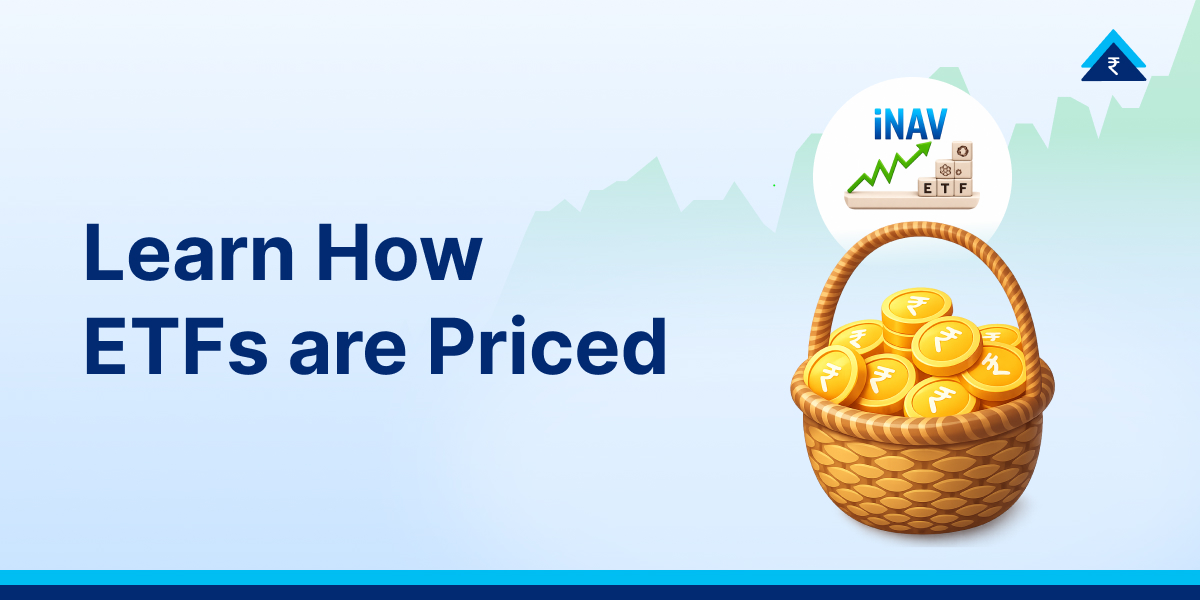
- iNAV (Indicative NAV): the real-time estimated value during market hours.
A Cafe Analogy To Make It Click
Picture an ETF as a small café selling three items. At the end of the day, the café totals up the cost of its products.
| Product | Price |
|---|---|
| Bread | ₹50 per-piece |
| Coffee | ₹60 per-cup |
| Cake | ₹100 per-piece |
| Total | ₹210 |
That ₹210 represents the actual value of the offerings, much like the NAV of an ETF.
Now, costs do not sit still. The price of electricity, milk and sugar shifts during the day, so the café’s estimated value also nudges up and down (say, ₹205, then ₹215). This continuous, intraday update is the iNAV of an ETF, the real-time estimated value during market hours, based on the changing prices of its underlying holdings.
But what if the café suddenly becomes the talk of the town and customers queue around the block? The owner might charge a bit extra. The same thing happens with ETFs:
- Premium: when the ETF price is higher than the NAV (high demand, buyers willing to pay more).
- Discount: when the ETF price is lower than the NAV (low demand, buyers expecting a price cut).
A Closer Look At How iNAV Is Calculated
ETF investing has long been praised for its transparency. Mutual funds have provided NAV figures for decades, but only once a day. That is not nearly often enough for ETF investors who trade throughout the session. iNAV fills that gap.
iNAV gives an intraday indicative value of an ETF based on the current market values of its underlying holdings. It is calculated and disseminated by the exchange or a designated calculation agent, and updated at frequent intervals during market hours. In India, SEBI requires AMCs to disclose iNAV for ETFs on a near-real-time basis throughout the trading day (for equity ETFs roughly every 15 seconds).
The calculation starts with something called the calculation basket, a basket of securities that represents a shareholder’s residual ownership in the fund’s holdings. In short, it reflects the value of a single ETF share.
Here is the basic process:
- The calculation agent multiplies the last available price of each security in the basket by the number of shares of that security in the basket.
- The totals for all securities are added together.
- Cash components are added in.
- Liabilities are subtracted.
- The final figure is divided by the number of ETF shares in a creation unit to arrive at a “per share” value.
That number is the iNAV, a handy reference point whenever you are weighing up an intraday trade. As a rule of thumb, paying substantially more than iNAV or selling for substantially less is generally not advisable.
It is worth noting that iNAV has its limitations too. For instance, it relies on the last available prices of the underlying securities, which may themselves be slightly stale in fast-moving or thinly traded markets. It is also an indicative figure, not the official NAV, so small differences between iNAV and the day-end NAV are normal.
Note On Tracking Error: Premium and discount are about how the ETF’s market price compares to its NAV on a given day. Tracking error is a different idea. It measures how closely the ETF’s returns follow the returns of the index or benchmark it is meant to replicate, over a period of time. A well-managed ETF will usually have a low tracking error. The two concepts are related but distinct, and it is worth checking both before choosing an ETF.
Why Are NAV And iNAV Important?
Experienced investors treat NAV and iNAV as a compass for fair pricing. They help answer one straightforward question: “Am I paying the right price for this ETF?”
Without these numbers, you are essentially relying on the market price alone, which may or may not reflect the true value of what you are buying.
Where Can You Check The NAV And iNAV Of An ETF?
The good news is that this information is freely available.
| Metric | Where To Find It |
|---|---|
| NAV | Declared by the AMC at the end of the day. Available on the AMC’s website, your broker’s platform, or with a quick Google search. |
| iNAV | Available on the NSE website, where AMCs send updates on a periodic basis. |
Conclusion
NAV and iNAV will not tell you whether an ETF is going to rise or fall tomorrow. What they do tell you is exactly what it is worth right now. That is a powerful piece of information for any investor.
So the next time you are about to click “buy” on an ETF, pause for a moment and ask yourself: are you trusting the market price blindly, or are you checking the NAV and iNAV to see what the ETF is truly worth before making your move?
Understanding the ETF pricing concepts can help investors make more informed ETF investment decisions. These values generally move closely together, but monitoring them regularly can help you avoid paying significantly above fair value or selling below it.
Disclaimer: Investments in the securities market are subject to market risks, read all the related documents carefully before investing. This content is purely for information purpose only and in no way to be considered as an advice or recommendation. The securities are quoted as an example and not as a recommendation.
Investors are requested to do their own due diligence before investing. Paytm Money Ltd SEBI Reg No. Broking – INZ000240532, Depository Participant – IN – DP – 416 – 2019, Depository Participant Number: CDSL – 12088800, NSE (90165), BSE (6707) Regd Office: 136, 1st Floor, Devika Tower, Nehru Place, Delhi – 110019. For complete Terms & Conditions and Disclaimers visit: https://www.paytmmoney.com/stocks/policies/terms .