


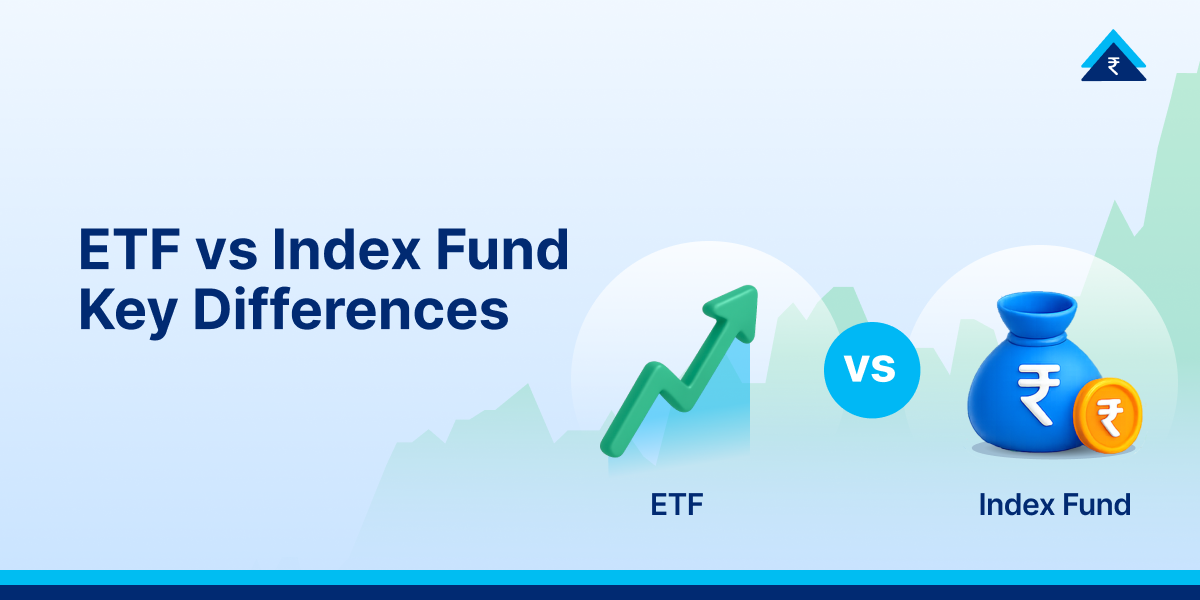
Two investments can track the exact same index, hold the exact same shares, and still leave you with different costs, different taxes and a different day-to-day experience. Welcome to the quiet confusion of ETFs and index funds.
- What Is an Index Fund?
- What Is an ETF?
- The Core Difference Between ETF and Index Fund
- Breaking the ETF vs Index Fund Comparison Down
- ETF vs Mutual Fund vs Index Fund: Clearing the Confusion
- Which Is Better, ETF or Index Fund?
- Index Fund vs ETF Returns and Safety
- Nifty ETF vs Nifty Index Fund
- So, Should You Invest in ETF or Index Fund?
- Conclusion
- FAQs
Most of us simply do not have the time to sit and watch the markets all day, and between work, family and everything else, tracking share prices feels like a full-time job on its own. That is exactly why passive investing has become so popular. You hand your money to a structure that quietly tracks the market for you, and you get on with your life.
Two options dominate this space: index funds and exchange-traded funds (ETFs). They sound almost identical, and in many ways they are. But the small differences between them trip up a surprising number of people. So if you have ever wondered about ETF or Index Fund as your starting point, this guide breaks it down in plain language.
What Is an Index Fund?
An index fund is a type of mutual fund that aims to copy a popular market benchmark, such as the Nifty 50 or the Sensex. Instead of a manager trying to pick winning stocks, the fund simply holds the same shares as the index, in roughly the same proportion.
The goal is straightforward: match the market rather than beat it. When the index rises, your fund rises with it. When the index falls, your fund falls too. There is no magic shield against losses, but you do get broad diversification and returns that closely follow the wider market.
Index investing in India has grown quickly because it is simple and low maintenance. A few quick characteristics:
- It is usually an open-ended scheme, so you can invest or redeem when it suits you.
- Many funds offer both growth and dividend options.
- Expense ratios are low compared with actively managed funds, though slightly higher than most ETFs.
What Is an ETF?
An ETF tracks an index in much the same way, but it trades on the stock exchange like an ordinary share. That means the price moves throughout the day, and you can buy or sell whenever the market is open.
ETF investing in India has its own flavour. You will need a demat and trading account, and prices shift in real time based on supply and demand. There are several types worth knowing about, including bond ETFs, commodity ETFs, currency ETFs and sector-specific ETFs.
Quick characteristics of ETFs:
- Lower expense ratios, but you pay brokerage and other trading costs.
- High transparency, so you can usually see exactly what the fund holds.
- Liquidity depends on market activity, so thinly traded ETFs can be harder to buy or sell at a fair price.
The Core Difference Between ETF and Index Fund
If you remember one thing, remember this. ETFs trade on the exchange like stocks at live prices, while index funds are bought and sold directly from the fund house at the end-of-day NAV (net asset value).
Here is a side-by-side view of the ETF and Index Fund difference:
| Feature | ETF | Index Fund |
|---|---|---|
| Trading | On the stock exchange, live prices | Through the fund house, once a day |
| Account needed | Demat and trading account | No demat required |
| Pricing | Real-time market price | End-of-day NAV |
| SIP option | Manual or broker-supported | Direct SIP available |
| Liquidity | Depends on market activity | Redeemable directly through the AMC |
| Costs | Lower expense ratio plus brokerage and spread | Slightly higher expense ratio |
| Tracking error | Generally lower (varies by fund) | Slightly higher (varies by fund) |
| Minimum investment | 1 unit | ₹100 to ₹500 (varies by fund) (AMC-defined minimum investment amount.) |
Breaking the ETF vs Index Fund Comparison Down
- Trading and liquidity. This is the heart of the ETF vs Index Fund liquidity debate. ETFs can be traded any time during market hours, which lets you react to price moves. Index funds are processed once a day at NAV, which is less flexible but also far simpler. You redeem index funds straight from the fund house without worrying about market depth.
- Costs. On ETF vs Index Fund costs, ETFs usually win on the expense ratio. The catch is that brokerage, taxes and the bid-ask spread can quietly add up. Index funds look slightly pricier on paper, yet they carry no hidden trading costs.
- Taxation. ETF vs Index Fund taxation is worth a closer look. Because of how ETFs are structured, you generally pay capital gains tax only on the units you actually sell. Index funds, being mutual funds, can pass on capital gains events to investors. This can make ETFs marginally more tax-efficient for some people, though your own tax situation matters.
- Tracking error. ETFs tend to track an index a little more tightly because they hold less cash. Index funds may show a slightly higher tracking error as they manage inflows and outflows.
ETF vs Mutual Fund vs Index Fund: Clearing the Confusion
People often muddle these three. A mutual fund is the broad family. An index fund is a mutual fund that passively tracks an index rather than being actively managed. An ETF also tracks an index, but it lists and trades on the exchange. So in the ETF vs Mutual Fund vs Index Fund picture, index funds and ETFs are both passive cousins within the wider mutual fund world.
Which Is Better, ETF or Index Fund?
There is no single right answer, and anyone who tells you otherwise is overselling. For ETF vs Index Fund for beginners, simplicity usually wins. For active types who enjoy timing their entries, ETFs hold appeal.
An ETF may suit you if:
- You already have a demat account.
- You want the lowest possible expense ratio.
- You like trading during the day.
- You understand the gap between price and NAV.
An index fund may suit you if:
- You want a simple, hands-off setup.
- You prefer automating a monthly SIP.
- You would rather not watch the market daily.
- You are focused on long-term investing.
Index Fund vs ETF Returns and Safety
On Index Fund vs ETF returns, the honest position is that over long periods they tend to land fairly close together. ETFs can hold a slight edge thanks to lower costs and tighter tracking, but the gap is usually small and not guaranteed.
On safety, both carry similar risk because both follow the same index. ETFs may feel slightly more volatile due to intraday price swings, while index funds price only at the close. For a long-term holder, that difference is often minor.
Nifty ETF vs Nifty Index Fund
A common real-world question. A Nifty ETF and a Nifty index fund both track the Nifty 50, so their underlying exposure is nearly identical. The choice usually comes down to whether you want live trading and a demat account (the ETF route) or a simple SIP with the index fund route.
So, Should You Invest in ETF or Index Fund?
When weighing the best passive investment options in India, match the tool to your habits. If you want flexibility, lower ongoing costs and active control, ETFs make sense. If you value automation, discipline and a buy-and-hold approach, index funds may be worth considering. Passive investing in India works either way, so the real question is which style fits your life, not which one is universally superior.
Conclusion
The mistake most investors make is treating ETF or Index Fund as a battle with a clear winner. It is not. Both track the same indices, both spread your risk across many companies, and both keep costs low. The difference between an ETF and an index fund is really about how you want to invest, not how much you stand to earn.
If you would rather set up a SIP, look away and let it run, an index fund quietly does its job. If you like a demat account, live prices and squeezing costs as low as they go, an ETF rewards that involvement. Be honest about how hands-on you actually are, pick the one that matches, and then leave it alone. In passive investing, the discipline to stay invested usually matters far more than the label on the fund.
Disclaimer: Investments in the securities market are subject to market risks. Read all the related documents carefully before investing. This content is purely for informational purposes only and should not be considered as investment advice or a recommendation. Securities quoted are for illustration purposes only and not recommendatory. Investors are requested to do their own due diligence before investing.
Paytm Money Ltd. SEBI Reg. No. Broking – INZ000240532; Depository Participant – IN – DP – 416 – 2019, Depository Participant Number: CDSL – 12088800. Trading and clearing member of NSE (90165, M52073), BSE (6707), MCX (57525), NCDEX (1315, M51110), and MSEI (85300). SEBI Reg. No. Research Analyst – INH000020086. Regd. Office: 136, 1st Floor, Devika Tower, Nehru Place, Delhi – 110019. For complete Terms & Conditions and Disclaimers visit: https://www.paytmmoney.com/stocks/policies/terms