


Ever wished you could own a slice of India’s fifty biggest companies without buying fifty different shares? That is exactly what a diversified ETF portfolio lets you do. If you are new to ETF investing, the idea of picking winning stocks can feel overwhelming, and honestly, even seasoned professionals get it wrong.
- What Are ETFs?
- One ETF, 50 Companies: Why Diversification Matters
- Types of ETFs Available in India
- Step-by-Step Guide to Building Your ETF Portfolio
- Sample ETF Portfolio Models
- Criteria for Selecting ETFs
- Tax Considerations for Indian ETF Investors
- Common Mistakes to Avoid
- How to Invest in ETFs on Paytm Money
- Conclusion
- FAQs
The good news? You do not need to be a stock-picking genius. With a handful of exchange-traded funds, you can spread your money across markets, sectors and asset classes in minutes. Let us walk through how to build one, step by step.
What Are ETFs?
Exchange-traded funds (ETFs) are investment funds that hold a basket of securities, such as stocks, bonds, or commodities, and trade on stock exchanges like the NSE and BSE throughout market hours, just like individual shares. Most ETFs follow a passive investment strategy by tracking an underlying index, such as the Nifty 50 or Sensex, which generally results in lower expense ratios than actively managed mutual funds. ETF holdings are typically disclosed daily, and investors need both a demat and a trading account to buy or sell ETF units.
ETF investing works by pooling money from investors to create a portfolio of securities that tracks a specific index or investment objective. The ETF units are listed and traded on stock exchanges, with their market price changing throughout the trading day based on demand and supply. To help keep the ETF’s market price close to its underlying Net Asset Value (NAV), authorised participants create or redeem ETF units by exchanging baskets of the underlying securities with the Asset Management Company (AMC).
One ETF, 50 Companies: Why Diversification Matters
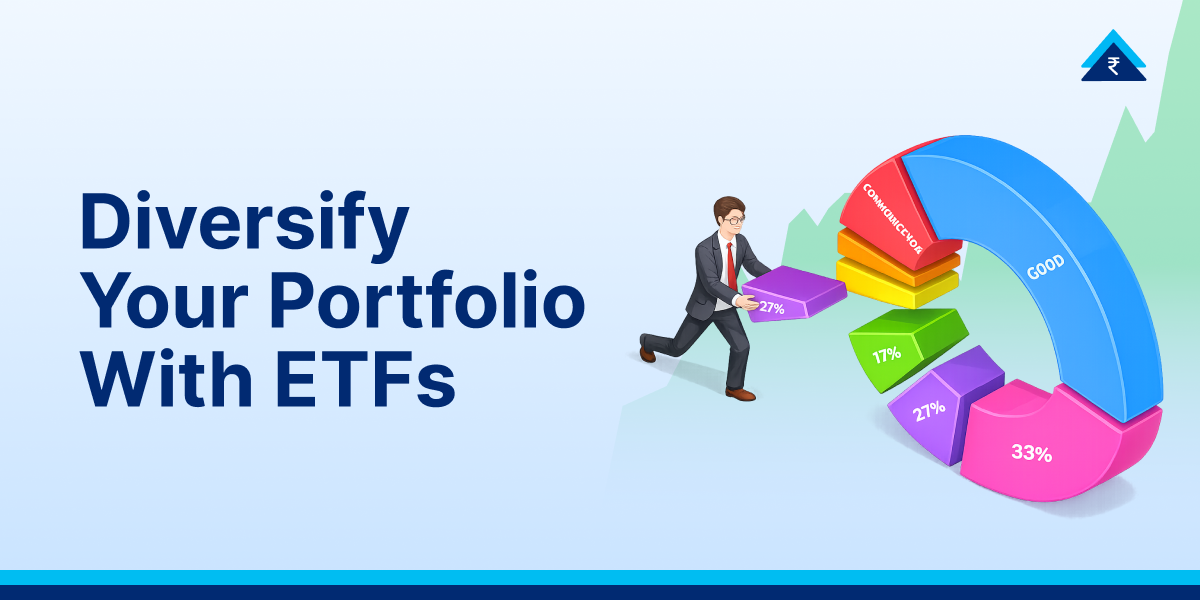
Portfolio diversification means spreading investments across asset classes, sectors and geographies so that no single setback sinks your entire portfolio. It is the classic wisdom of not putting all your eggs in one basket. When one holding stumbles, gains elsewhere can cushion the blow, lowering overall volatility.
ETFs make this remarkably easy. Buy a single Nifty 50 ETF and you instantly own exposure to fifty companies across energy, technology, healthcare and more. Correlation is the secret ingredient here. Stocks in the same sector often rise and fall together, while high-quality bonds frequently move independently of equities, and commodities such as gold and silver tend to have low or negative correlation with both. Blending assets that do not move in lockstep is what gives a diversified ETF portfolio its stability, especially during inflationary spells or downturns.
Diversification also adapts to your goals. Capital preservation may call for 60 to 70 percent in debt ETFs, balanced growth suits a 50/50 or 60/40 equity-bond mix, and long-term wealth building can lean 80 to 90 percent towards equity ETFs.
Types of ETFs Available in India
Indian investors can choose from several categories:
| ETF Type | Description |
|---|---|
| Equity ETFs | Track equity indices such as the Nifty 50, Sensex, Nifty Next 50, Nifty Midcap 150, and smart beta indices. |
| Debt ETFs | Invest in government securities, treasury bills, SDLs, PSU bonds, or corporate bonds. |
| Gold ETFs | Track the domestic price of physical gold. |
| Silver ETFs | Track the domestic price of physical silver. |
| Commodity ETFs | Currently, India primarily offers gold and silver ETFs. Broad commodity ETFs are still limited. |
| Sectoral and Thematic ETFs | Focus on sectors such as Banking, IT, Pharma, PSU, Infrastructure, Consumption, ESG, Manufacturing, Defence, etc. |
| International ETFs | Track overseas indices or invest in international ETFs, such as the S&P 500, NASDAQ-100, Hang Seng, or Nikkei 225. |
Step-by-Step Guide to Building Your ETF Portfolio
- Step 1: Define your investment goals: Long-term goals of 15 plus years can handle more equity risk, while shorter horizons of 3 to 5 years need caution.
- Step 2: Choose an asset allocation strategy: An aggressive approach may hold 70 to 90 percent equities, a balanced one roughly 50 to 60 percent equity ETFs with 40 to 50 percent in bonds, and a conservative one over 60 percent in debt ETFs.
- Step 3: Select ETFs for each asset class: Prioritise high liquidity, low expense ratios and minimal tracking error. Use a broad market ETF as your core, then add global, sectoral, bond and gold ETFs around it.
- Step 4: Decide weightings by risk profile: Younger investors may go 80 to 90 percent equity and 10 to 20 percent bonds; middle-aged investors might prefer 60 percent equity, 35 percent bonds and 5 percent alternatives; those nearing retirement can hold 60 to 70 percent in bonds.
- Step 5: Rebalance periodically: Review annually or semi-annually, or whenever an asset class drifts 10 percent or more from its target.
- Step 6: Monitor and adjust with life changes: Shift gradually from equities to fixed income as goals approach.
Sample ETF Portfolio Models
| Allocation | Conservative | Balanced | Aggressive |
|---|---|---|---|
| Large-cap / Broad Market Equity ETF | 30% Nifty 50 ETF | 35% Nifty 50 ETF | 30% Nifty 50 ETF |
| Mid & Small-cap Equity ETF | – | 15% Midcap 150 ETF | 20% Midcap 150 ETF + 10% Smallcap 250 ETF |
| Debt ETF | 50% | 25% | – |
| Gold ETF | 10% | 10% | 10% |
| International ETF | 10% | 15% | 15% |
| Sectoral/Thematic ETF | – | – | 15% |
Note: The allocations and ETF categories shown above are illustrative examples for educational purposes only. They are not investment recommendations and may not be suitable for every investor. Asset allocation should be based on an investor’s financial goals, risk tolerance, and investment horizon.
Criteria for Selecting ETFs
When comparing ETFs, consider these key factors before investing:
- Liquidity and Trading Volume: Choose ETFs with higher average daily trading volumes, as they are generally easier to buy and sell. Higher liquidity also tends to result in narrower bid-ask spreads, reducing your overall trading costs.
- Impact Cost: Impact cost refers to the additional cost you may incur when buying or selling an ETF due to low market liquidity. ETFs with lower impact costs usually provide smoother trade execution, especially for larger transactions.
- Tracking Error: Tracking error measures how closely an ETF replicates the performance of its underlying index. A lower tracking error indicates that the fund is more effectively tracking its benchmark.
- Total Expense Ratio (TER): The expense ratio is the annual fee charged by the fund to manage your investment. When comparing ETFs that track the same index, a lower TER can help improve long-term returns by reducing investment costs.
Tax Considerations for Indian ETF Investors
- Equity ETFs: Short-term capital gains (holding period of up to one year) are taxed at 20%.
- Long-term capital gains on Equity ETFs: Gains above ₹1.25 lakh in a financial year are taxed at 12.5%; the first ₹1.25 lakh is exempt.
- Gold ETFs: Capital gains on units held for up to 12 months are taxed at the investor’s applicable income tax slab. Gains on units held for more than 12 months are taxed at 12.5% without indexation.
- Debt ETFs: Capital gains are taxed according to the investor’s applicable income tax slab, regardless of the holding period.
- Capital loss set-off: Capital losses can be carried forward for up to eight assessment years, subject to the provisions of the Income-tax Act.
- Dividend taxation: Any dividends received from ETFs are taxed according to the investor’s applicable income tax slab rate.
Common Mistakes to Avoid
- Avoid over-diversification, since owning too many overlapping funds dilutes returns.
- Do not chase past performance, as yesterday’s winners rarely repeat on cue.
- Never ignore liquidity and hidden costs like wide spreads, and do not skip rebalancing, or your risk profile will quietly drift.
How to Invest in ETFs on Paytm Money
- Log in to your Paytm Money App.
- Navigate to the ETFs tab under the Invest & Trade section.
- Browse ETF categories such as Equity, Gold, Debt, and Global.
- Select an ETF that aligns with your financial goals and investment strategy.
- Choose your investment option by selecting Buy for a one-time investment or Start SIP for regular investing.
- If you choose Buy, select your preferred order type, such as Delivery, Intraday, or MTF, and place your order.
- If you choose Start SIP, enter your investment amount, choose your preferred SIP frequency, and confirm your mandate.
- Track your investments anytime from your Paytm Money portfolio dashboard.
(Source: Paytm Money App)
Conclusion
A diversified ETF portfolio is designed to build wealth gradually, not deliver overnight returns. Start with a simple portfolio, invest consistently, and give your investments time to compound over the long term. The key is to start with a portfolio that matches your financial goals and risk appetite, review it periodically, and remain consistent through market ups and downs. Over time, disciplined investing and the power of compounding can do far more for your wealth than trying to time the market.
Ready to put your ETF investing plan into action? With Paytm Money, you can explore a wide range of ETFs across equity, debt, gold, silver and global markets, invest through a one-time purchase or SIP, and manage your entire portfolio from a single platform. Building wealth is rarely about finding the perfect investment. It is about staying invested in the right portfolio for long enough to let compounding work in your favour.
Disclaimer: Investments in the securities market are subject to market risks. Read all the related documents carefully before investing. This content is purely for informational purposes only and should not be considered as investment advice or a recommendation. Securities quoted are for illustration purposes only and not recommendatory. Investors are requested to do their own due diligence before investing.
Paytm Money Ltd. SEBI Reg. No. Broking – INZ000240532; Depository Participant – IN – DP – 416 – 2019, Depository Participant Number: CDSL – 12088800. Trading and clearing member of NSE (90165, M52073), BSE (6707), MCX (57525), NCDEX (1315, M51110), and MSEI (85300). SEBI Reg. No. Research Analyst – INH000020086. Regd. Office: 136, 1st Floor, Devika Tower, Nehru Place, Delhi – 110019. For complete Terms & Conditions and Disclaimers visit: https://www.paytmmoney.com/stocks/policies/terms