

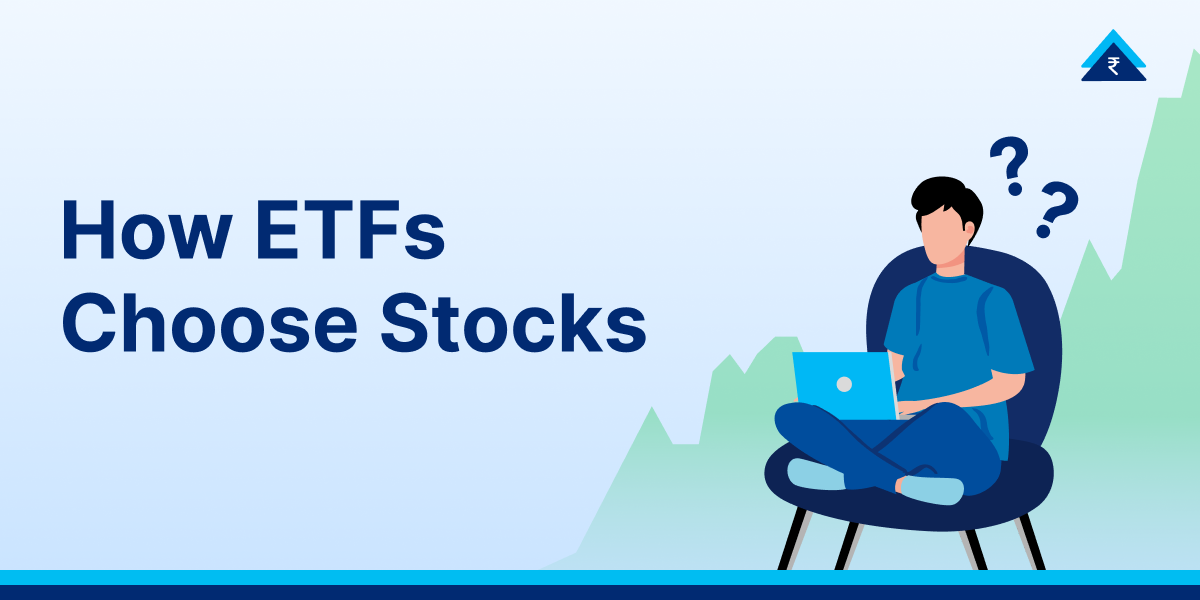
Imagine this scenario. You buy a Nifty 50 ETF on your trading app, and a few months later you notice a new company has quietly appeared in the portfolio while another has vanished. You never approved it. Your fund manager never called you. So who exactly is pulling the strings? It is a fair question, and the answer surprises most people. The stocks inside an exchange traded fund in India are not chosen by the fund manager, and certainly not by the asset management company’s star analysts. The real decision makers sit somewhere else entirely. Let us unpack how ETF stock selection in India actually works, who the key players are, and why the process is far more rules-based than you might imagine.
- The Short Answer: The Index Provider, Not the Fund Manager
- Three Key Players in ETF Stock Selection in India
- How the Index Provider Picks Stocks: The Nifty 50 Example
- Rebalancing: When Stocks Enter and Exit
- So What Does the Fund Manager Actually Do?
- SEBI: The Referee Watching the Watchmen
- What This Means for You as an Investor
- Conclusion
- FAQs
The Short Answer: The Index Provider, Not the Fund Manager
An ETF in India is a passive investment vehicle. It simply mirrors an underlying index, such as the Nifty 50 or the Sensex, by holding the same stocks in the same proportions. According to official investor guidance, the fund manager has no role in deciding which shares are bought for a Nifty or Sensex ETF. The constituents of the index are decided and changed periodically by the index provider, and the ETF must follow along.
In other words, ETF stock selection in India happens one level above the fund itself. The index is the recipe; the ETF is merely the dish cooked from it.
Three Key Players in ETF Stock Selection in India
| Player | Who They Are | What They Decide |
|---|---|---|
| Index provider | NSE Indices Limited (a wholly owned NSE subsidiary) for Nifty indices; BSE’s index arm for the Sensex family | Which stocks enter or exit the index, and at what weight |
| Asset management company (AMC) | Fund houses such as SBI, Nippon India, ICICI Prudential and others | Which index to track, expense ratio, and day-to-day replication of the index |
| SEBI | The market regulator | The rulebook: disclosure norms, tracking error limits, and now the governance of index providers themselves |
The Nifty 50, for instance, is owned and managed by NSE Indices Limited, which follows a published, rules-based methodology. A professional team and a multi-tier governance structure oversee index decisions, so no single individual can slip a favourite stock into the benchmark.
(Source: NSE)
How the Index Provider Picks Stocks: The Nifty 50 Example
The selection process is refreshingly mechanical. To be eligible for the Nifty 50, a company generally needs to clear these filters:
- Universe: It must already be part of the Nifty 100 and be available for trading in the NSE Futures and Options segment.
- Liquidity: It should have traded at an average impact cost of 0.50 percent or less for 90 percent of observations over the last six months, for a portfolio of ₹10 crore.
- Trading frequency: 100 percent over the previous six months.
- Size: Its average free-float market capitalisation should be at least 1.5 times that of the smallest existing constituent.
- Listing history: A minimum listing history of one month as on the cut-off date.
Weights are then assigned using the free-float market capitalisation method, which counts only shares genuinely available for public trading. The Nifty 50 captures roughly two-thirds of the NSE’s float-adjusted market capitalisation, according to the index methodology document, which is why it is treated as the pulse of the Indian stock market.
Rebalancing: When Stocks Enter and Exit
Index composition is not frozen. Here is the typical Nifty 50 rebalancing calendar:
| Step | Detail |
|---|---|
| Review frequency | Twice a year (semi-annual) |
| Data cut-off dates | 31 January and 31 July |
| Data considered | Average data for the six months ending the cut-off |
| Implementation | Last trading day of March and September |
| Market notice | Four weeks before the change |
| Annual cap on additions | A maximum of about 10 percent of constituents, meaning up to five companies in a calendar year |
When the index changes, every ETF tracking it must buy the incoming stock and sell the outgoing one. That is why index inclusion often moves share prices even before the change takes effect. Ad-hoc changes can also happen outside the schedule, for instance after mergers, delistings or suspensions.
So What Does the Fund Manager Actually Do?
Plenty, just not stock picking. The AMC decides which index its ETF will track, keeps the portfolio aligned with the index, manages inflows and outflows, and works to minimise tracking error, which is the gap between the ETF’s returns and the index’s returns. Under SEBI’s passive fund norms. SEBI requires equity ETFs and index funds to maintain tracking error within the prescribed regulatory limits and disclose it daily. For debt ETFs and index funds, the annualised tracking difference averaged over one year must stay within 1.25 percent.
AMCs must also appoint at least two market makers to provide liquidity on the exchange, and any change in index constituents has to be disclosed on the AMC website on the very day it happens.
SEBI: The Referee Watching the Watchmen
For years, index providers operated without a dedicated regulatory framework, even though their decisions steer enormous sums of money. That has changed. Under the SEBI Index Providers Regulations, 2024, providers administering “significant indices” must register with SEBI, with the rules taking effect from 6 May 2026. An index is treated as significant if mutual fund schemes tracking it hold an average daily cumulative AUM of more than ₹20,000 crore.
The scale explains the urgency. The ETF segment reportedly crossed ₹10 lakh crore in AUM by October 2025, with around 260 ETFs available to investors. Gold ETFs pulled in ₹24,040 crore in January 2026 alone. Separately, from 1 April 2026, the base expense ratio cap for index funds and ETFs was reportedly lowered from 1 percent to 0.90 percent, trimming costs further.
What This Means for You as an Investor
- Transparency: The stock selection rules are public. You can read the exact methodology before you invest.
- No manager bias: ETF stock selection in India is formula-driven, so personal opinions cannot creep into your portfolio.
- Predictable churn: Changes arrive on a known calendar, with four weeks of notice.
- Compare wisely: Since all ETFs on the same index hold identical stocks, your real comparison points are expense ratio, tracking error and liquidity.
Conclusion
So, who decides which stocks go into an ETF in India? The index provider writes the rules and applies them, the AMC faithfully copies the result, and SEBI supervises both. Your fund manager is a disciplined follower, not a stock picker, and in the world of passive investing, that is precisely the point.
Disclaimer: Investments in the securities market are subject to market risks. Read all the related documents carefully before investing. This content is purely for informational purposes only and should not be considered as investment advice or a recommendation. Securities quoted are for illustration purposes only and not recommendatory. Investors are requested to do their own due diligence before investing.
Paytm Money Ltd. SEBI Reg. No. Broking – INZ000240532; Depository Participant – IN – DP – 416 – 2019, Depository Participant Number: CDSL – 12088800. Trading and clearing member of NSE (90165, M52073), BSE (6707), MCX (57525), NCDEX (1315, M51110), and MSEI (85300). SEBI Reg. No. Research Analyst – INH000020086. Regd. Office: 136, 1st Floor, Devika Tower, Nehru Place, Delhi – 110019. For complete Terms & Conditions and Disclaimers visit: https://www.paytmmoney.com/stocks/policies/terms