


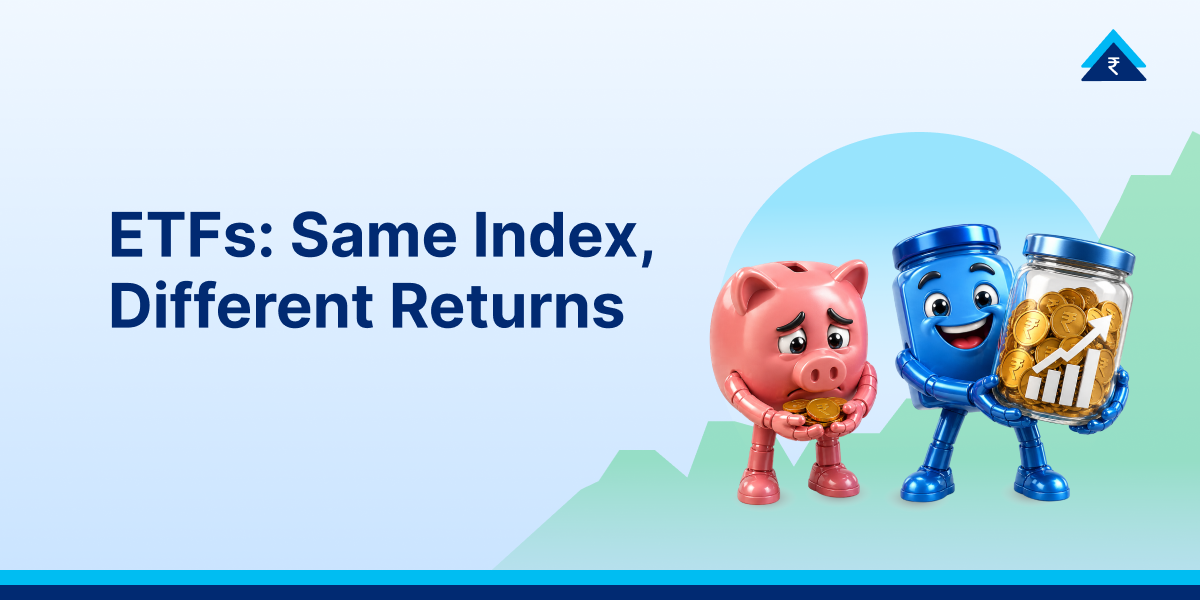
Have you ever lined up two funds that follow the very same benchmark, expected identical numbers, and then scratched your head when the returns did not match? You are not alone. On paper, every product that mirrors the Nifty 50 or the S&P BSE Sensex should hand you the same gain. In practice, the figures rarely line up perfectly. So what is quietly happening behind the curtain? Let us unpack why ETFs tracking the same index can still finish the year in different places, and what that means for your money.
- Same Index, Different Returns: The Puzzle
- What Causes the Difference?
- 1. Expense Ratio
- 2. Tracking Error
- 3. Portfolio Composition and Replication Strategy
- 4. Trading Mechanics
- 5. Liquidity
- Quick Comparison of the Key Factors
- The Factor You Control: Your Own Behaviour
- How to Pick the Better Fund
- Conclusion
- FAQs
Same Index, Different Returns: The Puzzle
Every fund linked to a single benchmark, whether Nifty 50 or Sensex, is designed to deliver that benchmark’s return. Two products following the S&P BSE Sensex should, in an ideal world, post the same yearly gain as the Sensex itself. Yet reality tells a different story.
Take the HDFC Index Fund Sensex Plan and the ICICI Prudential Sensex Index Fund. Both shadow the same 30-share index, and both tend to report slightly different figures. The gaps are usually small, but across asset management companies they can add up over time. So even ETFs tracking the same index are not carbon copies of one another.
(Source: HDFC MF and ICICI Prudential MF)
What Causes the Difference?
Several moving parts explain why ETFs tracking the same index drift apart. Here are the main ones, one by one.
1. Expense Ratio
Running a passive fund is not free. The fund house pays a manager to buy the index constituents and covers admin, record-keeping and customer support. These costs reach you as the total expense ratio (TER). SEBI caps the TER for index funds and ETFs, and from 1 April 2026 that base ceiling was set at 0.90% of assets, revised down from the earlier 1% (though part of that change is a reclassification of statutory levies rather than a straight cut). Either way, even a fraction of a percentage point compounds over the years, so a cheaper fund quietly edges ahead of a pricier twin.
2. Tracking Error
Tracking error is the gap between the fund’s return and the benchmark’s return, and a lower tracking error is preferable. NIFTY BeES defines it as the standard deviation of the difference between the daily returns of the underlying index and the scheme’s NAV. Why does it creep in? A fund manager cannot invest the entire corpus in exactly the same proportion as the index.
Schemes hold some cash to meet redemptions, deal with dividends and corporate actions, absorb their own fees, and adjust whenever the index is reshuffled or a regulatory limit bites. Each of these nudges returns away from the benchmark.
3. Portfolio Composition and Replication Strategy
Even passive funds sometimes sample the index rather than hold every single stock, and small differences in weightings matter. Picture two firms, A and B, in one sector. One fund puts 30% of its money in A and 70% in B, while another splits it evenly at 50-50. If A’s stock outperforms B’s, the two funds end the year with different returns despite chasing the same theme. When several funds track the same sector, how they slice their resources becomes decisive.
4. Trading Mechanics
ETFs trade on stock exchanges throughout the day at market prices, while index mutual funds are bought and redeemed only at the end-of-day NAV. During periods of high market volatility, an ETF’s trading price may temporarily trade at a small premium or discount to its NAV. Although this affects the price at which investors buy or sell units, it does not necessarily affect the fund’s long-term tracking performance.
5. Liquidity
ETFs with higher trading volumes generally have narrower bid-ask spreads, making it easier for investors to buy and sell units close to their underlying value. Less liquid ETFs may trade with wider spreads, increasing transaction costs and affecting an investor’s realised returns, even when both ETFs track the same index.
Quick Comparison of the Key Factors
| Factor | What it does | Effect on returns |
|---|---|---|
| Expense ratio (TER) | Annual fee charged by the fund; SEBI base cap of 0.90% for index funds and ETFs from 1 April 2026 | Lower cost improves net returns over time |
| Tracking error | Measures how closely the ETF follows its benchmark, influenced by cash holdings, fees, corporate actions, and rebalancing | Lower tracking error is preferable |
| Portfolio composition & replication | Differences in stock weightings or use of full replication versus sampling | Can create small variations in returns |
| Trading mechanics | ETFs trade throughout the day, while index funds transact at end-of-day NAV | Can affect the price investors buy or sell at |
| Liquidity | Trading volume and bid-ask spread in the ETF | Higher liquidity helps reduce transaction costs and improves execution |
The Factor You Control: Your Own Behaviour
Here is a driver that has nothing to do with the fund itself, namely you. Morningstar’s research on thematic products, titled The Big Shortfall, found that thematic ETF investors suffered return gaps of up to 500 to 600 basis points versus mutual funds, largely because of poorly timed trades.
Because ETFs can be bought and sold at any moment through the day, investors tend to chase performance, buying high and selling low. Since these ETFs also hold more concentrated, more volatile baskets, the damage from bad timing is amplified. It is a useful reminder that with ETFs tracking the same index, your habits can matter as much as the fund’s fine print.
How to Pick the Better Fund
When you are choosing between ETFs tracking the same index, a few simple checks tilt the odds in your favour:
- Compare the TER first: A lower expense ratio is one of the most reliable long-term advantages.
- Study the tracking error: Compare it across several periods, not just one strong year.
- Check the ETF’s liquidity: Higher trading volumes and narrower bid-ask spreads can help you buy and sell closer to the ETF’s underlying value.
- Trade sparingly: Avoid frequent buying and selling, as poor timing can reduce your realised returns.
Conclusion
So, why do two ETFs tracking the same index deliver different returns? The short answer is that tracking an index is rarely a perfect process. Factors such as expense ratios, tracking error, portfolio composition, trading mechanics, liquidity, and even your own investing behaviour can create small differences in returns over time.
While these gaps are usually modest, they can compound over the long term. When choosing between similar ETFs, look beyond the benchmark and compare costs, tracking efficiency, and liquidity. Then stay invested with discipline and let long-term compounding work in your favour.
Disclaimer: Investments in the securities market are subject to market risks. Read all the related documents carefully before investing. This content is purely for informational purposes only and should not be considered as investment advice or a recommendation. Securities quoted are for illustration purposes only and not recommendatory. Investors are requested to do their own due diligence before investing.
Paytm Money Ltd. SEBI Reg. No. Broking – INZ000240532; Depository Participant – IN – DP – 416 – 2019, Depository Participant Number: CDSL – 12088800. Trading and clearing member of NSE (90165, M52073), BSE (6707), MCX (57525), NCDEX (1315, M51110), and MSEI (85300). SEBI Reg. No. Research Analyst – INH000020086. Regd. Office: 136, 1st Floor, Devika Tower, Nehru Place, Delhi – 110019. For complete Terms & Conditions and Disclaimers visit: https://www.paytmmoney.com/stocks/policies/terms