


Sustainable investing is no longer just a niche concept. It is becoming a mainstream conversation among Indian investors. If you have ever wondered whether your investments can generate returns while also contributing to a better world, ESG funds in India may be worth exploring.
- What Are ESG Funds in India?
- Growth of ESG Funds in India
- Top ESG Mutual Funds by 5-Year CAGR
- Types of ESG Funds in India
- Benefits of ESG Funds in India
- Risks of ESG Funds in India
- ESG Funds vs Traditional Funds
- Taxation of ESG Mutual Funds
- Who Should Invest in ESG Funds?
- How to Choose the Right ESG Fund
- Key Things to Keep in Mind
- Investment Strategy for ESG Funds
- Conclusion
- FAQs
From climate change concerns to corporate governance issues, investors today are looking beyond just profits. But do ESG mutual funds really deliver on returns? And what risks should you be aware of? Let’s break it down in a simple and structured way.
What Are ESG Funds in India?
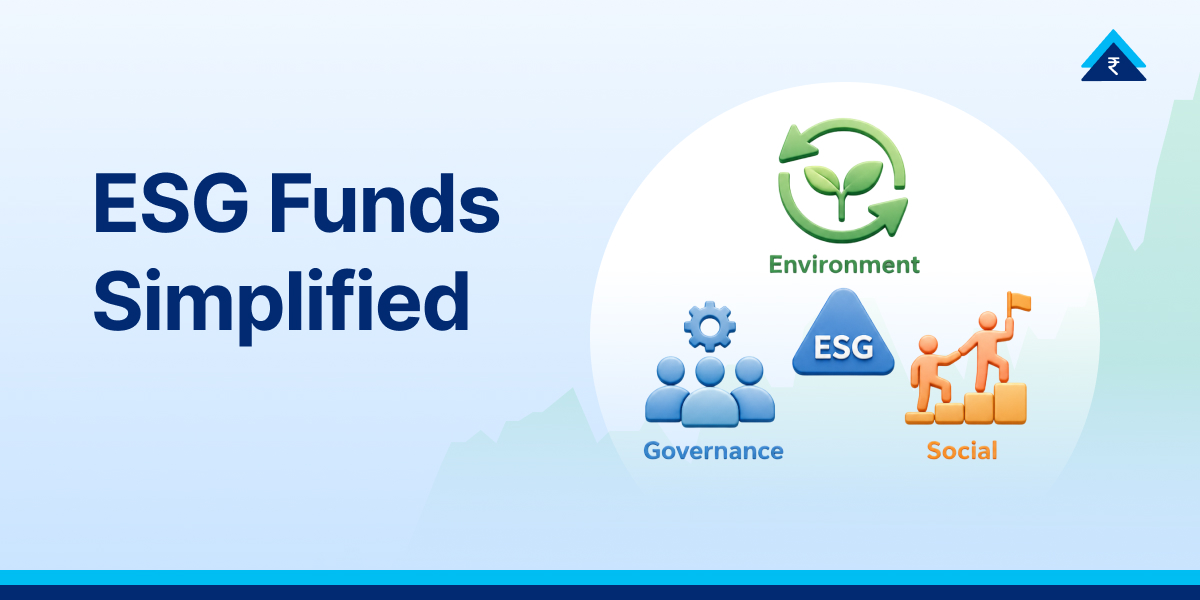
ESG funds in India are mutual funds that invest in companies based on three key factors:
- Environmental (E): Carbon emissions, waste management, resource usage
- Social (S): Employee welfare, diversity, community impact
- Governance (G): Transparency, ethical practices, regulatory compliance
These funds aim to balance financial returns with responsible investing.
While ESG investing is growing rapidly, most ESG mutual funds in India are relatively new. This means long-term performance data is still limited, making careful evaluation important.
Growth of ESG Funds in India
India’s sustainable investing space is gaining strong momentum.
- Green financing projects worth ₹31,000 crore are planned for FY27
- This marks an increase of nearly one-third compared to FY26 estimates
- Around 86% of asset owners are increasing allocations towards sustainable investments
This trend shows that ESG funds in India are becoming an important part of the financial ecosystem.
(Source: The Economic Times, IBEF)
Top ESG Mutual Funds by 5-Year CAGR
| Mutual Fund Name (Direct Plan – Growth) | 5-Year CAGR (%) | AUM (₹ Cr) | Expense Ratio (%) |
|---|---|---|---|
| Quant ESG Integration Strategy Fund | 20.82 | 225.60 | 0.93 |
| ICICI Pru ESG Exclusionary Strategy Fund | 13.86 | 1,246.18 | 1.06 |
| Aditya Birla SL ESG Integration Strategy Fund | 12.53 | 521.59 | 1.41 |
| SBI ESG Exclusionary Strategy Fund | 12.34 | 4,810.38 | 1.37 |
| Invesco India ESG Integration Strategy Fund | 11.29 | 348.40 | 1.14 |
| Kotak ESG Exclusionary Strategy Fund | 11.09 | 709.25 | 0.93 |
| Quantum ESG Best In Class Strategy Fund | 10.34 | 83.11 | 0.75 |
| Mirae Asset Nifty 100 ESG Sector Leaders FoF | 10.13 | 78.84 | 0.44 |
| Axis ESG Integration Strategy Fund | 9.33 | 1,006.49 | 1.40 |
(Source: Moneycontrol, Value Research)
Note: The data is as of April 27, 2026, and pertains to Direct Plan variants of the funds. Past performance may or may not be sustained in the future, and returns are subject to market risks and change.
Types of ESG Funds in India
Regulators have introduced multiple ESG categories, giving investors flexibility:
- Exclusion Strategy: Avoids companies with poor ESG practices
- Integration Strategy: Combines ESG factors with financial analysis
- Best-in-Class: Invests in ESG leaders within sectors
- Impact Investing: Focuses on measurable social or environmental outcomes
- Sustainable Objectives: Targets specific sustainability goals
- Transition Strategy: Supports companies moving towards ESG compliance
Additionally, ESG schemes must invest at least 80% of AUM in equity and related instruments aligned with their strategy.
Benefits of ESG Funds in India
- Invests in companies that focus on environmental and social responsibility
- Reduces risk by selecting companies with strong governance practices
- Helps diversify investments across sectors using ESG criteria
- Offers potential for long-term sustainable growth
- Supports positive environmental and social impact
Risks of ESG Funds in India
- Short-term returns may be lower compared to traditional funds
- Investments may be concentrated in specific sectors like renewable energy
- Changes in ESG regulations can impact fund performance
- Limited track record as most ESG funds in India are relatively new
- Higher expense ratios may reduce overall returns
- Declining investor interest may lead to capital outflows
ESG Funds vs Traditional Funds
| Feature | ESG Funds | Traditional Funds |
|---|---|---|
| What they focus on | Companies that are responsible and sustainable, along with profits. | Companies mainly chosen for financial profits and growth. |
| How they manage risk | Evaluates ethical practices, regulatory compliance, and sustainability risks. | Focuses primarily on market volatility and financial performance risks. |
| Return approach | Aims for steady, resilient long-term growth. | Often focuses on capitalizing on quick returns and market cycles. |
| Overall impact | Intended positive impact on society and the environment. | Limited focus on social or environmental consequences. |
Taxation of ESG Mutual Funds
Tax rules for ESG funds are the same as equity mutual funds:
- Short-Term Capital Gains (STCG): 20% (holding period < 12 months)
- Long-Term Capital Gains (LTCG): 12.5% (above ₹1.25 lakh, holding period > 12 months)
Who Should Invest in ESG Funds?
ESG funds in India might be suitable for:
- Investors with a long-term investment horizon
- Those comfortable with moderate to high risk
- Investors who value ethical and sustainable investing
- Individuals who understand ESG concepts and limitations
How to Choose the Right ESG Fund
- Check the fund’s strategy to see whether it excludes certain sectors, integrates ESG factors, or focuses on impact-driven investments.
- Review the portfolio to understand which sectors and companies the fund invests in and how well it fits your overall portfolio.
- Compare the expense ratio, as lower costs can help improve your net returns over time.
- Look at the ESG scores of the underlying companies to assess how well they follow sustainability and governance practices.
- Evaluate past performance against benchmarks and peers to understand how consistently the fund has performed.
Key Things to Keep in Mind
- ESG funds require a long-term perspective
- Diversification remains important
- Returns depend on both market performance and ESG compliance
- Align investments with your financial goals and values
Investment Strategy for ESG Funds
To make the most of ESG investing:
- Allocate only a portion of your portfolio to ESG funds
- Combine ESG funds with diversified equity funds
- Stay invested for at least 5 to 7 years
- Review fund performance periodically
This balanced approach helps manage risk while benefiting from sustainable growth trends.
Conclusion
ESG funds in India offer a unique blend of financial returns and responsible investing. While they may not always outperform in the short term, they provide exposure to companies focused on long-term sustainability.
However, they are not a one-size-fits-all solution. Investors must weigh returns, risks, and personal values before investing.
If your goal is to build wealth while supporting sustainable practices, ESG mutual funds can be a meaningful addition to your portfolio.
Disclaimer: Mutual fund investments are subject to market risks. Read all the related documents carefully before investing. This content is purely for information purpose only and in no way is to be considered as an advice or recommendation. The securities are quoted as an example and not as a recommendation. Investors are requested to do their own due diligence before investing.
SEBI Reg No.: Broking – INZ000240532, Research Analyst – INH000020086, Depository Participant – IN-DP-416-2019, Depository Participant Number: CDSL – 12088800, NSE (90165), BSE (6707), MCX (57525), NCDEX (1315), MSEI (85300).
Registered Office: 136, 1st Floor, Devika Tower, Nehru Place, Delhi – 110019.
For complete Terms & Conditions and Disclaimers, visit https://www.paytmmoney.com.