


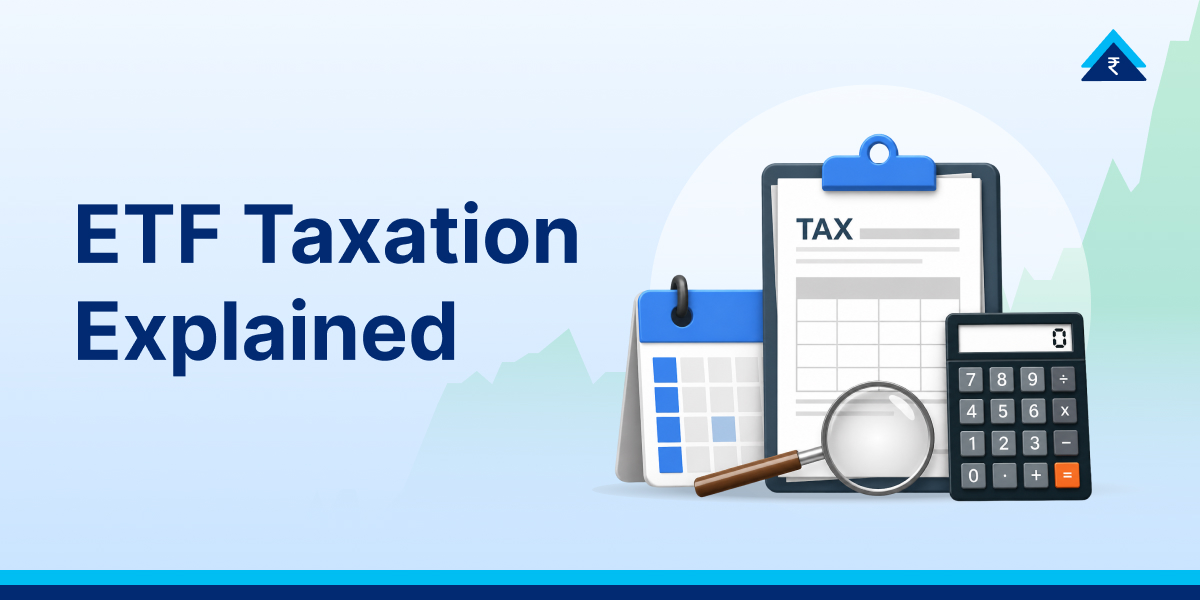
If you have started investing in ETFs, understanding how they are taxed is just as important as choosing the right fund. The returns you earn are not always the returns you keep, because taxes can take a bite out of your gains. The good news is that ETF taxation is not as complicated as it may seem.
However, recent changes introduced after the Union Budget 2024 have altered the tax treatment of several ETF categories. In this guide, we explain how equity, gold, silver, debt, and international ETFs are taxed in India, using simple language and practical examples.
What Is an ETF?
An Exchange Traded Fund (ETF) is simply a basket of assets that trades on a stock exchange, much like a single share. It can track an index such as the Nifty 50, or a commodity such as gold or silver. The big appeal is flexibility: you can buy or sell units any time the market is open, exactly as you would with a stock. Because ETFs are publicly listed, their holding periods and tax treatment differ from those of ordinary mutual funds.
How Are ETFs Taxed in India?
ETF taxation in India now depends on what the fund actually holds, whether that is equity, debt, gold or silver. The July 2024 Budget brought in separate holding periods and tax rates for each category. Here is the quick view.
| ETF Category | Underlying Asset | Holding Period for LTCG | STCG | LTCG |
|---|---|---|---|---|
| Equity ETF | ≥65% domestic equity | >12 months | 20% (Sec 111A) | 12.5% above ₹1.25 lakh exemption (Sec 112A) |
| Gold/Silver ETF | Physical gold or silver | >12 months | Slab rate | 12.5% without indexation |
| Debt ETF (bought after 1 Apr 2023) | >65% debt and money market | Not applicable | Slab rate | Slab rate (Sec 50AA) |
| International ETF (India-listed) | Foreign equities/indices | >12 months (post FY 2025-26) | Slab rate | 12.5% without indexation |
Note: Surcharge and cess apply on top of these rates. This information is based on rules reported for FY 2025-26 and may change with future budgets. Tax treatment of international ETFs may vary depending on fund structure and applicable tax provisions. Investors should verify the latest rules applicable to the specific ETF.
Equity ETFs
Equity ETFs are treated on par with equity mutual funds. Sell within 12 months and your short-term gains are taxed at a flat 20% (raised from the earlier 15%). Hold for more than 12 months and long-term gains are taxed at 12.5%, but the first ₹1.25 lakh of long-term gains across all your equity assets in a financial year is exempt.
Gold and silver ETFs
These got a friendlier deal. The holding period to qualify as long-term is now 12 months. Short-term gains are taxed at your slab rate, while long-term gains are taxed at 12.5% without indexation. Note that the ₹1.25 lakh exemption does not apply here; that benefit is reserved for equity-oriented funds.
Debt ETFs
A debt ETF puts more than 65% of its money into debt and money market instruments. For units bought on or after 1 April 2023, gains are treated as short-term regardless of how long you hold them, under Section 50AA. The whole gain is added to your income and taxed at your slab rate, with no separate long-term benefit.
Dividend Taxation on ETFs
Many ETFs, especially equity ones, pay dividends. You can choose a pay-out option (the dividend lands in your account periodically) or a reinvestment option (it is ploughed back in). Either way, the dividend is taxable at your applicable slab rate. TDS of 10% kicks in once your dividend income crosses ₹10,000 in a financial year.
A common slip-up is assuming reinvested dividends are tax-free; they are not. Report dividend income under “Income from other sources” in Schedule OS. The field exists in all forms (ITR-1 to ITR-4), so dividends alone rarely decide which form you pick. For international ETFs, a Resident and Ordinarily Resident (ROR) must also report this income in Schedule FSI, and disclose the investment in Schedule FA (foreign assets).
Securities Transaction Tax (STT)
Every security traded on an exchange attracts STT, and ETFs are no exception. The seller pays STT at 0.001% of the transaction value, and it is not deductible when working out capital gains. STT matters for another reason too: the beneficial rates under Sections 111A and 112A (20% and 12.5%) apply to equity-oriented funds only when STT has been paid.
Your broker usually deducts and remits it automatically, but it is worth confirming STT was charged on every equity ETF trade so you qualify for those lower rates.
How to Set Off ETF Capital Losses
Losses from selling ETFs can be set off against capital gains from other assets. The rules are tidy: a long-term capital loss can only be set off against long-term gains, while a short-term capital loss can be set off against both short-term and long-term gains. Any unused loss can be carried forward for up to 8 assessment years, provided you file your return by the due date. Some investors use tax-loss harvesting to trim taxable gains, but tread carefully, as overly aggressive harvesting can invite scrutiny and notices.
How to Report ETF Gains in Your ITR
Capital gains from ETFs go into Schedule CG of the ITR. The right form depends on your holding period, the fund’s equity orientation and the size of your gains. A critical rule to remember is that if you sell any ETF units and generate capital gains, even if your long-term equity ETF gains stay within the exempt ₹1.25 lakh limit, you cannot use ITR-1. You will need to file your returns using ITR-2.
Remember too that if you want to carry forward losses, ITR-1 is not an option. Do claim all transfer-related expenses (except STT), such as brokerage, clearing charges and SEBI turnover fees, since these reduce your taxable gains. In some cases, deducting these costs correctly can even bring your gains within the ₹1.25 lakh exempt limit.
ETF Taxation for NRIs
If you are an NRI, tax on your ETF income is mostly collected through TDS, meaning it is deducted at source before the money reaches you. The rates below follow the capital gains framework set out by the Income Tax Department, and they apply on a gross basis (no expense deductions for dividends). Remember too that indexation is no longer available on assets sold on or after 23 July 2024.
| Nature of ETF income | Rate for NRIs |
|---|---|
| STCG on equity ETFs (STT paid, Sec 111A) | 20% |
| LTCG on equity ETFs (STT paid, Sec 112A), on gains above ₹1.25 lakh | 12.5% |
| LTCG on gold, silver and other non-equity ETFs (Sec 112) | 12.5% (no indexation) |
| STCG on gold, silver, debt and other non-equity ETFs | Normal slab rates |
| Dividend income (TDS under Sec 196A/195) | 20% (gross) |
Surcharge and cess apply on top of all the rates above. Where a Double Taxation Avoidance Agreement (DTAA) between India and your country of residence offers a lower rate, the treaty rate prevails, but you must hold a valid Tax Residency Certificate to claim that benefit.
If more TDS has been deducted than you actually owe, you can claim the excess back as a refund by filing your income tax return in India. And the reinvestment exemptions under Sections 54 to 54GB are open to non-residents as well as residents, subject to the usual conditions, so an NRI sitting on a large long-term gain may have room to plan around it.
(Source: Income Tax Department)
Conclusion
Getting ETF taxation in India right is the difference between guessing your tax bill and knowing it. Your liability hinges on three things: the type of ETF, how long you held it, and the nature of your gains. Keep clean records of your purchase and sale details, stay aware of the current rates, and you will file accurately while keeping more of your returns. When a specific transaction looks unclear, a quick word with a tax professional is money well spent.
Disclaimer: Investments in the securities market are subject to market risks. Read all the related documents carefully before investing. This content is purely for informational purposes only and should not be considered as investment advice or a recommendation. Securities quoted are for illustration purposes only and not recommendatory. Investors are requested to do their own due diligence before investing.
Paytm Money Ltd. SEBI Reg. No. Broking – INZ000240532; Depository Participant – IN – DP – 416 – 2019, Depository Participant Number: CDSL – 12088800. Trading and clearing member of NSE (90165, M52073), BSE (6707), MCX (57525), NCDEX (1315, M51110), and MSEI (85300). SEBI Reg. No. Research Analyst – INH000020086. Regd. Office: 136, 1st Floor, Devika Tower, Nehru Place, Delhi – 110019. For complete Terms & Conditions and Disclaimers visit: https://www.paytmmoney.com/stocks/policies/terms