

If you’re exploring derivatives, one of the first questions you’ll encounter is what is F&O Trading. Futures and Options (F&O) are widely used instruments in the Indian stock market that allow traders to take positions on price movements without buying or selling shares outright.
In this guide, we explain what F & O trading is, how it works, simple examples, and key concepts every beginner should understand before getting started.
What is F&O Trading?
F&O trading refers to trading in Futures and Options contracts, which are derivative instruments whose value is derived from an underlying asset such as stocks, indices, or commodities.
In simple terms:
- You trade contracts, not the actual shares
- Prices are based on an underlying asset
- Contracts have a fixed expiry date
This is why F&O trading often focuses on contracts, margins, and expiry rather than delivery of shares.
In India, F&O trading takes place on recognised exchanges such as the National Stock Exchange of India (NSE) and Bombay Stock Exchange (BSE), under defined rules and position limits.
Understanding Futures and Options
To fully understand f and o trading, it’s important to know how futures and options differ.
Futures Contracts
A futures contract is an agreement to buy or sell an underlying asset at a predetermined price on a future date. Both the buyer and seller are obligated to honour the contract at expiry.
Futures are commonly used for:
- Taking directional positions
- Hedging existing investments
- Short-term trading strategies
Options Contracts
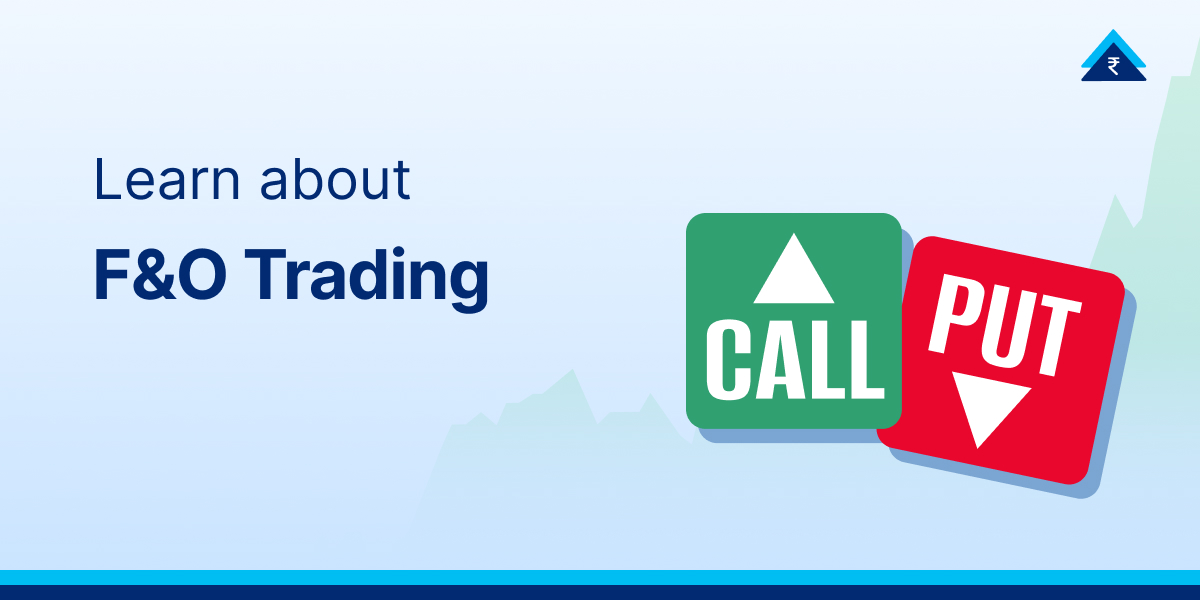
Options give the buyer the right, but not the obligation, to buy or sell an asset at a specified price before or on expiry.
There are two types of options:
- Call option: Right to buy
- Put option: Right to sell
This flexibility is a key reason many traders explore F&O trading as part of their market journey.
How Does F&O Trading Work?
Here’s a simplified view of how what is F&O trading works in practice:
- You choose an underlying asset (stock or index)
- Select a futures or options contract with a specific expiry
- Pay margin (for futures) or premium (for options)
- Take a position based on expected price movement
- Exit, square off, or let the contract expire
Unlike cash market trading, profits and losses in F&O trading are marked to market daily, which means margins and risk management play a critical role.
Example of F&O Trading
Let’s look at a simple example to understand F&O trading explained:
- A stock is trading at ₹1,000
- You expect the price to rise
- You buy a futures contract at ₹1,000
If the price moves to ₹1,050:
- You gain ₹50 per share (subject to lot size)
If the price falls:
- Losses are adjusted from your margin balance
This example shows how f and o trading allows traders to benefit from price movements without owning the stock.
Why Do Traders Use F&O Trading?
Traders use f&o trading for multiple reasons:
- To Hedge Portfolio risk
- To trade with lower capital compared to cash market
- To benefit from both rising and falling markets
- To manage short-term market exposure
However, higher leverage also means higher risk, which is why understanding what is F&O trading is essential before starting.
Things to Keep in Mind Before Trading F&O
Before you begin:
- Understand margin requirements
- Track open positions and risk exposure
- Know that losses can exceed initial margin
- Be aware of expiry dates. Options lose value with time. Even if the price stays unchanged, your premium may become zero on expiry
F&O trading requires discipline, planning, and a clear understanding of how contracts work.
The F&O Trader’s Toolkit
As you prepare to enter the F&O segment, having the right technology at your fingertips is as important as having a strategy. Professional traders rely on advanced features to manage the complexity of derivatives:
- Options Scalper: For high-speed entry and exits.
- Trade from Charts: To execute directly from your technical analysis.
- Market Radar & Screeners: To filter noise and find high-probability setups.
- Trade from Charts: Speed up your reaction time by executing F&O trades directly from your technical analysis charts without switching screens.
These tools allow you to move from understanding what F&O trading is to executing data-driven strategies with speed and clarity.
Start Your F&O Journey With Confidence
Now that you understand what F & O trading is, how futures and options work, and why traders use them, you’re better equipped to explore derivatives responsibly.
Start F&O trading on Paytm Money and access a platform designed to help you trade with clarity and control.
Disclaimer: Investment in the securities market is subject to market risks. Read all the related documents carefully before investing. This content is purely for information purpose only and in no way is to be considered as an advice or recommendation. The securities are quoted as an example and not as a recommendation. Investors are requested to do their own due diligence before investing.
SEBI Reg No.: Broking – INZ000240532, Research Analyst – INH000020086, Depository Participant – IN-DP-416-2019, Depository Participant Number: CDSL – 12088800, NSE (90165), BSE (6707), MCX (57525), NCDEX (1315), MSEI (85300).
Registered Office: 136, 1st Floor, Devika Tower, Nehru Place, Delhi – 110019.
For complete Terms & Conditions and Disclaimers, visit https://www.paytmmoney.com.