


Somewhere along the way, “just buy a Nifty 50 ETF” became the single most repeated piece of investing advice in India. And it’s actually good advice, but most people following it have no idea why. They buy the ETF, watch it move, and assume they understand how ETFs track the market, without really knowing what is happening underneath.
- What is an ETF?
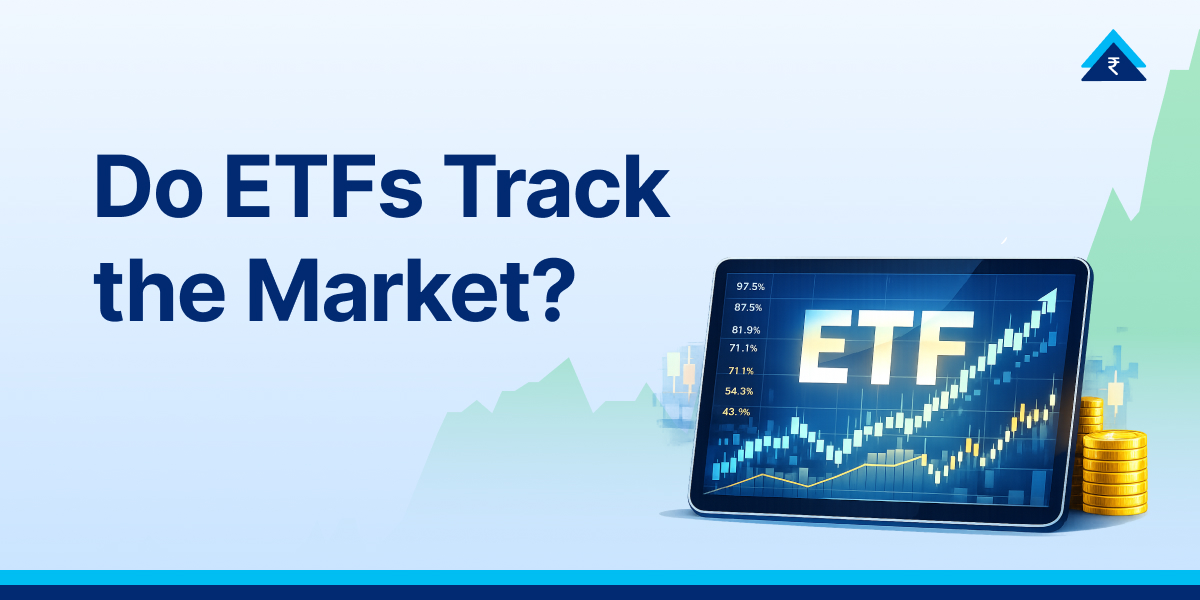
- How ETFs Track the Market?
- Step 1: The Index Is the Blueprint
- Step 2: The Fund House Buys the Underlying Stocks
- Step 3: The Price Moves With the Index
- ETF vs Mutual Fund: The Key Difference
- What is NAV and Market Price in an ETF?
- The Creation and Redemption Mechanism (Simply Explained)
- What is Tracking Error — and Why Should You Care?
- Types of ETFs You Will Come Across in India
- Equity ETFs
- Gold ETFs
- Debt ETFs
- International ETFs
- Sectoral ETFs
- How to Invest in ETFs in India
- ETF vs Index Fund: Which Is Better for Beginners?
- Key Things to Check Before Buying an ETF
- Conclusion
- FAQs
They watch it move with the market. They assume something automatic is happening.
They never ask the next question: how? How does a fund that nobody is actively managing somehow mirror 50 stocks simultaneously? How does the ETF price on your screen stay in sync with what those 50 stocks are actually worth? And why do two Nifty 50 ETFs (tracking the exact same index) sometimes give slightly different returns?
The answers to these questions are what separate an investor who holds an ETF from one who truly understands passive investing in India. This guide explains exactly how ETFs track the market, the mechanics, the math, and what to actually look for before you invest. Let’s get into it.
What is an ETF?
ETF stands for Exchange Traded Funds. Think of it as a basket of stocks that you can buy and sell on the stock exchange, just like a single share.
Here is a simple analogy. Imagine the Nifty 50 index is a thali (a full Indian meal) with 50 different dishes. Each dish is a different company — Reliance, HDFC Bank, Infosys, TCS, and so on. Buying a Nifty 50 ETF is like buying that entire thali in one go, instead of ordering 50 separate dishes.
That one purchase gives you a slice of all 50 companies, in the exact proportion they appear in the index.
This is the core idea: an ETF holds the same securities, in the same weights, as the index it is designed to track.
How ETFs Track the Market?
This is the question most beginners never get a clear answer to. Let us break it down step by step.
Step 1: The Index Is the Blueprint
Every ETF is designed to mirror a specific index. Common examples in India include:
- Nifty 50 — Top 50 companies by market cap on NSE
- Sensex — Top 30 companies on BSE
- Nifty Next 50 — The 51st to 100th largest companies
- Nifty Bank — Top banking stocks
The index has a set of rules: which stocks to include, in what proportion, and when to rebalance. The ETF simply follows those rules.
Step 2: The Fund House Buys the Underlying Stocks
When an ETF is launched by an Asset Management Company (AMC) like HDFC, SBI, or Nippon India, the fund house goes out and buys all the stocks in the index — in exactly the same proportion as the index.
So if HDFC Bank makes up 12% of the Nifty 50, the ETF holds 12% of its portfolio in HDFC Bank shares. If Reliance is 10%, the ETF holds 10% in Reliance. And so on.
The ETF then issues units that represent a small slice of this portfolio. You buy those units on the stock exchange.
Step 3: The Price Moves With the Index
As the market moves, the value of the underlying stocks changes. If the Nifty 50 goes up 1% on a given day, the value of all those stocks in the ETF portfolio goes up approximately 1% too. The ETF’s price on the exchange reflects this change, almost in real time.
This is how the ETF tracks the market, by holding the exact same stocks in the same weights.
ETF vs Mutual Fund: The Key Difference
Many beginners confuse ETFs with regular mutual funds. Here is the simplest way to understand the difference:
| Feature | ETF | Mutual Fund |
|---|---|---|
| Traded on exchange? | Yes, like a stock | No, through AMC/platform |
| Price updates | Real-time during market hours | Once a day (end-of-day NAV) |
| Demat account needed? | Yes | No (for regular MFs) |
| Expense ratio | Generally lower | Slightly higher |
| Who manages it? | Passively managed (follows index) | Actively or passively managed |
The big practical difference: when you buy a mutual fund, you get today’s NAV (Net Asset Value) regardless of when you place the order. When you buy an ETF, you buy it at whatever price it is trading at that exact moment on the exchange — just like buying a share of Infosys.
What is NAV and Market Price in an ETF?
Here is something that confuses a lot of new ETF investors.
An ETF has two prices:
- NAV (Net Asset Value): This is the actual value of all the underlying stocks in the ETF, divided by the number of units. It is calculated once at the end of each trading day.
- Market Price: This is the price at which the ETF is being bought and sold on the stock exchange at any given moment. It is driven by supply and demand.
In a well-functioning ETF, the market price stays very close to the NAV. If it drifts too far — say the ETF is trading at a premium or discount to its NAV — a special group of players called Authorised Participants (APs) step in to bring the price back in line. They do this through a mechanism called creation and redemption.
The Creation and Redemption Mechanism (Simply Explained)
This is the engine that keeps ETF prices accurate. Here is how it works:
- If the ETF is trading above its NAV (at a premium), Authorised Participants buy the underlying stocks, exchange them with the AMC for new ETF units, and sell those units on the exchange. This brings the ETF price back down.
- If the ETF is trading below its NAV (at a discount), Authorised Participants buy ETF units from the market, return them to the AMC, and receive the underlying stocks in exchange. This pushes the ETF price back up.
You do not need to do any of this. This process happens behind the scenes. As a retail investor, you simply buy or sell ETF units on your broker app, just like any stock.
What is Tracking Error — and Why Should You Care?
No ETF tracks its index perfectly. The small gap between an ETF’s actual returns and the index it follows is called tracking error.
Tracking error can happen because of:
- Fund management costs (expense ratio)
- Cash held by the fund that is not yet invested
- Transaction costs when stocks are added or removed from the index
- Dividend reinvestment timing
A lower tracking error is better. It means the ETF is doing a more accurate job of following the index.
When comparing two Nifty 50 ETFs, tracking error is one of the most important things to check alongside the expense ratio. Even a seemingly small difference in tracking error can affect your long-term returns.
Types of ETFs You Will Come Across in India
ETFs are not limited to just large-cap stocks. Here is a quick overview of the main types:
Equity ETFs
These track stock market indices. The most popular ones in India track the Nifty 50, Sensex, Nifty Next 50, and Nifty Bank.
Gold ETFs
These track the price of physical gold. One unit of a Gold ETF typically represents 1 gram of gold. It is a convenient way to invest in gold without worrying about storage.
Debt ETFs
These hold government bonds or corporate bonds. The Bharat Bond ETF series is a popular example in India, offering relatively stable, fixed-income returns.
International ETFs
Some ETFs allow you to invest in overseas markets, like the US S&P 500, through Indian exchanges.
Sectoral ETFs
These track a specific sector — banking, pharma, IT, infrastructure — useful if you have a view on a particular industry.
How to Invest in ETFs in India
Investing in an ETF requires three things:
- A Demat account — unlike mutual funds, you cannot buy ETFs without one
- A trading account — to place buy and sell orders on the exchange
- Knowing the ETF ticker — each ETF has a unique symbol, like NIFTYBEES, GOLDBEES, BANKBEES, etc.
On Paytm Money, you can search for ETFs directly, view the ETF’s NAV, expense ratio, and tracking error, and invest in a few taps. You can also start a SIP in select ETFs, making it easier to invest systematically without timing the market.
ETF vs Index Fund: Which Is Better for Beginners?
Both ETFs and index funds follow the same index. The difference is structural.
Index funds are like regular mutual funds — you invest through an AMC, there is no need for a Demat account, and the price is settled once a day. ETFs trade like stocks, which means you need a Demat account and you can buy at live market prices.
For most beginners in India, index funds are simpler to start with if you do not already have a Demat account. If you do have a trading account, ETFs give you real-time flexibility and often a marginally lower expense ratio.
Neither is wrong. Both give you the same underlying exposure to the index.
Key Things to Check Before Buying an ETF
Before investing, always look at:
- Expense Ratio — lower is better; even 0.1% difference matters over 10–15 years
- Tracking Error — how closely does the ETF follow its index?
- AUM (Assets Under Management) — higher AUM generally means better liquidity
- Liquidity/Trading Volume — an ETF with low trading volume can have a wide gap between buy and sell prices (bid-ask spread), making it expensive to trade
Conclusion
An ETF tracks the market by holding the exact same stocks as its benchmark index, in the exact same proportions. Its price moves with the index, is kept in check by the creation and redemption mechanism, and is passively managed, which keeps costs low.
For a beginner investor in India, a simple Nifty 50 or Nifty Next 50 ETF is one of the most transparent, low-cost ways to get started with equity investing. You are not betting on any one company or fund manager, you are simply buying a piece of India’s economy.
Start small, keep costs low, and stay invested for the long term. That is the ETF philosophy in three lines and a simple way of understanding how ETFs track the market.
Disclaimer: Investment in the securities market is subject to market risks. Read all the related documents carefully before investing. This content is purely for information purpose only and in no way is to be considered as an advice or recommendation. The securities are quoted as an example and not as a recommendation. Investors are requested to do their own due diligence before investing.
SEBI Reg No.: Broking – INZ000240532, Research Analyst – INH000020086, Depository Participant – IN-DP-416-2019, Depository Participant Number: CDSL – 12088800, NSE (90165), BSE (6707), MCX (57525), NCDEX (1315), MSEI (85300).
Registered Office: 136, 1st Floor, Devika Tower, Nehru Place, Delhi – 110019.
For complete Terms & Conditions and Disclaimers, visit https://www.paytmmoney.com.