


Market volatility is a given in the world of equity investing. While deep red portfolios can cause panic among novice investors, seasoned market participants often view red screens as a landscape of opportunity. When the broader market undergoes a correction, high-quality stocks frequently trade at discounted valuations. This scenario gives rise to one of the most popular investment strategies: “buying the dip.”
- What Does “Buying the Dip” Actually Mean?
- Understanding Margin Trading Facility (MTF-Pay Later)
- Why Use MTF During Market Corrections?
- Strategic Approaches to Buying the Dip with MTF
- Focus on Fundamentally Strong Stocks
- Avoid Catching a Falling Knife
- Employ Staggered Buying
- Have a Clear Exit and Repayment Strategy
- Risks and Essential Precautions
- How to Use MTF on Paytm Money
- Conclusion
- FAQs
However, spotting a great opportunity during a dip is only half the battle. Often, investors find themselves fully invested with little to no idle cash to deploy when the market suddenly corrects. This is where a Margin Trading Facility (MTF-Pay Later) can serve as a powerful financial bridge.
To learn about Paytm Money’s MTF-Pay Later, watch:
By understanding how to use MTF strategically, you can capitalise on market downturns without having to liquidate your existing long-term portfolio. Let’s dive deep into how you can effectively combine the “buy the dip” philosophy with MTF to potentially enhance your wealth-creation journey.
Market Correction – A market correction is generally defined as a decline of 10% or more in the price of a security, asset, or financial market from its most recent peak. It is considered a normal, healthy part of market cycles.
What Does “Buying the Dip” Actually Mean?
At its core, buying the dip refers to purchasing an asset after it has experienced a drop in price. The fundamental belief driving this strategy is that the price decline is a temporary aberration and that the asset will eventually rebound and continue its upward trajectory.
Imagine a fundamentally strong company that has consistently grown its revenue and profits. If broader macroeconomic fears—such as a sudden change in interest rates or temporary geopolitical tensions—cause its stock price to fall by 15%, the intrinsic value of the company hasn’t necessarily changed. Buying the dip allows you to acquire shares of this robust business at a “sale” price. When the market inevitably recovers, investors who bought at the lower price stand to make substantial gains, essentially lowering their average cost of acquisition and boosting their long-term return on investment (ROI).
Intrinsic Value – The perceived or calculated true value of an asset, investment, or company, based on fundamental analysis of its financials, regardless of its current market price.
Understanding Margin Trading Facility (MTF-Pay Later)
While buying the dip sounds great in theory, liquidity is a practical hurdle. You might spot a fantastic buying opportunity but lack the immediate funds to execute the trade. This is exactly where the Margin Trading Facility (MTF) comes into play.
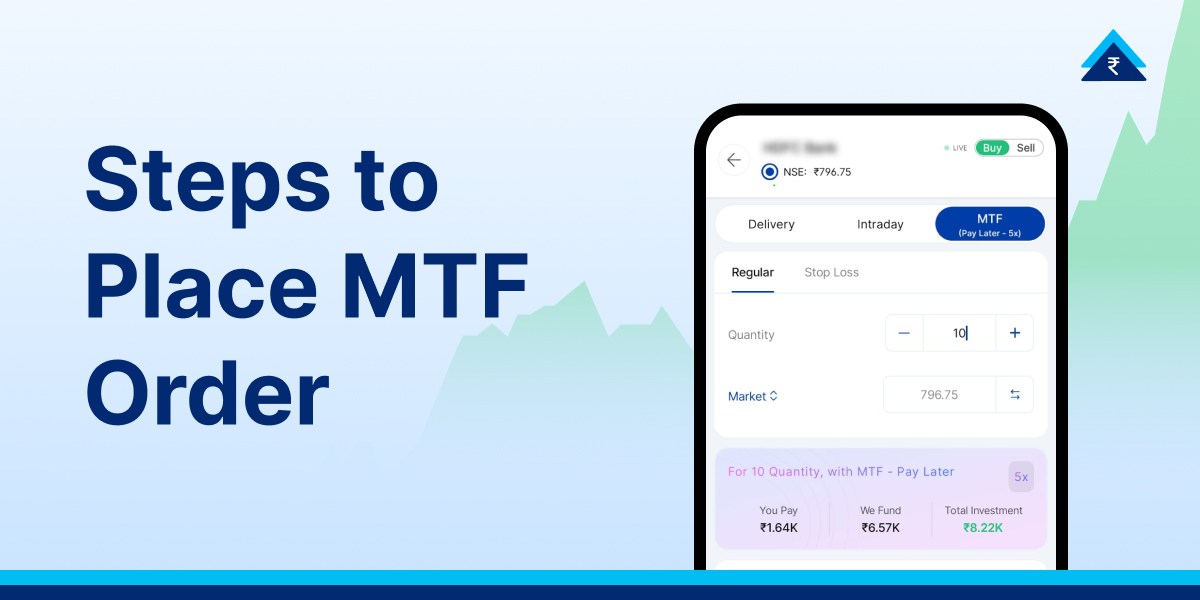
MTF-Pay Later is a service offered by stockbrokers, like Paytm Money, that allows you to buy stocks by paying only a fraction of the total transaction value. The broker funds the remaining amount. In exchange, the broker charges a nominal interest rate on the funded amount, and the shares you purchase act as collateral. For example, if a stock requires a 25% margin under MTF, you can buy ₹10,000 worth of that stock by investing only ₹2500 from your pocket. The broker funds the remaining ₹7500. You can hold these shares for an extended period, provided you maintain the required margin and pay the interest charges. Interest rates on Paytm Money begin at just 7.99% per annum,
Margin Trading Facility (MTF) – A facility provided by brokers allowing investors to buy stocks by paying just a percentage of the total value (the margin), with the broker financing the rest of the purchase.
Why Use MTF During Market Corrections?
Using MTF during a market correction provides several strategic advantages for informed investors:
- Overcoming Liquidity Crunches: Corrections are often swift and unpredictable. You might not have the time to arrange fresh funds. MTF provides instant purchasing power, ensuring you don’t miss out on fleeting discount windows.
- Amplifying Returns Through Leverage: When you buy a deeply discounted stock using MTF, and it rebounds, your returns are calculated on the total value of the stock, not just the margin you put up front. If the ₹1,00,000 position in the previous example grows by 20% to ₹1,20,000, your profit is ₹20,000. Considering your initial capital was only ₹25,000, your return on your actual capital is significantly amplified (minus interest costs).
- Portfolio Preservation: Without MTF, you might be tempted to sell your existing, long-term holdings to free up cash for buying the dip. This triggers unnecessary capital gains taxes and disrupts your long-term compounding. MTF allows you to add to your portfolio without disturbing your existing investments.
Leverage – The use of borrowed capital (like MTF) to increase the potential return of an investment. While it magnifies profits, it equally magnifies potential losses.
Strategic Approaches to Buying the Dip with MTF
While MTF is a powerful tool, combining it with buying the dip requires a disciplined approach. Haphazardly borrowing money to buy falling stocks is a recipe for disaster. Here are strategic ways to utilise MTF correctly:
Focus on Fundamentally Strong Stocks
MTF should strictly be reserved for high-conviction, fundamentally robust companies. During a correction, mid-cap and small-cap stocks with weak fundamentals often fall the hardest and may take years to recover, or they might never recover at all. Stick to blue-chip stocks or market leaders with strong balance sheets, consistent cash flows, and proven management.
Avoid Catching a Falling Knife
One of the biggest mistakes investors make is buying aggressively the moment a stock starts falling. Wait for the dust to settle. Look for signs of price consolidation or a reversal in technical indicators before deploying your MTF funds. Buying into a stock that is in a relentless freefall can quickly trigger margin shortfalls.
Employ Staggered Buying
Never deploy your entire MTF limit in a single trade. Instead, break your purchases into smaller tranches. If a stock falls 10%, buy a portion. If it falls another 5%, buy more. This strategy averages out your purchase price and provides a cushion if the market corrects deeper than you initially anticipated.
Have a Clear Exit and Repayment Strategy
Before you use MTF, know exactly how long you plan to hold the position and how you will cover the interest costs. Remember, MTF incurs a daily interest charge. If the market stays stagnant for months, these interest charges will eat into your eventual profits. Set a target price for booking profits and a timeline for either squaring off the position or bringing in fresh cash to convert the MTF position into regular delivery.
Risks and Essential Precautions
Using borrowed money in the stock market carries inherent risks. When you use MTF, your losses can exceed your initial margin if the stock price plummets severely.
The most critical risk to manage is the Margin Call. If the value of the stocks you bought falls below a certain threshold, the broker will require you to bring in additional cash or pledge more shares to maintain the minimum margin requirement. If you fail to do so, the broker has the right to forcefully sell your shares to recover their funds, which could result in booking a heavy loss at the worst possible time. Always maintain a buffer in your account and utilise strict stop-loss orders to protect your capital. Learn more about Margin Shortfall.
Margin Call – A demand by a broker that an investor deposit further cash or securities to cover possible losses and maintain the required minimum margin in their account.
Stop-loss Order – An order placed with a broker to buy or sell a specific stock once the stock reaches a certain price, designed to limit an investor’s loss on a position.
How to Use MTF on Paytm Money
Paytm Money has streamlined the Margin Trading Facility to make it accessible, transparent, and user-friendly for Indian investors. With over 1400+ approved stocks across various sectors, investors have many options to invest using MTF-Pay Later.
Starting at just 7.99% interest per annum, Paytm Money has designed a slab-based interest rate structure to cater to investors of all types:
| Book Size (Funded Amount) | Interest Rate (p.a.) |
|---|---|
| Up to ₹1 Lakh | 7.99% |
| ₹1.01 Lakh – ₹1 Crore | 9.99% |
| Above ₹1 Crore | 8.99% |
Even at 9.99% p.a., the pricing stays highly competitive—so as your portfolio grows, your costs stay in control. Plus, with Paytm Money, you can use your existing shares as collateral (Margin Pledge), giving you access to MTF funding without adding any fresh cash.
Brokerage is charged at 0.1% of trade value or current brokerage, whichever is higher. Check Paytm Money Pricing.
Conclusion
Buying the dip during market corrections is a time-tested strategy for wealth creation, allowing investors to accumulate quality assets at discounted prices. When paired strategically with a Margin Trading Facility, you can unlock purchasing power without liquidating your portfolio, maximising your potential upside. However, MTF is a double-edged sword. It requires discipline, a focus on fundamentally strong stocks, and rigorous risk management. By utilising platforms like Paytm Money, which offer transparent and efficient MTF services, informed investors can navigate market volatility with confidence and turn corrections into stepping stones for financial growth.
Disclaimer: Investment in securities market is subject to market risks. Read all the related documents carefully before investing. This content is purely for information purpose only and in no way is to be considered as an advice or recommendation. The securities are quoted as an example and not as a recommendation. Investors are requested to do their own due diligence before investing.
SEBI Reg No.: Broking – INZ000240532, Research Analyst – INH000020086, Depository Participant – IN-DP-416-2019, Depository Participant Number: CDSL – 12088800, NSE (90165), BSE (6707), MCX (57525), NCDEX (1315), MSEI (85300).
Registered Office: 136, 1st Floor, Devika Tower, Nehru Place, Delhi – 110019.
For complete Disclaimers, visit https://www.paytmmoney.com.