


Imagine spotting an incredible macroeconomic trend—perhaps India’s infrastructure sector is booming, or the banking sector is poised for a multi-week rally. You want to capture this broad market momentum, but you do not want to take on the high company-specific risk of buying individual stocks. Naturally, you lean toward Exchange Traded Funds (ETFs). But there is a catch: you have identified a high-conviction setup, yet your liquid cash is tied up, or you simply want to amplify your potential returns. What do you do?
- Understanding the Core: What are MTF and ETF?
- What is Margin Trading Facility (MTF)?
- What is an Exchange Traded Fund (ETF)?
- Benefits of Using MTF to Buy ETFs
- 1. Amplified Buying Power with Risk Spreading
- 2. Tactical Sectoral Bets
- 3. Capturing Index Corrections
- 4. Cashless Trading through Margin Pledge
- Mechanics: How MTF for ETFs Works on Paytm Money
- Upfront Margin and Leverage Limits
- Competitive Interest Structure
- Extended Holding Periods
- Evaluating the Risks of Pledging and Margin Calls
- The Mechanism of a Margin Call
- Managing the Leverage Double-Edge
- The Cost Factor over Time
- Step-by-Step Guide to Buying ETFs on MTF via Paytm Money
- Leverage the Paytm Money MTF Calculator
- Conclusion
- FAQs
This is where combining two financial instruments in the Indian market comes into play: using MTF to buy ETFs.
In this comprehensive guide, we will unpack how to use MTF to buy ETFs, explore the underlying mechanics, evaluate the strategic benefits, manage the risks, and show you how to execute this strategy seamlessly to make your capital work harder than ever before.
Understanding the Core: What are MTF and ETF?
Before diving into the strategic synergy of these two instruments, let us break down their fundamental definitions and see how they operate individually in the Indian financial ecosystem.
What is Margin Trading Facility (MTF)?
Margin Trading Facility is an exchange-approved feature regulated by the Securities and Exchange Board of India (SEBI). It allows investors and traders to buy eligible securities by paying only a portion of the total transaction value as an upfront margin. The remainder of the capital is funded by the broker as a short-to-medium-term loan, for which a competitive interest rate is charged.
What is an Exchange Traded Fund (ETF)?
An Exchange Traded Fund is a basket of securities that tracks an underlying index, commodity, or sector. Unlike traditional mutual funds, ETFs are listed on stock exchanges (like the NSE and BSE) and trade in real-time throughout the market hours just like ordinary shares.
Benefits of Using MTF to Buy ETFs
Leverage is frequently associated with high-risk, volatile day trading. However, when you use MTF to buy ETFs, you are executing a sophisticated MTF trading strategy that balances aggressive wealth generation with built-in diversification. Here are the core benefits:
1. Amplified Buying Power with Risk Spreading
When you trade individual stocks on leverage, a single bad corporate governance news event or poor earnings report can send the stock tumbling, resulting in severe losses. ETFs basket multiple stocks together. By using MTF to buy ETFs, you gain up to 4x leverage on an asset class that is structurally protected against single-company vulnerability.
2. Tactical Sectoral Bets
If you believe a specific sector—such as IT, Pharma, or Consumption—is undergoing a cyclical upturn, you can buy a sectoral ETF via MTF. Instead of locking up large amounts of your principal capital, you can ride the multi-week or multi-month sector trend using borrowed capital, leaving your core savings intact.
3. Capturing Index Corrections
When the broader market corrects (e.g., a 5% dip in the Nifty 50 or Nifty Next 50), it presents a high-probability swing trading opportunity. Traders use MTF to buy ETFs tracking major indices during these dips, expecting a sharp technical rebound. This allows you to deploy maximum force exactly when the index is undervalued.
4. Cashless Trading through Margin Pledge
You do not always need fresh cash to use MTF. If you hold quality long-term stocks or mutual funds in your Demat account, you can pledge them as collateral and get trading margin. This process is known as Margin Pledge.
Mechanics: How MTF for ETFs Works on Paytm Money
Understanding the financial and mathematical framework behind MTF to buy ETFs ensures you can confidently calculate your costs and project clean profit metrics.
Upfront Margin and Leverage Limits
The exchange classifies financial instruments into different risk categories, applying specific “haircuts.”
Competitive Interest Structure
When you borrow capital to fund your positions, interest is a crucial variable. Paytm Money offers a tiered and transparent MTF interest structure, with rates that keep your break-even threshold low across different position sizes. The interest tiers are structured based on your MTF book size:
| MTF Book Size | Annual Interest Rate (p.a.) |
|---|---|
| Up to ₹1 Lakh | 7.99% |
| ₹1 Lakh to ₹1 Crore | 9.99% |
| Above ₹1 Crore | 8.99% |
Important Note on Interest: Interest is calculated daily and applied on a pro-rata basis strictly on the broker-funded amount, not on your total trade value. For instance, if you buy ₹1,00,000 worth of a Nifty ETF using 4x leverage, your own contribution is ₹25,000, and the borrowed amount is ₹75,000. At a low rate of 7.99% p.a., your daily interest cost is roughly just ₹16.42.
Beyond interest, the transparent fee structure includes:
- Brokerage: 0.1% of the trade value or the standard brokerage up to ₹20 (whichever is higher), applicable on both buy and sell transactions.
- Pledge / Unpledge Fees: ₹20 per transaction (which includes the standard ₹5 CDSL charge).
- DP Charges: ₹20 when you eventually sell the shares and debit them from your account.
Extended Holding Periods
Unlike intraday leverage, which forces you to square off your positions by 3:30 PM, using MTF to buy ETFs gives you the freedom to hold your positions for up to 365 calendar days, provided you maintain the necessary margin cover. This makes it a perfect instrument for positional and swing trading over weeks or months.
Evaluating the Risks of Pledging and Margin Calls
While the upside of using MTF to buy ETFs is compelling, disciplined investing requires a thorough evaluation of the risks and operational safeguards.
The Mechanism of a Margin Call
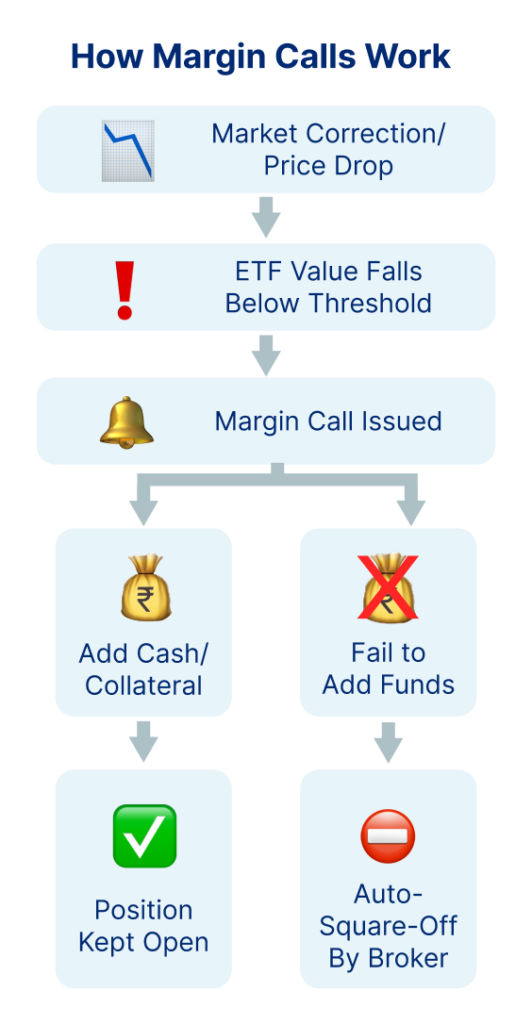
Even though ETFs are vastly diversified, they are not immune to market corrections. If the price of your chosen ETF falls significantly, the equity value of your margin account drops. If it breaches the minimum exchange-mandated threshold, your broker will issue an urgent Margin Call.
Margin Call: A notification from your stockbroker informing you that the value of your investment account has fallen below the required minimum margin level, requiring you to deposit additional funds or securities to maintain your position.
If you fail to fulfill the margin shortfall within the stipulated timeframe, the broker is legally obligated to execute an auto-square-off, selling a portion of your ETF holdings to recover the outstanding loan.
Learn how to handle a margin call.
Managing the Leverage Double-Edge
Leverage magnifies both gains and losses. If you purchase an ETF with 4x leverage, a 5% upward move in the index translates to an impressive 20% return on your deployed capital. Conversely, a 5% drop in the index results in a 20% depletion of your upfront margin.
The Cost Factor over Time
Because interest accrues daily, time is a critical variable. Holding an underperforming or completely flat ETF via MTF over multiple months will slowly erode your capital via interest drag. Therefore, exits should always be calculated with high precision.
Step-by-Step Guide to Buying ETFs on MTF via Paytm Money
Executing an MTF trading strategy with ETFs has been made remarkably seamless on the Paytm Money platform. Here is how you can initiate a trade in under two minutes:
- Access the Application: Open your Paytm Money app and navigate directly to the Stocks or Portfolio tab.
- Select Your Instrument: Use the search bar to find your desired ETF (e.g., Nifty 50 ETFs, Bank ETFs, Gold ETFs, or IT ETFs).
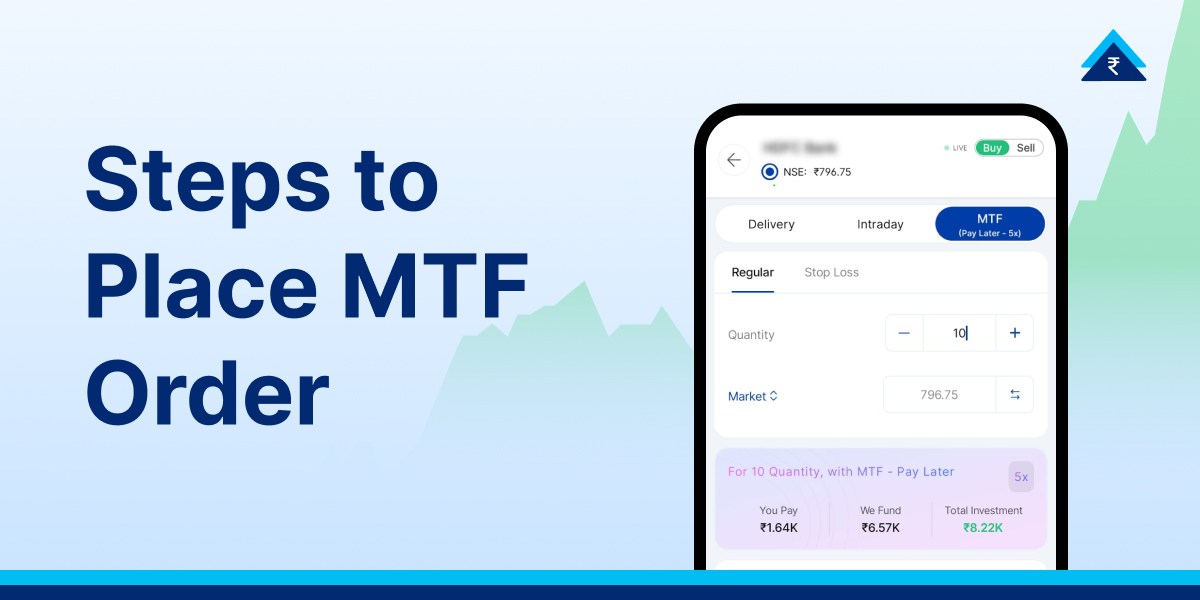
- Open the Order Pad: Tap on the Buy button to bring up the core transaction screen.
- Choose Your Product Type: On the order pad, select MTF-Pay Later instead of regular cash delivery.
- Review and Execute: The screen will instantly display the required upfront margin and the available buying power leverage. Confirm the order to instantly deploy your position.
Leverage the Paytm Money MTF Calculator
Before executing any trade, it is highly recommended to use the Paytm Money MTF Calculator tool to carefully review your structural costs. The calculator allows you to:
- Get an instant breakdown of daily interest fees, processing charges, and exchange taxes.
- Perform a clear profit vs. cost comparison to make sure your projected ETF target easily offsets holding costs.
- Analyze up to 5 instruments simultaneously in a single multi-stock basket layout.
- Filter available ETFs based on the precise leverage tiers that suit your unique risk appetite.
Conclusion
So, is it worth it? MTF works well for ETFs when you have a clear, time-bound market thesis, the discipline to monitor margin levels daily, and a holding period short enough that interest costs don’t erode your gains. It is less suitable as a passive, long-term strategy — the daily interest drag on a flat or slowly rising ETF can quietly eat into returns over months. Use it tactically, not habitually.
Success with margin trading relies entirely on maintaining clinical discipline, calculating holding fees accurately, and utilizing robust risk tools. If you are ready to expand your trading systems and maximize your capital efficiency, open your platform, explore the interactive MTF Calculator, and discover how the MTF-Pay Later option on Paytm Money can seamlessly elevate your trading capabilities today.
Disclaimer: Investments in the securities market are subject to market risks. Read all the related documents carefully before investing. This content is purely for informational purposes only and should not be considered as investment advice or a recommendation. Securities quoted are for illustration purposes only and not recommendatory. Investors are requested to do their own due diligence before investing.
Paytm Money Ltd. SEBI Reg. No. Broking – INZ000240532; Depository Participant – IN – DP – 416 – 2019, Depository Participant Number: CDSL – 12088800. Trading and clearing member of NSE (90165, M52073), BSE (6707), MCX (57525), NCDEX (1315, M51110), and MSEI (85300). SEBI Reg. No. Research Analyst – INH000020086. Regd. Office: 136, 1st Floor, Devika Tower, Nehru Place, Delhi – 110019. For complete Terms & Conditions and Disclaimers visit: https://www.paytmmoney.com/stocks/policies/terms