


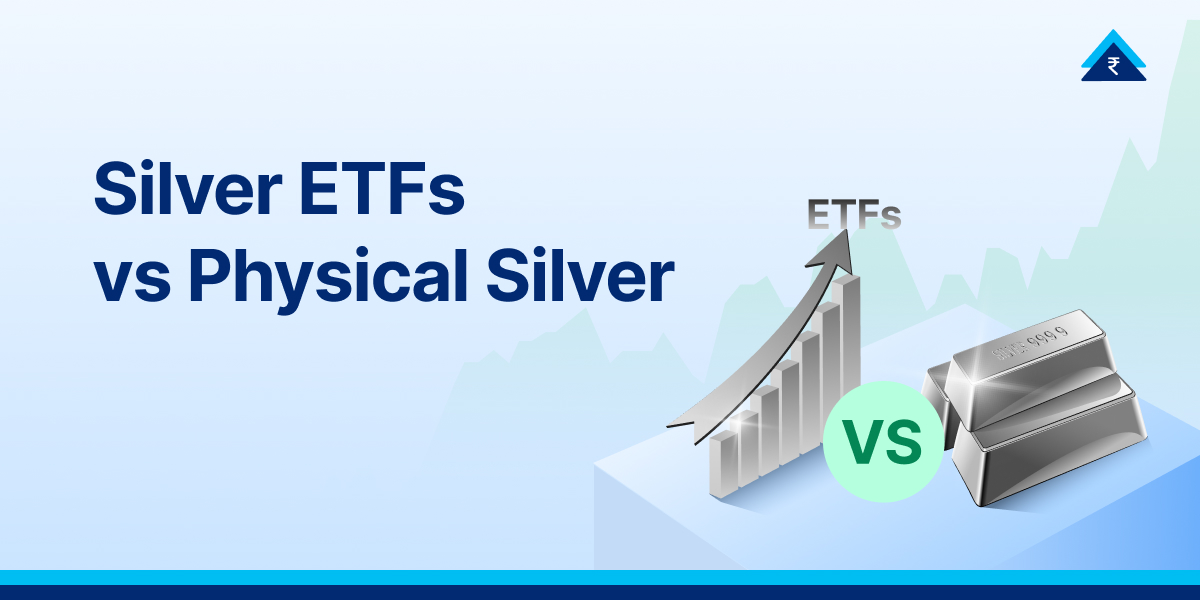
Have you ever walked past a jewellery store and felt that familiar pull towards the gleaming white metal in the window? In India, silver has always held a special place in Indian households. From jewellery and gifts to long term savings, the metal has cultural and financial significance. But today, the way investors buy silver is changing. Many investors now face a common question: Silver ETFs vs Physical Silver: which investment option should you choose?
- Why Silver Matters as an Investment
- What Are Silver ETFs?
- Key Features of Silver ETFs
- What Is Physical Silver?
- Silver ETFs vs Physical Silver: Key Differences
- Taxation: Silver ETFs vs Physical Silver
- Physical Silver Taxation
- Silver ETF Taxation in India
- Who Should Choose Silver ETFs?
- Who Should Choose Physical Silver?
- Resale Value of Physical Silver
- Risks and Limitations
- Silver ETF Risks
- Physical Silver Risks
- Why Silver Investing Is Relevant in 2026
- Conclusion
- FAQs
If you are exploring silver investment options in India, this comparison becomes important. The choice between Silver ETFs vs physical silver affects your liquidity, taxation, storage responsibility, and overall investment convenience.
In this guide, we break down the difference between Silver ETFs and physical silver in simple terms so you can decide which option fits your investment style.
Why Silver Matters as an Investment
Silver occupies a unique position among commodities because it is both a precious metal and an industrial metal. Unlike gold, silver demand is heavily influenced by industrial use.
Key industries that drive silver demand include:
- Electronics manufacturing
- Solar panels and renewable energy
- Medical and industrial equipment
- Electric vehicles and semiconductors
Because of these factors, silver prices can move due to both economic growth and market sentiment. Investors often consider silver when looking for diversification or when hedging against inflation and economic uncertainty.
(Source: MMTC)
What Are Silver ETFs?
A Silver ETF (Exchange Traded Fund) is a mutual fund that tracks the domestic price of physical silver.
Instead of buying the metal directly, investors purchase ETF units through the stock exchange. Each unit represents a certain quantity of silver that the fund holds in secure vaults.
In simple terms:
- You do not hold the metal physically
- The fund buys high purity silver (usually 99.9% or higher)
- You trade ETF units just like stocks through a demat account
Key Features of Silver ETFs
- Traded on recognised stock exchanges
- Backed by physical silver stored by the fund
- Transparent price tracking of domestic silver prices
- No storage or security concerns for investors
For many investors today, Silver ETFs are among the most convenient silver investment options in India.
What Is Physical Silver?
Physical silver investing means buying the metal directly in forms such as:
- Silver bars or bullion
- Silver coins
- Silver jewellery
When you buy physical silver, you become the direct owner of the metal. You must store it yourself, either at home or in a bank locker. Many Indian investors prefer this format because it feels tangible and traditional. Holding the metal physically offers emotional comfort and cultural value.
However, this also comes with practical concerns such as:
- Storage safety
- Purity verification
- Resale spreads
- Making charges in jewellery
Both formats give exposure to the same metal, but the ownership experience is very different.
Silver ETFs vs Physical Silver: Key Differences
The most important differences between Silver ETFs and physical silver are related to liquidity, convenience, and costs.
| Aspect | Silver ETFs | Physical Silver |
|---|---|---|
| Ownership | Investors hold ETF units backed by silver stored in vaults | Investors directly own silver bars, coins, or jewellery |
| Liquidity | High liquidity through stock exchanges | Depends on jewellers or local dealers |
| Purity | Usually backed by 99.9% purity silver | Purity must be verified at purchase |
| Storage | No storage responsibility for investors | Requires secure storage (lockers/safes) |
| Costs | Expense ratio and tracking error | Making charges, dealer spreads, storage costs, GST |
| Minimum Investment | Can start with small amounts depending on ETF unit price | Higher upfront cost for bars or coins |
| Price Transparency | Tracks domestic silver price electronically | Prices vary by city or dealer |
| Trading Convenience | Buy or sell instantly via demat account | Sale depends on local market demand and physical movement |
This comparison highlights why many modern investors prefer Silver ETFs for convenience and transparency.
(Source: Tata Mutual Fund)
Taxation: Silver ETFs vs Physical Silver
Tax rules are an important factor when deciding between physical silver vs Silver ETF investment in India.
Physical Silver Taxation
Physical silver is treated as a capital asset.
- Held less than 24 months: Short term capital gains taxed as per income tax slab
- Held more than 24 months: Long term capital gains
For long term gains:
- If purchased before 23 July 2024: Taxed at 20% with indexation
- If purchased on or after 23 July 2024: Taxed at 12.5% without indexation
(Source: PIB)
Silver ETF Taxation in India
Silver ETFs follow different holding rules.
- Held less than 12 months: Short term capital gains taxed as per slab
- Held more than 12 months: Long term capital gains taxed at 12.5% without indexation
(Note: ETFs become “Long-Term” much faster (1 year) compared to physical silver (2 years), which can be a significant advantage for those looking to rebalance their portfolios sooner.)
(Source: Clear Tax)
Who Should Choose Silver ETFs?
Silver ETFs can be suitable for investors who prioritise convenience and flexibility.
You may consider Silver ETFs if you want:
- Small and flexible investment amounts
- Transparent price tracking
- No storage costs
- A regulated investment route
- Easy buying and selling through exchanges
Investors who prefer digital investing through demat accounts usually find ETFs easier to manage.
Who Should Choose Physical Silver?
Physical silver appeals to investors who value direct ownership and traditional investing.
You may prefer physical silver if:
- You want metal for gifting or cultural purposes
- You prefer holding a tangible asset
- You do not mind managing storage and security
In India, physical silver is also popular for weddings, festivals, and long term family savings.
Resale Value of Physical Silver
Resale value depends on the product form and documentation.
Typical retail outcomes may look like this:
| Product Type | Typical Resale Value |
|---|---|
| Silver Bars / Coins | Around 80% of retail value depending on purity and invoice |
| Silver Jewellery | Around 50% to 60% due to non recoverable making charges |
The resale price may vary depending on purity, dealer spreads, and local demand.
(Source: India Infoline)
Risks and Limitations
Every investment carries risks, and silver is no exception.
Silver ETF Risks
- Tracking error compared to actual silver prices
- ETF market price may slightly differ from indicative NAV
- Expense ratio reduces returns over time
Physical Silver Risks
- Risk of theft or loss
- Storage expenses
- Purity verification issues
- Higher buy and sell spreads
Both formats also face silver price volatility, since the metal itself can fluctuate significantly.
(Source: Livemint)
Why Silver Investing Is Relevant in 2026
Silver demand is influenced by both industrial growth and economic uncertainty.
In recent years, silver demand has increased due to:
- Rapid growth in solar energy installations
- Rising use in electronics and semiconductor manufacturing
- Demand from electric vehicle production
At the same time, investors often buy silver during periods of inflation or global uncertainty as part of portfolio diversification.
This combination of industrial and investment demand makes silver an interesting asset class for long term portfolios.
(Source: MMTC)
Conclusion
There is no single “correct” way to invest. If you are looking for a wealth-building tool that is easy to manage and tax-efficient, Silver ETFs are generally the superior choice for the modern Indian investor. They offer simplicity, high liquidity, and lower friction.
On the other hand, if you are buying for tradition, gifting, or the emotional comfort of direct ownership, Physical Silver still holds its charm. How to choose between silver ETF and physical silver ultimately depends on your own risk tolerance and your need for convenience versus tangibility. Use this guide to assess your storage comfort and investing style before making your next move.
Disclaimer: Investments in securities market are subject to market risks, read all the related documents carefully before investing.. This content is purely for information purpose only and in no way is to be considered as an advice or recommendation. The securities are quoted as an example and not as a recommendation. Investors are requested to do their own due diligence before investing.
SEBI Reg No.: Broking – INZ000240532, Research Analyst – INH000020086, Depository Participant – IN-DP-416-2019, Depository Participant Number: CDSL – 12088800, NSE (90165), BSE (6707), MCX (57525), NCDEX (1315), MSEI (85300).
Registered Office: 136, 1st Floor, Devika Tower, Nehru Place, Delhi – 110019.
For complete Terms & Conditions and Disclaimers, visit https://www.paytmmoney.com.
FAQs
What is the difference between Silver ETFs and physical silver?
+
Are Silver ETFs safer than buying physical silver?
+
How are Silver ETFs taxed in India?
+
Silver ETFs are taxed as capital assets.
• Held less than 12 months: Short term gains taxed as per income slab.
• Held more than 12 months: Long term gains taxed at 12.5% without indexation.