


Imagine analyzing a stock chart and spotting the perfect setup. The technical indicators are flashing green, the fundamental thesis is solid, and you anticipate a strong upward price movement over the next few weeks. You have high conviction in this trade, but there is one frustrating hurdle: your available cash balance is limited. How do you maximize this opportunity without liquidating your core long-term portfolio to free up funds?
- What is Swing Trading?
- How Does MTF (Margin Trading Facility) Give a Boost to Swing Trades?
- Proven Strategies for Swing Trading Using MTF
- 1. The Breakout Trading Strategy
- 2. The Moving Average Bounce
- 3. Tactical Sectoral Momentum
- Real-World Example: MTF Swing Trade Breakdown
- Navigating the Risks of Margin Trading
- Best Practices for Using MTF-Pay Later
- Conclusion
- FAQs
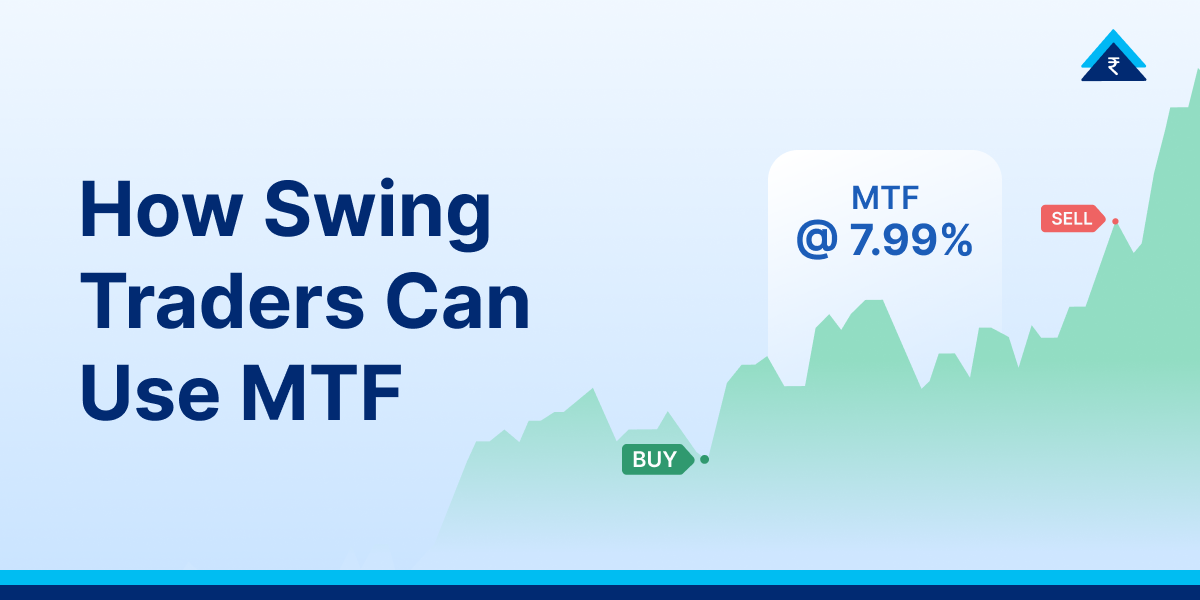
This is where Swing Trading Using MTF (Margin Trading Facility) comes into play. By allowing you to borrow capital to increase your buying power, MTF enables you to capitalize on short-to-medium-term market trends with a much larger position size than your standard cash balance would permit.
What is Swing Trading?
Before diving into leverage, it is important to understand the foundation of the trading style itself. Swing trading is a strategy designed to capture “swings” or price movements in a stock over a short to medium timeframe. Unlike intraday traders who buy and sell within the same day to capture micro-movements, swing traders hold their positions overnight, often for weeks, to ride out larger market trends.
Conversely, unlike long-term “buy and hold” investors who might hold a stock for a decade regardless of volatility, swing traders have strict entry and exit criteria based on technical patterns or short-term catalysts (like an upcoming earnings report). Swing trading is the sweet spot for many retail investors because it balances the potential for quick returns with the flexibility of not needing to stare at a trading terminal all day.
How Does MTF (Margin Trading Facility) Give a Boost to Swing Trades?
When you combine swing trading with the Margin Trading Facility (often referred to as MTF-Pay Later), you are essentially adding wings to your trading engine. Paytm Money’s Margin Trading Facility allows you to boost your purchasing power by up to 4x on over 1,400+ eligible stocks. Instead of paying the full price for a trade, you pay only a fraction of the total trade value upfront (as low as 25%). Paytm Money funds the rest as a low-cost loan.
Here is why MTF is tailor-made for swing traders:
- Amplified Position Sizes: If you have ₹50,000 in cash, MTF allows you to take a position worth up to ₹2,00,000.
- Long Holding Periods: Unlike intraday leverage which forces you to square off your position before the market closes, MTF allows you to hold your positions for up to 365 calendar days, provided you maintain the required margin cover. This perfectly aligns with the multi-day or multi-week timeframe of a swing trade.
- Cashless Trading via Margin Pledge: You don’t necessarily need fresh cash to initiate an MTF trade. You can pledge your existing eligible Demat holdings to get collateral margin and use that to fund your upfront 25% requirement.
Learn how you can hold MTF trades longer.
Proven Strategies for Swing Trading Using MTF
Because you are paying daily interest on the borrowed funds, MTF is not meant for “buy and forget” investing. You need precision, high-probability setups, and clear exit strategies to justify the borrowing costs. Here are three popular swing trading strategies that pair well with MTF:
1. The Breakout Trading Strategy
This is arguably the most popular setup for MTF traders. A breakout occurs when a stock’s price moves above a historical resistance level (a price ceiling it has struggled to cross) with heavy trading volume.
How to play it: You identify a stock that has been consolidating in a tight range for months. As soon as it breaks above that range with high volume, you initiate an MTF position. Because breakouts often lead to swift, violent price movements over the next few weeks, the rapid capital appreciation quickly offsets the daily interest costs of the MTF loan.
2. The Moving Average Bounce
Many fundamentally strong stocks trend upward steadily, respecting key technical indicators like the 50-day or 200-day Simple Moving Average (SMA).
How to play it: Instead of chasing a stock when it is hitting new highs, you wait for a healthy market correction. When the stock dips and “bounces” off its 50-day moving average (showing that buyers are stepping in to support the price), you enter the trade using MTF. You then place a strict stop-loss just below the moving average to protect your capital in case the support fails.
3. Tactical Sectoral Momentum
Sometimes, an entire sector catches a tailwind due to macroeconomic factors. For instance, if global commodity prices surge, the Metals sector might experience a multi-month rally.
How to play it: You can use MTF to build a medium-term “Satellite” portfolio to ride this sectoral momentum. You might buy heavily into top-tier metal stocks using up to 4x leverage. Meanwhile, your long-term “Core” portfolio (perhaps consisting of stable banking or IT compounders) remains entirely untouched and safe from liquidation.
Real-World Example: MTF Swing Trade Breakdown
Let’s look at the math to understand how MTF impacts a swing trade, comparing a standard cash delivery trade with an MTF trade. Assume you have spotted a high-conviction setup in Stock XYZ, currently trading at ₹1,000. You have ₹75,000 in available cash. You plan to hold the stock for 30 days, expecting a 10% price increase.
Note: For the sake of this example, we will assume an MTF interest rate of 7.99% p.a. (Paytm Money’s rate for MTF book sizes upto 1 Lakh) and exclude statutory charges for simplicity.
| Metric | Scenario A: Standard Cash Delivery | Scenario B: Swing Trading using MTF (4x Leverage) |
|---|---|---|
| Upfront Capital | ₹25,000 | ₹25,000 (25% margin) |
| Borrowed Funds (MTF) | ₹0 | ₹75,000 (3x of capital for 4x total leverage) |
| Total Trade Value | ₹25,000 | ₹1,00,000 |
| Shares Bought | 25 shares | 100 shares (assuming stock price of ₹1,000) |
| Target Price Reached | ₹1,100 (10% increase) | ₹1,100 (10% increase) |
| Gross Profit | ₹2,500 | ₹10,000 (100 shares × ₹100 profit) |
| Holding Costs | ₹0 | MTF Interest: ₹75,000 × 7.99% × (30/365) ≈ ₹492.53 |
| Net Profit | ₹2,500 | ₹9,507.47 |
| Return on Capital (ROI) | 10% | ~38.03% |
The Verdict: By utilizing MTF, you transformed a 10% movement in the underlying stock into a 38.03% net return on your deployed capital, easily absorbing the borrowing costs.
Note: Brokerage for MTF trades is charged at 0.1% of the trade value or the current standard brokerage, whichever is higher.
Navigating the Risks of Margin Trading
Leverage amplifies both gains and losses. A 10% drop in your stock position could erode nearly half your initial capital once interest is factored in. Before trading, be aware of these primary risks:
- The Reality of Margin Calls: If your collateral value falls below maintenance margins, you’ll face a margin call. Failure to cover this shortfall allows your broker to auto-square-off your positions. Always keep a cash buffer to handle such volatility; avoid using your entire balance on one trade.
- Exchange Haircuts: When pledging shares, you receive less than their full market value due to these ‘haircuts’. For example, a 20% haircut on ₹1,00,000 worth of shares provides only ₹80,000 in collateral margin.
- Time is Money: Interest accrues daily on MTF loans. If a stock trades sideways, interest costs compound daily, eroding your capital. MTF is designed for short-term opportunities expecting rapid price moves, not long-term investing.
Learn how to handle a margin call.
Best Practices for Using MTF-Pay Later
To use MTF successfully, you must approach it like a calculated professional, not a gambler trying to recover past losses.
- Use the MTF Calculator: Paytm Money offers a built-in MTF Calculator that provides instant cost estimation. Before placing a trade, use it to see exact daily interest charges, required margin, and profit vs. cost comparisons. It even allows you to analyze up to 5 stocks simultaneously.
- Use Stop-Losses Religiously: Because leverage amplifies losses, a strict stop-loss order is non-negotiable.
- Calculate the Breakeven Point: Know exactly how much the stock needs to rise to cover your brokerage (0.1% or ₹20, whichever is higher), pledge fees (₹20 per transaction), and daily interest before you take the trade.
- Start Small: Dip a toe in the water. Try utilizing margin for a single, high-quality setup with a small portion of your capital to get comfortable with how the daily interest and pledge mechanics work.
Conclusion
Swing Trading Using MTF can unlock the full potential of your high-conviction trading ideas. By providing up to 4x leverage at highly competitive interest rates, Paytm Money’s MTF-Pay Later ensures that you never have to sit out a great market opportunity simply because your funds are tied up elsewhere.
However, this tool rewards discipline and punishes recklessness. If you have a tested strategy, understand technical setups, and respect the rules of risk management, MTF can be the ultimate catalyst for your portfolio’s growth.
Disclaimer: Investments in the securities market are subject to market risks. Read all the related documents carefully before investing. This content is purely for informational purposes only and should not be considered as investment advice or a recommendation. Securities quoted are for illustration purposes only and not recommendatory. Investors are requested to do their own due diligence before investing.
Paytm Money Ltd. SEBI Reg. No. Broking – INZ000240532; Depository Participant – IN – DP – 416 – 2019, Depository Participant Number: CDSL – 12088800. Trading and clearing member of NSE (90165, M52073), BSE (6707), MCX (57525), NCDEX (1315, M51110), and MSEI (85300). SEBI Reg. No. Research Analyst – INH000020086. Regd. Office: 136, 1st Floor, Devika Tower, Nehru Place, Delhi – 110019. For complete Terms & Conditions and Disclaimers visit: https://www.paytmmoney.com/stocks/policies/terms