


If you’ve spent even a little time around the stock market, you’ve probably heard people talk about F&O. It’s one of the most active segments in Indian markets, but also one of the most misunderstood.
So what exactly is F&O? And why do so many traders prefer it over regular equity trading? Let’s break it down in simple terms.
What Is F&O?
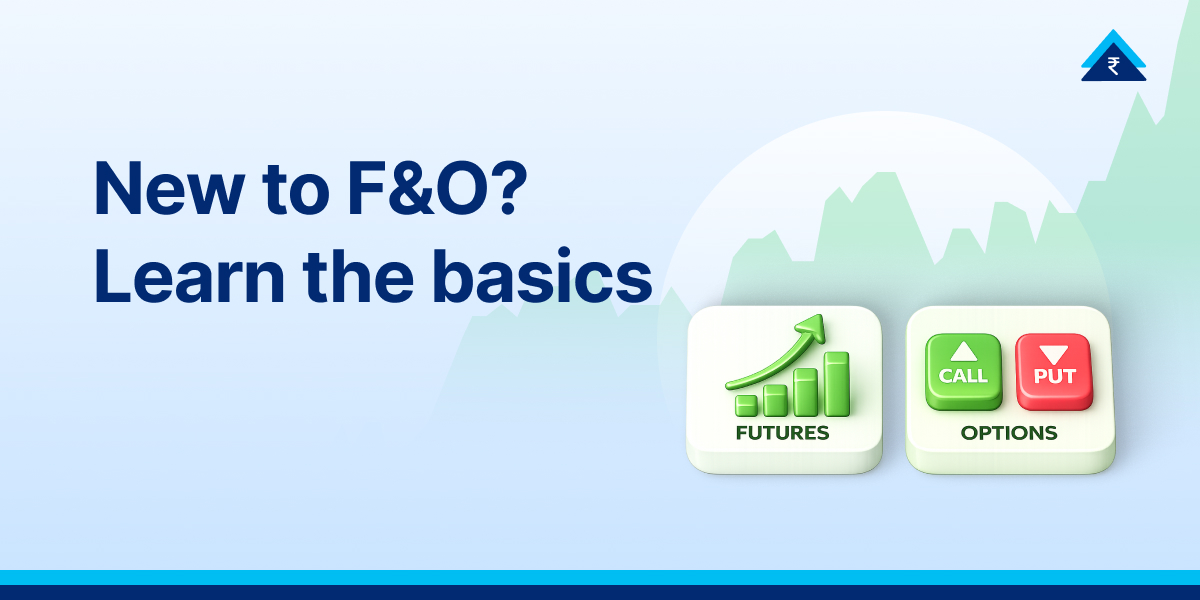
F&O stands for Futures and Options. When people search for f&o meaning, they’re essentially trying to understand how these two contracts work. Both futures and options are derivative contracts. That means their value depends on (or is derived from) an underlying asset, like a stock or an index such as Nifty or Sensex.
But unlike buying shares in the cash market, you’re not directly owning the stock here. Instead, you’re trading a contract linked to its price movement. That’s the basic idea behind F&O.
Futures vs Options- What’s the Difference?
To understand F&O properly, you need to know how futures and options differ. A futures contract is an agreement to buy or sell an asset at a fixed price on a specific future date. Both parties are obligated to complete the transaction at expiry. An options contract, on the other hand, gives the buyer the right, but not the obligation, to buy or sell at a certain price before expiry.
There are two types of options:
- Call Option – Right to buy
- Put Option – Right to sell
This difference is important. In options, the maximum loss for the buyer is limited to the premium paid. In futures, losses can expand if the market moves against you. Understanding these basic differences forms the foundation of f&o trading basics.
Why Do Traders Choose F&O?
There are a few main reasons why F&O attracts active traders. First, leverage. You don’t need to pay the full contract value upfront. Instead, you pay margin, which allows you to control a larger position with less capital.
Second, flexibility. You can take both bullish and bearish views easily. If you think a stock will fall, you don’t need to own it to benefit from the downside. Third, hedging. Many investors use F&O to protect their long-term equity portfolios during volatile periods.
But leverage cuts both ways. While profits can multiply, so can losses. That’s why risk management is critical in F&O.
Which Stocks Are Eligible for F&O?
Not every stock can be traded in the derivatives segment. Exchanges select eligible stocks based on criteria such as:
- Market capitalisation
- Liquidity
- Average daily turnover
- Public shareholding
Index contracts, such as the Sensex and Nifty 50, are widely accessible. The derivatives list also includes huge, liquid equities. This list isn’t permanent. It changes periodically depending on trading activity and regulatory conditions. So before entering any trade, it’s always a good idea to check whether the stock is currently available for F&O trading.
Is F&O Riskier Than Equity?
In short, yes, it can be. Because F&O involves margin and expiry dates, positions require closer monitoring. In equity investing, you can hold shares for years. In F&O, contracts expire. If the market doesn’t move in your favour within that time, the position may lose value.
Options also suffer from time decay. Even if price doesn’t move much, the premium can reduce as expiry approaches. This is why understanding f&o trading basics is so important before risking capital.
How Traders Analyse F&O Trades
Successful F&O trading isn’t random. Traders look at price action, open interest changes, volatility levels, and liquidity. For example, before entering a trade, many traders analyse:
- Where support and resistance lie
- How open interest is building at different strike prices
- Whether volume supports the move
- How volatile the market is
Having access to structured tools makes this easier. With Market Depth & Advanced Charts on Paytm Money, traders can see real-time demand and supply, apply technical indicators, and evaluate price behaviour, all before placing a trade.
Instead of reacting emotionally, they make decisions based on visible data.
Should Beginners Trade F&O?
F&O is accessible, but it shouldn’t be approached casually. If you’re new:
- Start small
- Understand lot sizes
- Learn how margin works
- Avoid over-leverage
- Always define your risk
Because the greatest loss (for purchasers) is capped at the premium paid, many traders start with options. Even still, discipline is more important than speed.
Conclusion
F&O offers flexibility, leverage, and strategic possibilities that go beyond regular equity investing. But it also demands responsibility. Understanding f&o meaning is only the starting point. Real success in derivatives comes from learning risk management, position sizing, and structured analysis. If you’re ready to explore derivatives with better clarity and real-time tools, Start F&O trading on Paytm Money and use advanced charts and market depth to make more informed trading decisions.
Disclaimer: Investments in the securities market are subject to market risks, read all the related documents carefully before investing. This content is purely for information purpose only and in no way to be considered as an advice or recommendation. The securities are quoted as an example and not as a recommendation.
Investors are requested to do their own due diligence before investing. Paytm Money Ltd SEBI Reg No. Broking – INZ000240532, Depository Participant – IN – DP – 416 – 2019, Depository Participant Number: CDSL – 12088800, NSE (90165), BSE (6707) Regd Office: 136, 1st Floor, Devika Tower, Nehru Place, Delhi – 110019. For complete Terms & Conditions and Disclaimers visit: https://www.paytmmoney.com/stocks/policies/terms .