


Thinking about putting your money into mutual funds? You’re probably asking yourself the same question every new investor does: how much can I actually lose here? It’s a fair concern, and honestly, returns alone don’t tell the whole story. The risk you take to earn those returns matters just as much, sometimes more.
That’s exactly why the Securities and Exchange Board of India (SEBI) introduced a handy little tool called the Riskometer. Think of it as a speedometer, but instead of measuring speed, it tells you how risky a mutual fund scheme really is. In this beginner’s guide, we’ll break down what the Riskometer in mutual funds is, how it works, and why every investor should check it before investing.
What Is Riskometer in Mutual Funds?
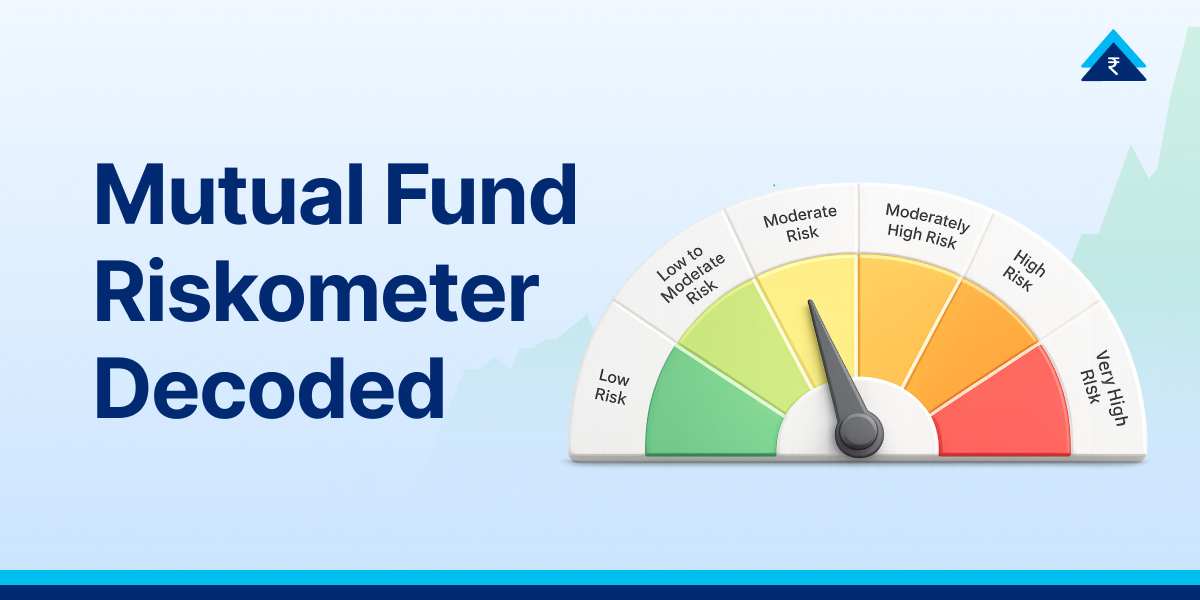
The Riskometer is a visual tool that displays the risk level of a mutual fund scheme. SEBI has made it mandatory for every asset management company (AMC) to show the Riskometer on their scheme documents, fact sheets, and promotional material.
In simple terms, it converts complicated risk calculations into one easy-to-read graphic, allowing investors to instantly understand whether a fund is suitable for their risk appetite.
How Does the Riskometer Work?
The Riskometer in mutual funds classifies schemes into six risk levels, each represented by a distinct colour for quick visual recognition.
| Risk Level | Colour Code | Suitable For | Example Fund Categories |
|---|---|---|---|
| Low Risk | Irish Green | Conservative investors prioritising capital protection | Overnight funds, arbitrage funds |
| Low to Moderate Risk | Chartreuse | Investors with a medium to long-term view willing to take small risks | Ultra short duration funds, money market funds |
| Moderate Risk | Neon Yellow | Investors ready to take calculated risks for slightly higher returns | Medium term funds, corporate bond funds, banking and PSU funds |
| Moderately High Risk | Caramel | Investors comfortable with greater volatility | Equity savings funds, credit risk funds |
| High Risk | Dark Orange | Aggressive investors aiming to maximise gains | Gold and silver funds |
| Very High Risk | Red | Investors seeking high returns and ready to accept significant risk | Equity funds, sectoral funds, dynamic asset allocation funds, international funds |
(Source: SEBI)
The Riskometer reading is determined by several factors, including the nature of the underlying assets (equity, debt, or hybrid), market volatility, credit risk, and interest rate sensitivity.
Why the Riskometer in Mutual Funds Matters
The Riskometer isn’t just a regulatory formality. It plays a key role in shaping smarter investment decisions.
- Aligns with your risk appetite: Not every investor can stomach market swings. Someone nearing retirement may want to avoid a “very high risk” fund, while a young investor with decades ahead might be comfortable taking that bet.
- Sets realistic expectations: A “high” or “very high” reading signals that returns can fluctuate sharply, helping you mentally prepare for short-term dips.
- Ensures transparency: SEBI requires fund houses to update the Riskometer every month based on the actual portfolio composition. So what you see is current, not outdated.
- Aids portfolio diversification: Checking risk levels across different schemes helps you build a balanced portfolio, blending low-risk debt funds with high-risk equity funds.
- Guides long-term planning: Investing for wealth creation over 10 to 15 years may justify a “very high risk” fund, but saving for a child’s school fees in 3 years calls for something far safer.
Benefits of the Riskometer in Mutual Funds
Here’s a quick rundown of how the Riskometer helps investors:
- Risk Assessment: Lets you gauge the risk level before investing.
- Better Decision Making: Helps match your risk tolerance with the right fund category.
- Transparency: Builds trust by clearly communicating risk.
- Simplification: The visual format is easy for beginners to grasp.
- Greater Awareness: Highlights the risk-return trade-off.
- Informed Choices: Aligns your investments with your financial goals.
- Standardisation: Ensures uniformity across all fund houses.
- Prevents Mismatched Investments: Stops low-risk investors from accidentally landing in high-risk schemes.
Key Things to Remember About the Riskometer
A few important points every investor should keep in mind:
- The Riskometer is reviewed periodically and updated as market conditions change.
- Fund houses must include it in fact sheets and promotional content.
- It applies to all mutual fund categories, including equity, debt, and hybrid funds.
- It follows SEBI guidelines to ensure consistency across the industry.
How to Check the Riskometer in Mutual Funds on the Paytm Money App
If you’re using the Paytm Money app, checking the Riskometer takes just a few taps.
- Step 1: Open the Paytm Money app and head to the Mutual Funds section from the home screen.
- Step 2: Browse and pick a mutual fund that fits your financial goals.
- Step 3: Once the fund’s page opens, tap on the full fund name at the top to view detailed information.
- Step 4: Look for the “Riskometer” tab, which appears next to the “Return Calculator” tab.
- Step 5: Tap the Riskometer tab to view the fund’s risk level graphically, ranging from Low to Very High.
That’s it. In under a minute, you’ll know exactly where your chosen fund stands on the risk scale.
Conclusion
The Riskometer in mutual funds is one of the simplest yet most powerful tools available to Indian investors. It cuts through jargon and gives you a clear picture of how risky a scheme really is, helping you invest with confidence. But remember, the Riskometer is just one piece of the puzzle. Always review it alongside other factors like past performance, expense ratio, and your investment horizon before making a decision.
Whether you’re a first-time investor or a seasoned one, making the Riskometer a regular part of your research routine can save you from unpleasant surprises and keep your portfolio aligned with your goals.
Disclaimer: Mutual fund investments are subject to market risks. Read all the related documents carefully before investing. This content is purely for information purpose only and in no way is to be considered as an advice or recommendation. The securities are quoted as an example and not as a recommendation. Investors are requested to do their own due diligence before investing.
SEBI Reg No.: Broking – INZ000240532, Research Analyst – INH000020086, Depository Participant – IN-DP-416-2019, Depository Participant Number: CDSL – 12088800, NSE (90165), BSE (6707), MCX (57525), NCDEX (1315), MSEI (85300).
Registered Office: 136, 1st Floor, Devika Tower, Nehru Place, Delhi – 110019.
For complete Terms & Conditions and Disclaimers, visit https://www.paytmmoney.com.