


So you have been hearing a lot about Sectoral ETFs and wondering whether they deserve a place in your portfolio? You are not alone. For years, picking the right banking, pharma or technology share felt like a job best left to seasoned experts. That thinking is now changing. Today, getting exposure to an entire sector can be as simple as buying a single fund. Let us walk through what this shift means for you and whether Sectoral ETFs are worth your attention.
For a long time, passive investing meant broad markets. Investors who chose index funds accepted a simple deal: give up the chance of beating the market in return for low costs, transparency and consistency. That deal made sense in large-cap equities, where active managers rarely beat their benchmarks.
Sectors, however, were treated differently. Sector investing was seen as a space for stock-pickers, where exposure to banking, pharma or energy meant choosing the right companies at the right moment. That distinction is now fading.
What Are Sectoral ETFs?
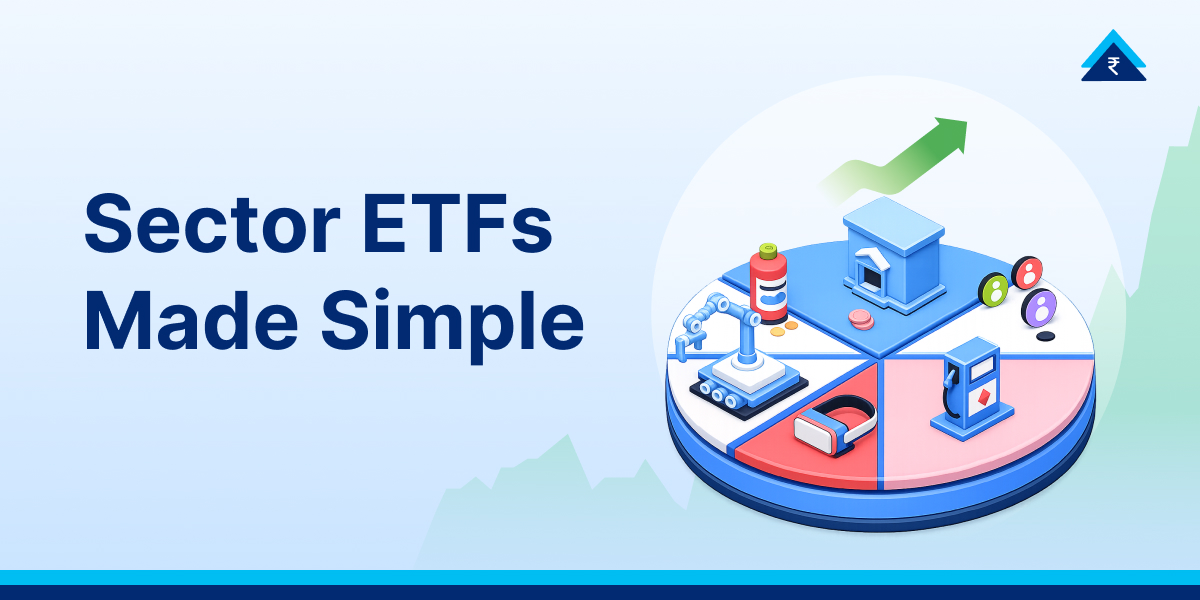
A Sector ETF is an exchange-traded fund that invests in companies within a single industry, such as technology or energy. These Sector-specific ETFs give you targeted exposure to one part of the market while still spreading your money across several companies. Among the various Exchange Traded Funds India offers, Sectoral ETFs India have become a popular way to back a particular theme without the guesswork of stock selection.
So, what are Sectoral ETFs really doing for you? In plain terms, they let you express a view on a whole sector rather than on individual firms.
How Sectoral ETFs Work
Sector investing has always carried two layers of risk. The first is choosing the right sector at the right time. The second is choosing the right stocks within that sector. Active funds try to manage both. Understanding how Sectoral ETFs work is simple: they remove the second layer entirely.
By design, these funds hold the leading companies in a sector, weighted by market capitalisation or another transparent rule. There is no discretion, no style drift and no reliance on a manager’s judgement.
This matters because a large part of sector fund underperformance came not from getting the sector wrong, but from stock selection errors. Imagine this: the Nifty PSU Bank ETF delivered annual returns of 36 percent over the last five years. Yet an investor who actively over-weighted shares like Punjab & Sind Bank and UCO Bank would have fared far worse, as those names returned only 16 per cent and 18 percent a year over the same period.
Investor Interest in Sectoral ETFs
The growth in Nifty sectoral ETFs is not just talk, and the same is true of overall Sector ETF performance. Assets under management (AUM) have risen steadily over five years.
Gaining Scale: Rising AUM (in ₹ crore)
| Sector | 2021 | 2022 | 2023 | 2024 | 2025 |
|---|---|---|---|---|---|
| Banking | 29,477 | 31,008 | 34,789 | 38,297 | 46,392 |
| Pharma | 216 | 319 | 657 | 1,181 | 1,281 |
| Technology | 5,949 | 2,084 | 3,079 | 3,995 | 4,875 |
| Consumption | 56 | 73 | 110 | 239 | 378 |
| Infrastructure | 30 | 46 | 163 | 279 | 538 |
| PSU | 15,978 | 19,387 | 30,526 | 36,998 | 28,861 |
(Source: Value Research)
Metric: Assets Under Management (AUM) in ₹ crore
Pharma ETFs, once thought too stock-picking heavy, have seen a six-fold rise in assets over the same period. Technology ETFs have held sizeable bases despite global volatility, while infrastructure and consumption ETFs have grown from niche to mainstream.
Liquidity has improved too. Banking and technology ETFs regularly see daily turnover running into several crores. Even smaller segments, such as Dividend Yield or ESG, now show enough activity for most retail investors to enter and exit with ease.
Sectoral ETF Benefits
Some of the key benefits include:
- Focused Exposure to a Sector: Sectoral ETFs allow investors to invest in a particular industry, such as banking, technology, healthcare, or infrastructure, through a single investment. This makes it easier to participate in the growth potential of an entire sector.
- Diversification Within the Sector: Instead of relying on the performance of one company, sectoral ETFs invest in multiple companies within the same industry. This helps reduce company-specific risk while still providing exposure to the chosen sector.
- Easy Buying and Selling: Since sectoral ETFs are traded on stock exchanges, investors can buy or sell them during market hours just like shares. This provides flexibility and liquidity, making them convenient to manage.
- Transparent Portfolio Holdings: Most ETFs regularly disclose their underlying holdings, allowing investors to see exactly which companies are included in the fund. This transparency helps investors better understand their sector exposure.
- Lower Costs Compared to Active Funds: Because sectoral ETFs typically track an index rather than relying on active stock selection, their expense ratios are often lower than those of actively managed sector funds. Lower costs can help investors retain a larger portion of their returns over time.
Sectoral ETF Risks
No instrument is perfect, and the Sectoral ETF risks are real:
- No Downside Protection: If a sector enters a long slump, a passive fund falls right along with it. There is no cash buffer and no avoiding the weaker companies.
- Cyclical Behaviour: Money tends to flow in after strong runs and dry up after weak ones. Passive tools can amplify this pattern.
- Uneven Liquidity: Banking and technology ETFs trade easily, but spreads in smaller sectors can widen during volatile spells.
- Concentration: Overexposure to one or two sectors can distort your overall risk, whether the holding is passive or active.
Best ETF Sectors in India
The Indian market, tracked by the NSE and BSE, splits into several core sectors. Here is a quick guide to the Best ETF sectors in India and the indices that follow them.
| Sector | Representative Companies | Tracked Via |
|---|---|---|
| Banking & Financial Services | HDFC Bank, ICICI Bank, SBI, Bajaj Finance | Nifty Bank, Nifty Financial Services |
| Information Technology | TCS, Infosys, HCLTech, Wipro | Nifty IT |
| FMCG | HUL, ITC, Nestle India | Nifty FMCG |
| Automobile | Tata Motors, Maruti Suzuki, M&M, Hero MotoCorp | Nifty Auto |
| Energy & Utilities | Reliance, ONGC, NTPC, Tata Power | Nifty Energy, Nifty Oil & Gas |
| Healthcare & Pharma | Sun Pharma, Cipla, Dr Reddy’s | Nifty Pharma, Nifty Healthcare |
| Industrials & Capital Goods | L&T, Siemens, BEL | Nifty Infrastructure |
| Metals & Mining | Tata Steel, JSW Steel, Hindalco, Vedanta | Nifty Metal |
| Consumer Discretionary | Titan, Trent, IndiGo | Nifty Consumer Durables |
| Real Estate | DLF, Godrej Properties, Lodha | Nifty Realty |
Note: The companies listed above are illustrative examples of businesses commonly associated with each sector. Actual ETF holdings and index constituents may change over time due to periodic index rebalancing, market movements, and other factors. Investors should refer to the latest index methodology and ETF portfolio disclosures for current holdings.
Globally, the Global Industry Classification Standard (GICS), developed by MSCI and S&P, categorises companies into 11 sectors, 25 industry groups, 74 industries and 163 sub-industries. This framework helps investors compare businesses, build diversified portfolios and gain targeted exposure to specific parts of the economy.
Thematic ETFs vs Sectoral ETFs
A quick word on a common mix-up. In the Thematic ETFs vs Sectoral ETFs debate, a sector ETF tracks one defined industry like banking, while a thematic ETF follows a broader idea, such as digital growth or clean energy, that may stretch across several sectors. Sectoral ETFs are narrower and more rules-driven by nature.
Conclusion
So, should you invest in Sectoral ETFs? The honest answer is that it depends on your conviction and your discipline. These funds will not protect you from a bad sector call, and they are no substitute for sound asset allocation. But among modern ETF investment strategies, they offer a clean, low-cost way to back a sector you genuinely believe in.
Used judiciously, Sectoral ETFs can complement a core diversified portfolio. They separate two decisions that were once tangled together: backing a sector, and backing specific companies. For many investors, making only the first decision is challenging enough. As part of a wider approach to Passive investing India, that simplicity is no small thing.
Disclaimer: Investments in the securities market are subject to market risks. Read all the related documents carefully before investing. This content is purely for informational purposes only and should not be considered as investment advice or a recommendation. Securities quoted are for illustration purposes only and not recommendatory. Investors are requested to do their own due diligence before investing.
Paytm Money Ltd. SEBI Reg. No. Broking – INZ000240532; Depository Participant – IN – DP – 416 – 2019, Depository Participant Number: CDSL – 12088800. Trading and clearing member of NSE (90165, M52073), BSE (6707), MCX (57525), NCDEX (1315, M51110), and MSEI (85300). SEBI Reg. No. Research Analyst – INH000020086. Regd. Office: 136, 1st Floor, Devika Tower, Nehru Place, Delhi – 110019. For complete Terms & Conditions and Disclaimers visit: https://www.paytmmoney.com/stocks/policies/terms